

Printing Outlook 2021: How Workflow Automation Speeds Up Print Job Turnaround

In traditional printing, working on more print orders requires more staff and includes more cost. But when print companies adopt automated workflow the same number of print jobs requires less or just a single employee and lesser cost.
The shrinking run lengths across the printing industry indicates a desire for more custom solutions for the consumers. PSPs can deliver quick turnarounds of short-run jobs with automated workflows even when complex processes are involved.
NAPCO Research identifies that print companies with higher automation tend to produce work in faster timeframes than those with less automation.
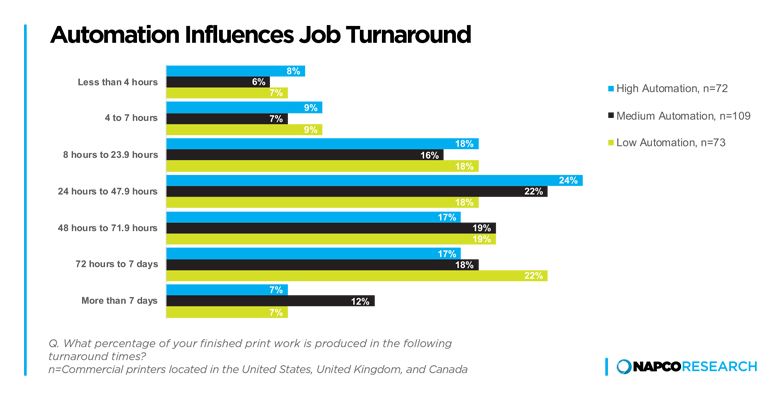
The research includes data from 201 Commercial Printers focused on the primary benefit of workflow automation.
Most respondents report some level of automation across the various stages but few achieved full automation from end-to-end.
Some interesting facts - Automation helps Printers Turn around the job much quicker than less automated companies.
- 24% of highly automated printers are in a rewarding situation when it comes to print jobs lasting 24 - 47.9 hours followed by 22% of medium automated printers, leaving 17% lowly automated printers behind.
- Low Automated companies 22% of jobs take 72 hours to 7 days vs only 17% for Highly Automated companies. Also, highly automated companies can complete 24% of jobs within 24 hours to 47.9 hours.
Key Takeaway - Highly automated printers are saving more time due to lesser confusion and chaos in their workflows. They bear the least impact from order processes as compared to firms with medium and low automation as they have well-defined workflows. They are clearly in the winning bracket with a print job order processing time of fewer than 4 hours.
A thorough analysis will help companies categorize what percentage of manual tasks, processing tasks and collecting tasks can be defined into activities with the highest automation potential to streamline their business and add value.
Given this, a valid question print companies must ask - what percentage of their finished print work gets done in the following turnaround times?
Automation streamlines many of the recurrent activities that generate profits and strong customer satisfaction and loyalty. This allows PSPs to avoid competing on product pricing and initiate more strategic and fulfilling relationships with their employees, customers, vendors and stakeholders.