


Summary: Automation now decides which print businesses scale profitably and which get stuck fighting manual bottlenecks. This guide breaks down every operational area automation touches, from order intake to fulfillment, backed by current market data, real implementation steps, and the common mistakes that stall rollouts. Read on to build a practical automation roadmap for your print business.
The print eCommerce world has witnessed a significant growth in recent years, driven by the rise in changing consumer demands and rapid development in technological advancements.
As per reports, the eCommerce sector is valued to be a $6.8 trillion industry and is expected to reach $8 trillion by the year 2027. Also, almost 72% of high-performing businesses are already utilizing this technology in their workflows for performing day-to-day operations.
Unlike traditional approaches that depend on manual operations for performing complex tasks, a futuristic print ecommerce solution helps modern print businesses achieve 2X productivity and higher efficiency.
If you are a print ecommerce store owner and are curious about the multi-faceted role that this leading-edge technology can play for improving print operations, then this blog is a must-read for you.
So, buckle up as we dive into this interesting blog that discusses the role of automation in streamlining print eCommerce processes.
What Is Print eCommerce Automation?
Print ecommerce automation replaces manual, repetitive print business tasks with software-driven workflows. It covers order intake, pre-press checks, production scheduling, and shipping, all connected through a single platform instead of scattered spreadsheets and phone calls.
The core idea is simple. Any task that a system can handle accurately and faster than a human should not sit on a person's desk. That includes price calculations, file checks, job routing, and shipment tracking.
Print businesses that build this foundation typically run on a web-to-print platform. This software connects order capture, pricing, production, and fulfillment into one continuous workflow instead of disconnected steps.

The Significance of Automation in Print eCommerce Business
Implementing automation for print ecommerce businesses is essential, especially when managing large volumes of orders. The automation of key operations like order management, pre-press, production, shipping and fulfillment, allows print businesses to scale effortlessly and meet the evolving demands of customers.
By utilizing a groundbreaking online print storefront to streamline tedious tasks, you can free up time for your team members, allowing them to focus on more strategic tasks that will grow your business. By simplifying product customization and offering personalized experiences to your customers, revolutionary print eCommerce can significantly improve customer satisfaction and ensure repeat business.
Key Areas Where Automation Transforms Print Operations
Print businesses run on four interconnected workflows. Automating each one removes a different kind of friction.
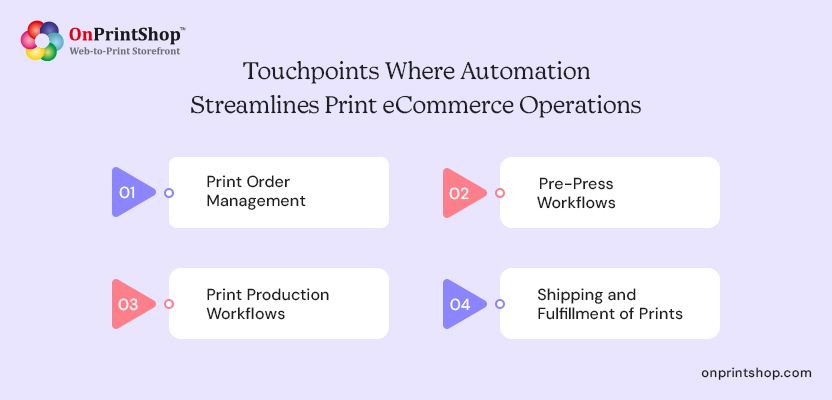
1. Print Order Management
Order management is usually the first automation priority because it touches every other department downstream
- Unified Order Entry
A groundbreaking online print storefront lets you capture orders from walk-ins, phone calls, emails, and web submissions, then centralizes all of that data in one dashboard. Staff stop re-keying the same order details into three different systems.
- Real-Time Order Tracking
With a B2C web to print storefront and B2B web to print storefront running side by side, both your team and your customers can see live order status. This removes the constant "where is my order" phone call and frees staff time for higher-value work.
- Direct production integration
When order data flows straight into production queues, jobs move from placement to press without manual handoffs, cutting the delay between order confirmation and print run.
2. Pre-Press Workflow Automation
Pre-press is repetitive by nature, which makes it one of the highest-return areas for automation.
- Online Design Proofing and Approvals
Future-ready online proofing tools give designers and customers a shared, version-controlled space to review artwork. Feedback happens in real time instead of through email attachments, which shortens approval cycles significantly.
- Automated Preflight Inspection
Automated preflighting checks bleed settings, color profiles, file formats, font embedding, resolution, and margins before a file ever reaches the press. Catching these issues digitally, rather than after a wasted print run, is one of the fastest ways to cut material waste.
- Variable Data Printing
Smart variable data printing software automates the insertion of unique data such as names, addresses, or images into print runs. This turns bulk personalization into a standard capability rather than a custom project, which matters as B2B buyers increasingly expect personalized print the same way they expect personalized email.
3. Print Production Workflow Automation
Production automation is where operational cost savings become most visible.
- Intelligent Print Job Scheduling
Modern scheduling engines prioritize jobs based on deadline, machine availability, and job complexity, keeping presses running at optimal capacity instead of idle or overbooked.
- Quality Control Systems
Quality control software flags pixelation, color drift, and brand inconsistency before a job ships, reducing costly reprints and customer complaints.
- Report on ‘Production Time Spent’
With an next-gen reporting and analytics tools show exactly where time is spent on each order, making bottlenecks visible instead of anecdotal. This is also where predictive analytics is starting to add value, flagging likely delays before they happen based on historical job data.
4. Print Shipping and Fulfillment Automation
The last mile determines whether a customer's overall experience feels modern or dated.
- Cross-Border Shipping
An integrated order management solution helps printers tackle the challenges involved in cross-border shipping, including duty calculation, customs documentation, and delivery estimation for international B2B clients.
- Automated labels and tracking
Automatically generated shipping labels paired with real-time tracking cut manual data entry and give customers visibility without needing to call for updates.
- Third-party fulfillment integration
API-based integrations with shipping carriers, payment gateways, and inventory systems let a print business plug into established logistics networks instead of building everything in-house.

Business Benefits of Print Automation
Understanding how print automation can benefit your print business starts with looking at where the returns actually show up.
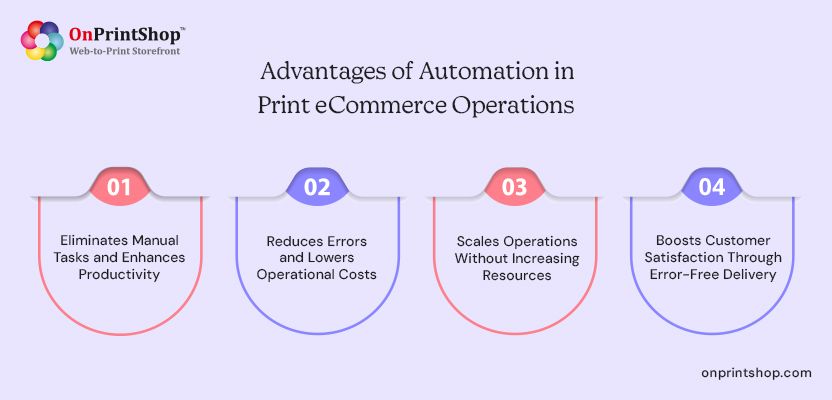
1. Higher Productivity without Added Headcount
Automation removes repetitive manual work so staff can focus on quoting complex jobs, account management, and business development instead of data entry.
2. Fewer Errors, Lower Operational Costs
Manual processes strain under tight deadlines and high volume, and that is exactly when human error rates climb. Automated preflight, proofing, and scheduling keep quality consistent regardless of order volume.
3. Scale without Proportional Cost Increase
A future-ready B2B web to print storefront lets a print business absorb order growth without a matching increase in staff. This is the difference between linear growth and margin-expanding growth.
4. Stronger Customer Retention
Customer acquisition is expensive. Research shows acquiring new customers can be 5 to 25 times higher in cost than retaining existing ones, which makes fast, accurate, self-service ordering a retention tool as much as a convenience feature. Customers who get accurate quotes and on-time delivery are far more likely to reorder.
How to Implement Automation in Your Print Business
Rolling out automation works best as a structured project, not a one-time software purchase.
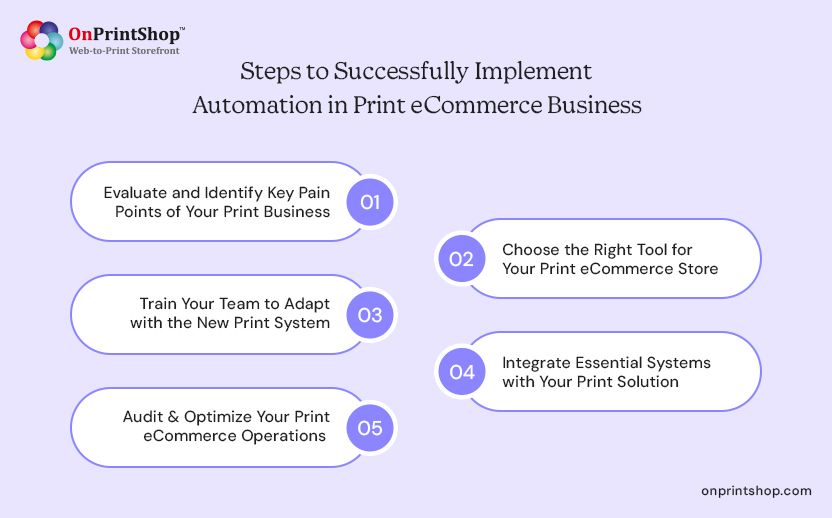
1. Evaluate Your Current Operations
Map every step from order intake to delivery and flag where delays, errors, or manual re-entry happen most often. Common pain points include manual quoting, inconsistent pricing, and slow approval chains.
2. Choose the Right Platform
Compare vendors against your actual workflow, not a generic feature checklist. Look for a print automation solution to maximize the productivity and profitability of your specific product mix, whether that is wide-format, apparel, packaging, or corporate print.
3. Integrate Your Existing Systems
Connect your chosen platform to shipping carriers, payment gateways, CRM, MIS, and accounting software through APIs. A platform that cannot integrate with your existing MIS will create new data silos instead of removing them.
4. Train Your Team Properly
Adoption fails more often from weak training than from weak software. Budget for structured onboarding, reference documentation, and a feedback channel so staff can flag friction points early.
5. Audit & Optimize Your Print Ecommerce Operations
Once you have successfully implemented a web to print solution, review performance quarterly. Track order-to-delivery time, error rates, and customer satisfaction, then adjust configuration based on what the data shows.
Overcoming Challenges of Implementing Automation in Print eCommerce
Automation delivers strong returns, but rollout is rarely frictionless.
Challenge #1: High Upfront Investment
Full-featured platforms can carry a real cost, which is a barrier for smaller print shops.
Strategy: Choose a profitable web to print solution for print ecommerce businesses that offers modular pricing, so you pay only for the capabilities you need today and add more as revenue grows.
Challenge #2: Integrating Multiple Systems
No single platform handles everything, and legacy print systems often lack modern integration support.
Strategy: Prioritize platforms with open APIs and pre-built connectors for MIS, shipping, and marketing tools, so data flows in one direction without duplicate entry.
Challenge #3: Staff Resistance to Change
Teams accustomed to manual processes may distrust new software, especially if early errors go unaddressed.
Strategy: Run hands-on training sessions, provide a simple internal knowledge base, and create a feedback loop so staff feel heard rather than overridden.
Challenge #4: Ongoing Maintenance
Software requires updates, and skipped updates create downtime risk.
Strategy: Choose a vendor with a strong update cadence and responsive support, and treat platform upgrades as routine maintenance rather than optional extras.

Where Print Automation Is Headed Next
A few trends are reshaping what "automated" means for print businesses over the next few years.
AI-driven Quoting and Pricing
AI models are starting to generate instant, accurate quotes based on job specifications, material costs, and historical pricing data, replacing manual estimation for complex jobs.
Predictive Production Planning
Instead of reactive scheduling, predictive analytics is beginning to forecast machine downtime, material shortages, and order surges before they disrupt production.
Deeper MIS and ERP Integration
Print MIS platforms are increasingly connecting directly to ecommerce storefronts, giving owners a single source of truth across pricing, inventory, and production capacity.
Customer Self-service Expansion
Buyers increasingly expect to configure, price, and reorder print products without contacting a sales rep, pushing print businesses toward fully self-service B2B portals.
OnPrintShop’s Client Success Story: MaxQ Printing
MaxQ Printing, one of OnPrintShop's client base of over 2,000 print businesses, migrated from Magento to OnPrintShop and achieved a significant increase in sales alongside faster, more accurate price estimation.
The company primarily served B2B clients with print and marketing services but struggled to convert website traffic into orders, maintain long-term client relationships, and expand its product catalog efficiently.
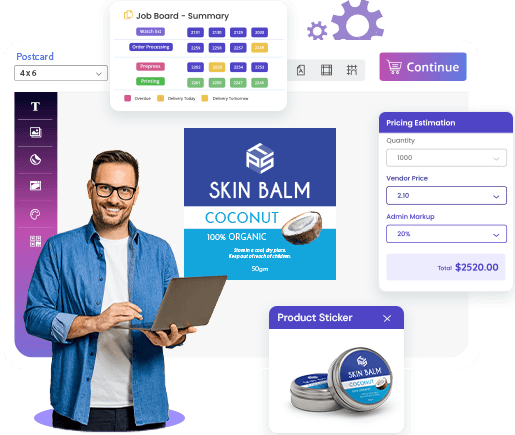
OnPrintShop's platform gave MaxQ Printing order management tools, a dynamic price calculator, and catalog configuration features, delivering end-to-end automation across their storefront and production workflow.
Wrapping It Up!Print ecommerce will keep growing alongside the broader digital economy, and the print businesses that automate now will hold a clear efficiency advantage over those still running manual workflows in a few years.Choosing an advanced print ecommerce solution is not just a technology upgrade. It is an operational decision that determines how much order volume you can handle, how consistently you deliver quality, and how quickly you can expand into new product lines.OnPrintShop has supported print businesses through this exact transition for years, with production automation, order management, and integration capabilities built specifically for the print industry.Request a demo today and see how automation can streamline your operations, improve delivery speed, and support sustainable growth.