


Summary: Manual POD workflows cap your growth. This guide breaks down what print-on-demand automation actually does, where it delivers the fastest ROI, and how AI-driven tools are reshaping order intake, production, and fulfillment in 2026.
Print-on-demand remains one of the most competitive corners of the printing industry, and it is not slowing down. The global print on demand market was valued at USD 10.8 billion in 2025 and is projected to grow to USD 13.1 billion in 2026, at a CAGR of 23.6% from 2026 to 2033. Earlier estimates placed the global print on demand market size is valued at USD 12.39 billion in 2025, and while projections vary by research firm, they all point in the same direction: double-digit growth, every year, for the rest of the decade.
That growth means more order volume, tighter delivery windows, and less tolerance for manual bottlenecks. Print shops that pair a forward-thinking web-to-print software with automation are the ones absorbing that volume without adding headcount. This guide covers what POD automation actually is, why it matters now, and exactly which parts of your workflow to automate first.
What Is Print on Demand Automation?
Print-on-demand automation uses software to handle POD tasks that once required manual work: order intake, file preparation, supplier routing, production tracking, and fulfillment updates. Instead of staff manually forwarding each order, the system pushes it through automatically, from checkout to shipped package.
In practice, this looks like: a customer places an order, the platform auto-generates a print-ready file, routes it to the right supplier or production queue, and triggers tracking notifications, all without a human touching the order. The result is fewer errors, faster turnaround, and a workflow that scales without proportional staff growth.

Why Does Print-on-Demand Automation Matter in 2026?
Manual POD operations do not scale. As order volume climbs, so does the risk of missed deadlines, mispriced jobs, and file errors, and customers notice fast in an industry built on quick turnarounds.
Automation removes that ceiling. Shops starting a print-on-demand business today are building automated workflows from day one, because retrofitting automation onto a manual operation later is slower and more expensive than starting with it. For established printers, automation is less about survival and more about margin: it lets existing teams handle higher volume without proportional cost increases.
Three forces are driving urgency in 2026 specifically:
Rising customer expectations. Buyers expect real-time order tracking and same-week turnaround as standard, not a premium feature.
AI-native competitors. Newer POD entrants are launching with AI-assisted design and pricing built in, raising the baseline for everyone.
Thinner margins. Material and shipping costs keep climbing, so operational waste has a bigger impact on profitability than it did even two years ago.
What Are the Business Benefits of POD Automation?
Automation touches nearly every part of a print shop's P&L, from order speed to customer retention. Here is where the impact shows up first.
1. Faster Order Processing
Automated intake means orders move to production the moment they are placed, with no queue waiting on manual review. Shops typically see same-day routing become the norm instead of the exception.
2. Fewer manual errors
Automation validates print-ready files, standardizes workflows, and flags problems before they reach production. That catches sizing mismatches, missing bleed, and low-resolution art before they become reprints.
3. Lower Production Costs
Cutting manual touchpoints directly reduces waste. Automated file checks and standardized routing go a long way toward reducing material wastage and improving cost efficiency. freeing your team to focus on higher-value work instead of fixing avoidable mistakes.
4. A stronger Buying Experience
Customers expect to design, order, and track without calling support. Automated print ecommerce storefronts, give buyers 24/7 access to design tools, live pricing, and order status, which shortens the path from browsing to checkout.
5. Easier Scalability
Automated workflows handle seasonal spikes without new hires. Shops using advanced third-party integrations can plug into new marketplaces or sales channels in days instead of months, expanding reach without expanding overhead.
7 Areas of Print-on-Demand Workflow that Can be Automated
Not every part of a POD business needs automation on day one. These are the areas that deliver the fastest, most measurable return.
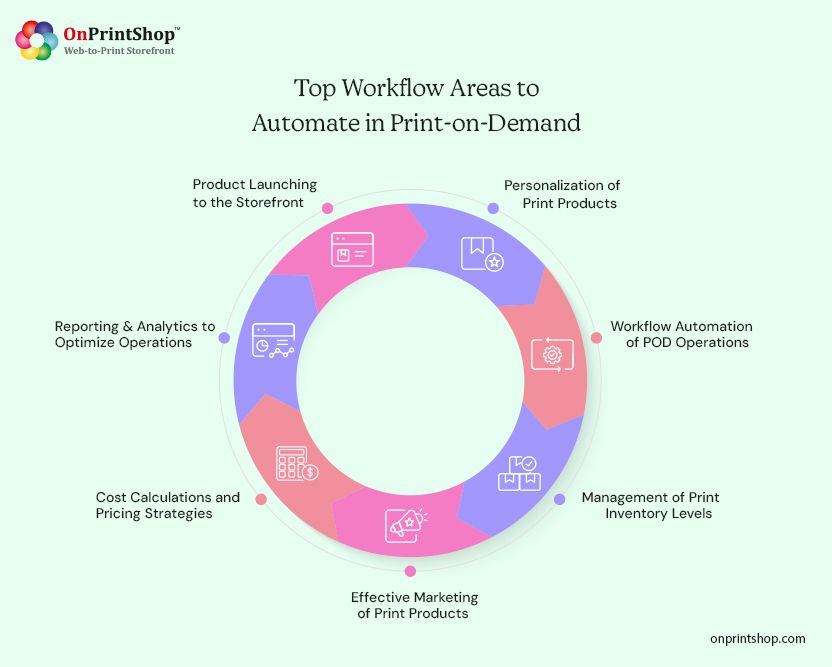
1. Storefront and Product Setup
AI-based web-to-print systems to customize and personalize product catalogs cut the time needed to launch new items. Instead of manually building mockups and writing descriptions, teams can generate both automatically and focus review time on the details that matter.
2. Product Personalization
Live design studios inside new-age personalized print software let buyers customize products in real time using templates and variable data printing. AI-assisted layout suggestions now speed this up further, guiding buyers toward designs that print cleanly the first time.
3. End-to-end Workflow Automation
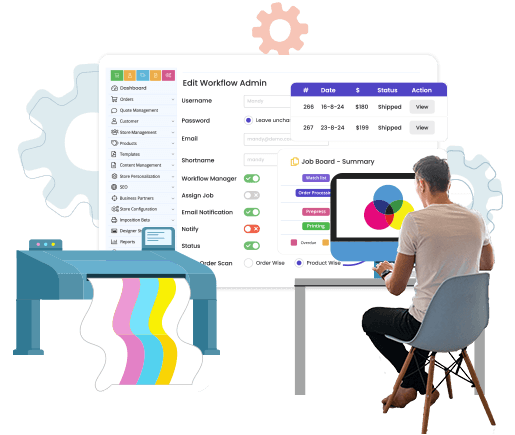
A scalable print workflow automation software platform connects order intake, pre-press, production routing, fulfillment, and reporting into one continuous flow. Intelligent order routing sends each job to the right supplier or press automatically, based on capacity, location, or product type, which cuts turnaround without manual dispatching.
4. Inventory and Supplier Coordination
Automated stock tracking flags material shortages before they delay a run. Paired with supplier automation, this keeps production moving even during high-volume seasonal periods, without a team member manually checking stock levels every morning.
5. Marketing and Customer Engagement
Powerful marketing automation tools handle product recommendations, cart-abandonment emails, and personalized promotions automatically. Automated order notifications, from confirmation to shipped, also reduce support tickets by keeping customers informed without staff intervention.

6. Pricing and Cost Management
Precise print cost estimating tools calculate margins, material costs, and supplier pricing automatically, so quotes stay accurate and consistent even as material costs shift.
7. Reporting and Analytics
Modern reporting and analytics tools surface sales trends, customer behavior, and conversion data in real time. Predictive analytics is the natural next step here, flagging demand shifts before they show up in a missed reorder.
Is Automation Suitable for Small Print Shops, or Just Large Operations?
Yes. Most modern web-to-print platforms offer modular automation, so small and startup POD businesses can automate just order intake and fulfillment first, then add pricing, marketing, or reporting automation as volume grows. You do not need enterprise infrastructure to start.
How Do AI and Automation Work Together in POD?
Automation handles the repeatable, rules-based steps: routing, notifications, file checks. AI adds judgment to those steps: generating design variations, predicting demand, catching quality issues a rules engine would miss, and personalizing pricing or recommendations based on buyer behavior. Together, they turn a fixed workflow into one that improves the more orders it processes.
What Should You Look for in POD Automation Software?
Before choosing a platform, confirm it covers:
- Ecommerce integrations with your existing sales channels (Shopify, WooCommerce, Amazon, and similar)
- API-driven automation so it connects with your print MIS or ERP instead of running in isolation
- Cloud print automation for remote access and multi-location production
- Order routing logic that matches your supplier or press network
- Reporting depth that goes beyond basic sales totals
Automate Your Print-on-Demand Business with OnPrintShopAutomation is not a nice-to-have anymore. It is what separates print shops that scale from ones stuck fielding the same manual tasks every order cycle. A powerful web-to-print software platform brings order intake, production, pricing, and reporting into one connected system, so growth does not mean adding headcount at the same pace.If your current workflow still relies on manual order handling, schedule a demo with our team. We will walk through your specific bottlenecks and map out where automation delivers the fastest return for your business.