



Summary: Is your B2B print business facing operational inefficiencies due to disconnected systems? By aligning front-end print job processing and back-end business operations with B2B web-to-print and ERP integration, printers can streamline operations and enhance efficiency. Keep reading to explore more about this topic and learn ways to achieve maximum ROI with successful implementation.
In today’s evolving B2B printing industry, businesses are looking for ways to enhance efficiency, maximize productivity, and meet the rising demands of customers. Without a well-connected system, printers may face challenges like manual errors, data inconsistencies, poor inventory management, and more. Hence, a powerful B2B web2print system that integrates with your existing ERP workflows is the need of the hour.
As per research, the web to print market size is worth USD 26.59 billion in 2025 and is anticipated to reach USD 35.07 billion by 2030, rising at a CAGR of 5.69% during the forecast period (2025 to 2030).
Integrating advanced B2B web to print storefront with your ERP systems can offer smoother workflows, help you make smarter decisions, and build stronger customer relationships.
This modern-day system allows you to effectively meet the changing demands of customers while allowing you to solve operational inefficiencies and maximize business growth.
In this blog, we will delve into how W2P-ERP integration can be game-changing for B2B print businesses and learn valuable insights into leveraging this integration to stay ahead of the competition. Let’s begin.
Importance of ERP Systems in B2B Web-to-Print Operations
Integrating ERP systems with web-to-print systems is crucial for optimizing B2B operations. Let’s understand the transformative factors that make this ERP integration essential:
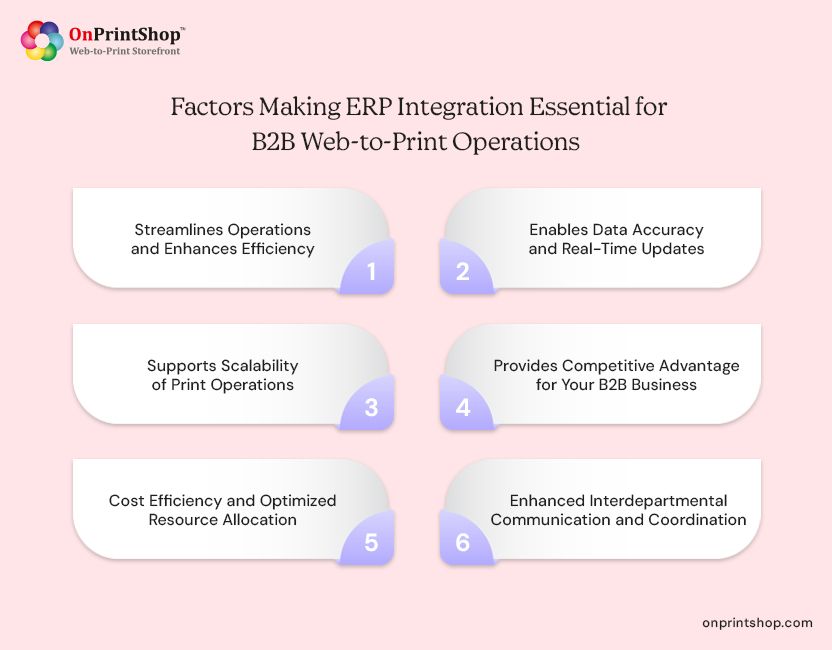
Streamlines Operations and Enhances Efficiency
The web-to-print software with b2b erp integration streamlines the operations of B2B businesses with its automation-driven tasks, including order processing, inventory management, and production scheduling. Utilizing powerful print workflow automation software reduces manual intervention, minimizes errors, and speeds up the print processes, enhancing the overall operational efficiency.
Enables Data Accuracy and Real-Time Updates
This integration ensures accurate data flow between the ERP and web-to-print driven b2b commerce storefront, reducing the risk of potential errors in print operations. It also enables print businesses to get real-time updates on the status of orders and inventory levels to enhance decision-making and ensure customer satisfaction.
Supports Scalability of Print Operations
As your B2B print business grows, the volume of print orders and the complexity of operations might increase. Integrating ERP with web-to-print driven b2b printing solutions supports the scalability of operations by providing the necessary tools for handling bulk orders, new product lines, or expanding market reach without hindering your existing processes.
Provides Competitive Advantage for Your B2B Business
The W2P-ERP integration helps B2B print businesses gain a competitive edge in this ever-evolving print industry. The high-tech capabilities achieved with this integration offer several web to print benefits for B2B print businesses including easy adaptation to the changing market demands and competitive edge.
Cost Efficiency and Optimized Resource Allocation
W2P integration with ERP systems can automate operations like bulk order management, production scheduling, and inventory management, reducing human intervention and operational inefficiencies. These automation-powered processes can contribute to significant cost savings and enable effective resource allocation for your B2B business.
Enhanced Interdepartmental Communication and Coordination
The b2b web to print storefront with ERP integration enables print business owners like you to provide your team members with a unified view of business operations and get up-to-date information about orders consistently. This capability enhances communication and coordination across different departments, leading to efficient print business operations.

Key Considerations Before Integration of B2B W2P and ERP System
Before diving deeper into the W2P-ERP integration, let’s look at the must-know key considerations before the integration process.
Compatibility Between W2P and ERP Systems
Consider choosing the most suitable B2B web to print storefront for your print business, that provides seamless integration capabilities to optimize your print operations. Ensure to assess the compatibility between your ERP system and the web to print system before starting the integration process.
Data Synchronization and Security Concerns
Ensure there are advanced security measures in place for secured and accurate transmission of your business data between the two systems. Look for regular security audits and data backups for precise data synchronization.
Key Benefits of Integrating B2B Web-to-Print with ERP System
The key benefits of W2P-ERP integration for your B2B print business are discussed below. Let’s find out what these include.
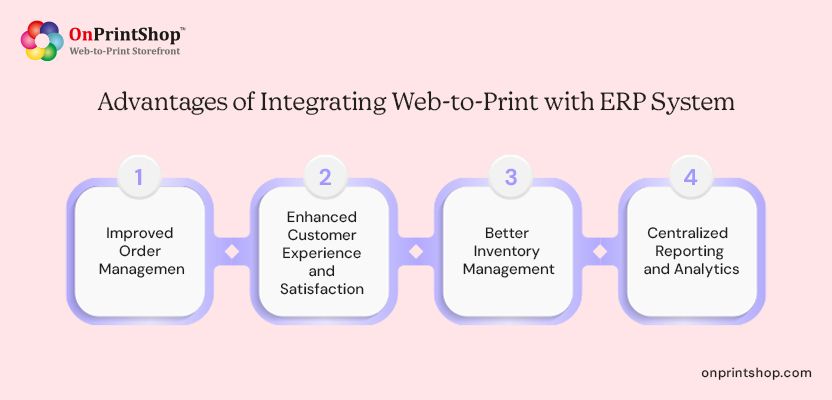
Improved Order Management
Integrating scalable order management software with ERP system automates the order management workflow from start to finish. When a customer places an order through the online printing storefront, the order details are automatically sent directly into the company's ERP system. This streamlined approach results in faster processing times, higher productivity, fewer errors, and timely delivery of orders.
Enhanced Customer Experience and Satisfaction
One of the key benefits of W2P-ERP integration is its capability to offer customers functions like browsing products, designing, print estimating, placing orders, and tracking them using a web-to-print B2B storefront. This integration enables printers to offer personalized customer experiences, improve their overall satisfaction, and achieve repeat business.
Better Inventory Management
This integration can enable printers to get real-time visibility into inventory levels, manage stock levels, and make informed decisions about purchasing, production scheduling, and inventory management. The integrated system offers ongoing stock monitoring with actionable data to prevent stockouts and overstocking of valuable resources, eliminating material wastage and enabling effective resource allocation.
Centralized Reporting and Analytics
The W2P-ERP integration allows printers to achieve centralized data with comprehensive reporting & analytics, providing up-to-date information across teams for better collaboration. Printers can leverage this capability to get data-driven insights on several aspects including sales trends, customer behavior, inventory levels, and more for informed decision-making.
Steps for Successful B2B Web-to-Print Integration with ERP
Reaping the benefits of post-implementation depends on how well the integration is done. Here’s a step-by-step approach to successfully integrate web-to-print software with your existing ERP systems for small companies and large enterprises.
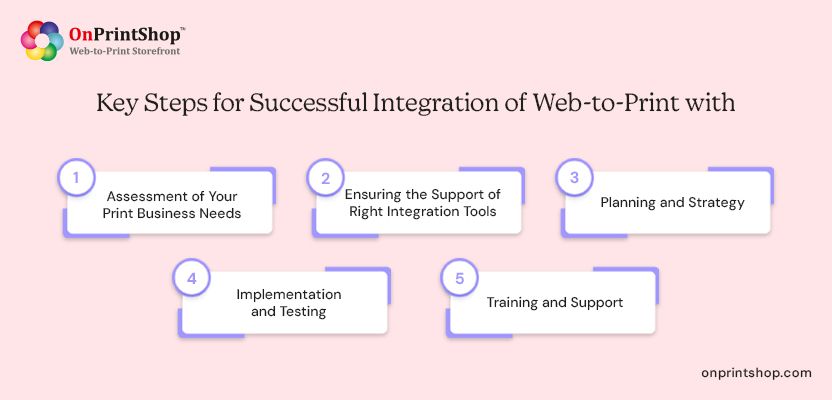
Assessment of Your Print Business Needs
Begin by thoroughly assessing the unique challenges and goals of your print business to determine what you would like to achieve with the W2P-ERP integration. Whether your goal is to reduce manual order processing or manage inventory levels effectively, clearly defining your objectives will enable you to get tailored capabilities that align with your operational needs.
Ensuring the Support of the Right Integration Tools
The web-to-print system should be compatible with your ERP system, offer flexible middleware or API support for seamless integration, and accommodate the future needs of your B2B business. Ensure the integration support offered by the W2P solution enables seamless data flow between the systems and has no data synchronization issues.
Planning and Strategy
Consider creating a comprehensive web-to-print software with a B2B ERP integration roadmap for your b2b printing services company that includes dependencies and bottlenecks at every step of the process. A roadmap with a detailed plan and timeline will help guide your team throughout the integration process and proactively address complex challenges.
Implementation and Testing
Before fully implementing the integration, conduct pilot testing on a smaller scale, i.e., integrating only a few operations of the W2P-powered b2b print storefront with the ERP system and testing it in a controlled environment. As print integration is a true game-changer in today’s world, this smart approach will help you identify any technical issues and rectify them during the full-scale implementation.
Training and Support
Once the integration process is complete, make sure to provide thorough training for your team on how to use the newly integrated system. Offer ongoing support to your team to ensure they quickly adapt to the system, especially during the initial stages of post-integration, ensuring they quickly adapt to the system.

Overcoming the Common W2P-ERP Integration Challenges
Understanding how to deal with challenges that occur during web-to-print and ERP system integration is crucial. Let’s know the challenges that occurred and ways to overcome them.
Data Migration Issues
Challenge -
Data migration from existing ERP systems to the web-to-print solution can be quite challenging and lead to errors if not implemented correctly. It can cause issues like inconsistent data, duplicate entries, or different data formats, which can cause issues in the print operations.
Solution -
Phased Migration - This process involves breaking the migration process into smaller phases to identify and resolve issues in a manageable manner.
Data Cleansing - Before migrating, printers can clean the data by removing duplicates, rectifying errors, and standardizing formats to ensure the data transferred does not have any inconsistencies or errors.
System Compatibility
Challenge -
Integrating systems with different technologies and security protocols can be extremely challenging. An incompatible web-to-print system can cause issues with differences in data formats, risk of vulnerabilities, and challenges in seamless data exchange.
Solution -
Middleware - This method involves utilizing an extension that acts as a bridge between the b2b web to print software and the ERP system to facilitate data transfer, ensuring smooth communication even if they use different technologies.
Custom APIs - Print businesses can leverage a custom API by coordinating with the web-to-print solution provider to enable seamless data exchange between the two systems in a standardized way.
Change Management
Challenge -
Dealing with resistance to change within the print business is a common issue and can make your team members hesitant to adapt to the newly implemented system, fearing issues in their existing workflows and a steep learning curve.
Solution -
Clear Communication – Make sure to clearly communicate the importance of ERP with advanced web-to-print storefront integration to your team members and explain how it will improve the efficiency of your print business.
Stakeholder Involvement – Consider involving key stakeholders in the integration process from planning and testing to feedback sessions, and provide adequate training to them for smooth adaptation.
Wrapping It Up!W2P-ERP integration has become a necessity for modern B2B print businesses to achieve long-term success and gain a competitive edge in the printing industry.Integrating ERP systems with the best b2b web to print storefront like the ones offered by OnPrintShop can help you to effortlessly scale your print business operations and achieve maximum ROI.If you haven’t integrated web to print systems with your ERP systems yet, then don’t wait and request a demo with OnPrintShop today. Our team will get in touch with you for a successful implementation that will help you deliver a better customer experience and drive your print business forward in this ever-evolving print landscape.