


Summary: Is your print business keeping pace with AI-driven printing, or falling behind? This guide breaks down the AI tools reshaping print operations in 2026, from personalized design creation to smarter order management. Here is how the right AI tools can strengthen every stage of your print business.
The print industry is moving into a phase where AI is no longer experimental. Customers now expect deeper personalization, consistent print quality at fair pricing, and faster turnaround, and printers are turning to AI to keep up.
According to Grand View Research, the global artificial intelligence market size was valued at USD 390.9 billion in 2025 and is projected to grow from USD 539.5 billion in 2026 to USD 3,497.3 billion by 2033, at a CAGR of 30.6 percent. That growth is filtering directly into print operations.
The rise is a wave of AI-powered web-to-print software that helps new-age printers operate with more accuracy and speed. These tools have become a growth enabler for print businesses competing in a crowded landscape.
This guide covers the AI tools print businesses are adopting in 2026, what to check before investing, and where AI in printing is headed next.
Why Are Printing Businesses Rapidly Adopting AI Tools?
Printers are adopting AI tools because buyer expectations, operational pressure, and competitive positioning have all shifted at once. Here is what is driving that shift.
How Are Print Buyer Expectations Changing?
Print buyers no longer tolerate manual, back-and-forth processes. Spreadsheets and email chains used to be standard, but today's buyers expect instant estimates, easy design personalization, faster approvals, and a smoother online ordering experience from start to finish.

What Operational Pressures Are Pushing Printers Toward AI?
Print businesses are managing more complex jobs without added headcount. Rising material costs, tight margins, unpredictable production fluctuations, and limited staff all make it harder to hit faster turnaround times using manual methods alone.
Why Is AI Becoming a Strategic Growth Tool for Printers?
AI takes printers a step beyond basic automation. Automation follows pre-defined rules, while AI applies machine learning to predict what is possible and identify patterns humans would miss. Printers now launch AI-based web-to-print storefronts that analyze order history, customer behavior, production performance, and pricing trends, turning AI into a strategic growth lever rather than a back-office convenience.
How Does AI Work in the Printing Industry?
AI in printing works by learning from historical and real-time data, then using that learning to automate and optimize decisions across the production cycle. It combines data inputs, predictive models, visual analysis, and system integrations to improve outcomes over time.
Rule-based automation follows fixed instructions and does not adapt. AI-driven automation is different: it analyzes patterns in historical and live data, then adjusts its recommendations as conditions change, which is why AI systems improve the longer they run.
What Are the Top Trending AI Tools for Print Businesses in 2026?
Print businesses are adopting AI across design, production, pricing, order management, and analytics. Below are the AI tool categories delivering the most measurable value in 2026.
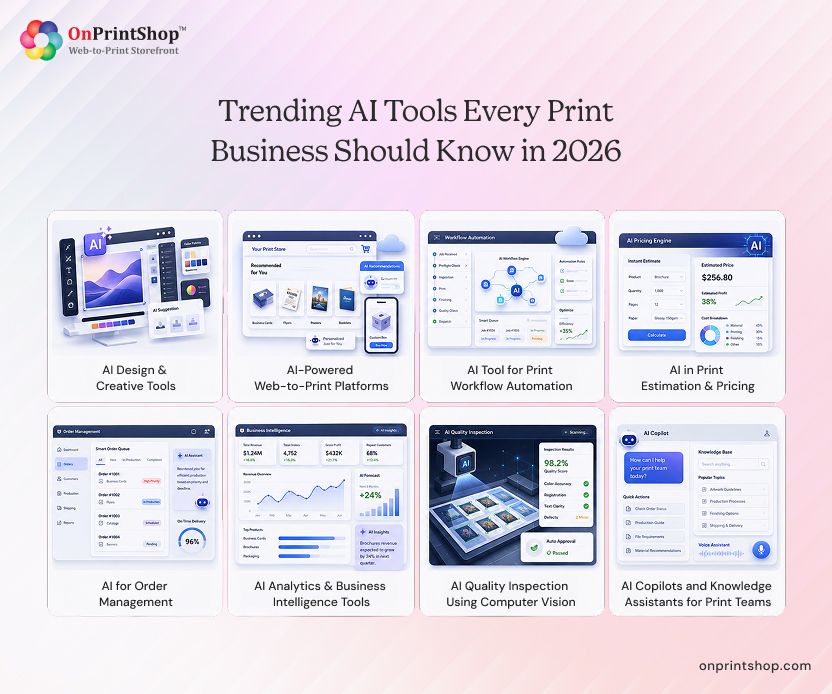
1. AI Design & Creative Tools
AI design tools use generative models such as GANs and diffusion models to automate layout creation, remove backgrounds, and enhance images for print-ready output. Variable data printing tools built on this technology auto-adjust text and images across templates without manual rework.
2. AI-Powered Web-to-Print Platforms
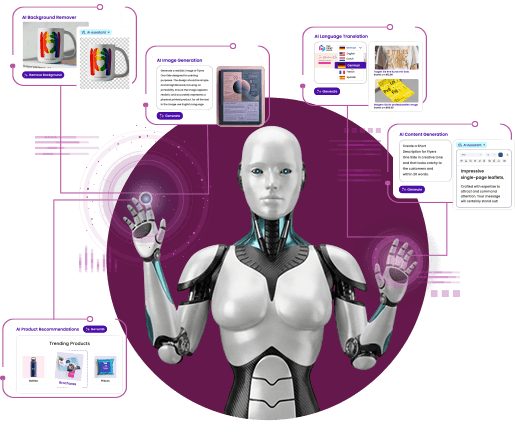
Web-to-print platforms built with AI extend far beyond order taking. Printers now rely on AI-led web-to-print features to boost print operations to launch products faster using image and text generators, localize storefronts through AI translation, and recommend relevant products to buyers through AI-driven suggestion engines.
3. AI Tool for Print Workflow Automation
Basic automation reduces manual steps, but advanced workflow automation software powered by AI goes further. Machine learning-backed job schedulers prioritize work by deadline and complexity, while prepress automation engines apply rule-based AI checks to speed up proof approvals.
4. AI in Print Estimation & Pricing
AI-based estimating tools use predictive models that continuously monitor material, machine, labor, and job complexity data. These AI-based print estimators cut costs AI-based print estimators cut costs by generating accurate quotes automatically, protecting margins without slowing down the sales process.
5. AI for Order Management
AI-backed order management analyzes historical order data, online ordering behavior, and real-time production status to prioritize orders, flag issues early, and predict repeat orders. This is one of the clearest ways AI redefines the printing industry moving order handling from reactive to predictive.
6. AI Analytics & Business Intelligence Tools
Modern next-gen reporting & analytics tools give printers visibility into machine usage, sales trends, seasonal demand patterns, and productivity metrics, turning raw production data into decisions leadership can act on.
7. AI Quality Inspection Using Computer Vision
Computer vision systems now scan printed sheets in real time to catch color drift, misregistration, and defects before a job reaches finishing. This shortens inspection time significantly compared to manual checks and reduces reprints tied to late-stage quality catches.
8. AI Copilots and Knowledge Assistants for Print Teams
AI copilots are emerging inside print MIS and web-to-print platforms to answer operator questions, surface job specifications, and guide staff through pricing or production rules. These knowledge assistants reduce onboarding time for new staff and cut down on repetitive internal queries.

What Should You Consider Before Adopting AI Tools for Your Print Business?
AI offers real advantages, but successful adoption depends on how well a tool fits your existing operations, not just its feature list. Evaluate these factors before you commit.
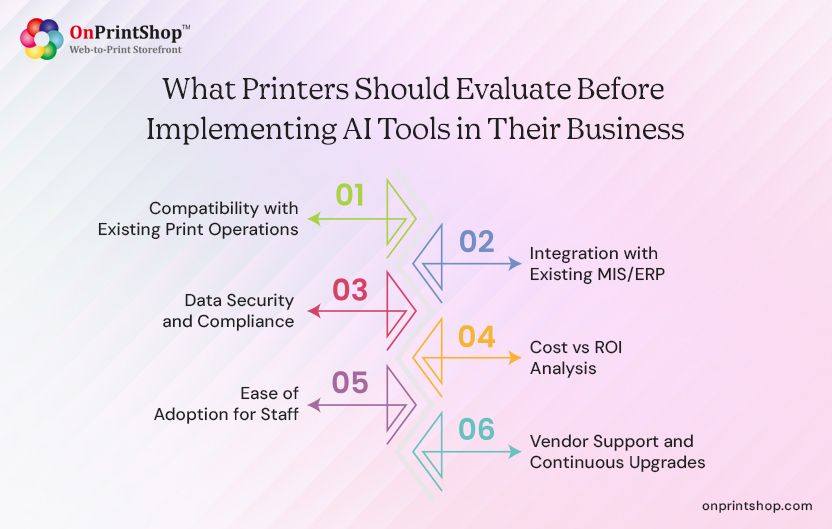
1. Does the Tool Fit Your Existing Print Operations?
Confirm the AI tool works with your machine types, substrates, and production volumes. A tool that does not match your current setup can create more manual work than it removes.
2. Does It Integrate With Your MIS or ERP?
Check whether the AI tool offers seamless web-to-print integrations with your MIS or ERP. Strong integration prevents data silos, duplicate entry, and bottlenecks across estimation, production, billing, and fulfillment.
3. Is Your Data Secure and Compliant?
AI tools handle sensitive data, including customer details, artwork, pricing, and transaction records. Confirm the vendor provides strong data encryption, access controls, and compliance with regulations such as GDPR or relevant ISO standards.
4. What Is the Realistic ROI?
Before implementation, evaluate ROI of implementing AI in print operations, including reduced manual effort, faster turnaround, and fewer errors, against total cost of ownership such as licensing, implementation, training, and upgrades.
5. Can Your Staff Adopt It Easily?
A tool with a steep learning curve slows adoption regardless of its capability. Look for intuitive interfaces, clear documentation, and training resources that help staff get comfortable quickly and reduce resistance to change.
6. Does the Vendor Offer Ongoing Support?
AI tools evolve quickly, so choose a vendor that ships regular, market-relevant upgrades and backs them with responsive customer support. This keeps your investment useful well beyond the initial rollout.

What Is the Future of AI in the Printing Industry Beyond 2026?
AI has moved past being a support technology. It is becoming a core driver of personalization, automation, and sustainability across print operations. Here is where that trend is heading next.
1. Hyper-Personalized Print Experiences
By analyzing online ordering behavior, purchase history, and demographics, modern personalized print software can recommend relevant products, tailor messaging, and surface personalized offers automatically at the point of ordering.
2. Fully Autonomous, Predictive Print Workflows
Traditional automation follows fixed rules. AI-driven workflows go further by predicting issues before they occur, making data-driven scheduling decisions, and improving performance continuously as more production data flows through the system.
3. AI-Driven Sustainability and Waste Reduction
AI supports sustainability by improving color accuracy on the first pass, forecasting production demand more precisely, and predicting machine downtime before it happens. This reduces overproduction, material waste, and unplanned maintenance costs.
4. AI Demand Forecasting and Predictive Maintenance
Demand forecasting models are helping printers plan inventory and staffing around seasonal order spikes instead of reacting to them. Paired with predictive maintenance, which flags equipment issues before a breakdown, printers can protect uptime while keeping working capital in check.
Wrapping It Up!AI is no longer optional for print businesses that want to stay competitive in an AI-driven printing industry. Printers who adopt the tools covered in this guide put themselves in a stronger position for 2026 and beyond.By adopting AI-enabled web-to-print software like OnPrintShop, printers can deliver a better online ordering experience, which translates into repeat customers and stronger ROI.To see how OnPrintShop applies AI to everyday print operations, request a personalized demo and take the next step toward an AI-first print business.