


Summary: AI is the operating standard for businesses that want to remain competitive in the print industry in 2026. This guide covers how AI is transforming print workflows from prepress to delivery, the real challenges operators face when adopting it, and what the next wave of agentic AI means for production teams.
Artificial intelligence has moved from pilot project to production reality across the global print market. According to Keypoint Intelligence, intelligent automation in 2026 is expected to become the baseline for competitiveness, with AI-driven routing, color control, quoting, and quality assurance shifting from novel add-ons to standard components of modern print operations.
Modern printing businesses have to utilize a futuristic AI-powered web to print solution for enhancing efficiency, print quality, customization, and sustainability. In this guide, we will explore the limitless possibilities of artificial intelligence in the printing industry and how businesses can leverage it to make informed decisions that drive growth.
How AI-Driven Automation can Streamline Printing Shop Operations?
Short answer: AI analyses job specifications, printer capabilities, resource availability, and deadlines simultaneously, then allocates and sequences work in ways no manual scheduler can match at scale.
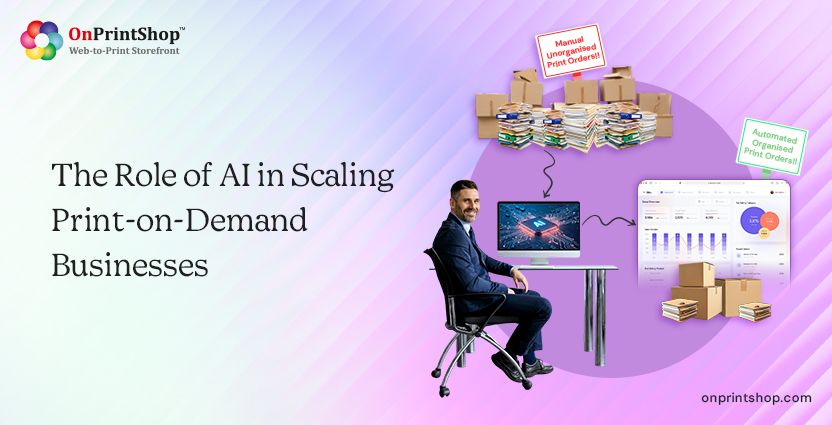
Modern print operations manage enormous variability: substrate types, finishing options, color profiles, file formats, rush jobs, and customer-specific requirements all arrive at once. AI-powered production scheduling reads these variables in real time, identifies bottlenecks before they occur, and re-routes jobs dynamically when conditions change.
Before integrating AI into print operations, understanding web-to-print fundamentals, from order intake to prepress automation, provides the foundation that makes AI-driven results measurable and sustainable.
Key operational areas where AI is already active in print businesses:
- Intelligent job routing and production scheduling
- Automated color calibration and profile management
- AI-assisted artwork preparation and preflight checking
- Real-time inventory monitoring and demand forecasting
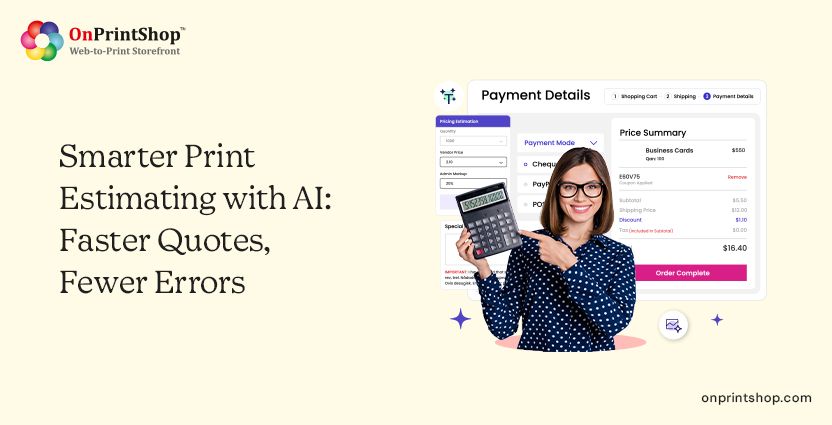
- Automated customer service responses and quote generation
- Proofing and quality assurance at prepress and press stages

Implementing AI in Your Print Business: 10 Distinct Benefits
Each benefit below addresses a specific operational area. Where two capabilities were previously described separately but deliver the same outcome, they have been merged for clarity.
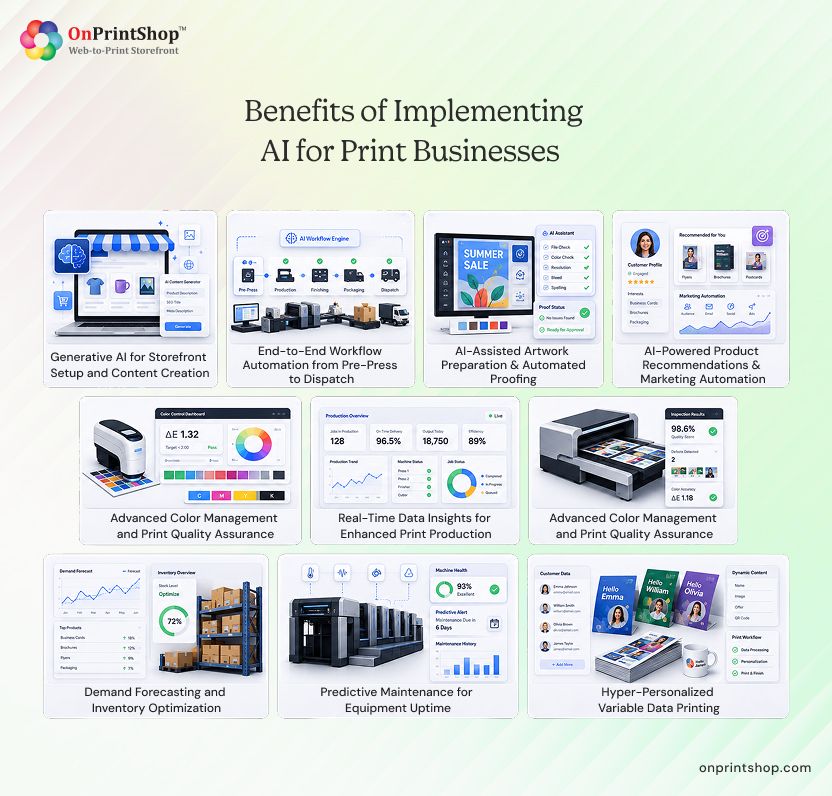
1. Generative AI for Storefront Setup and Content Creation
AI-powered web-to-print systems now generate product images, descriptions, and design variations from simple text prompts, reducing storefront setup time by up to 70%. Print businesses can launch new product lines faster, with consistent visual quality, without manual design cycles for every SKU.
2. End-to-End Workflow Automation from Pre-Press to Dispatch
AI adoption to automate the full production chain: file intake, preflight, imposition, color correction, job ticketing, and dispatch documentation. Self-detecting error correction reduces manual intervention at each handoff, cutting turnaround times and eliminating the bottlenecks that accumulate in high-volume environments.
3. AI-Assisted Artwork Preparation and Automated Proofing
Before a job reaches press, AI checks files for resolution, bleed, font embedding, color mode, and overprint settings. Automated soft-proofing systems flag issues and, in many cases, apply corrections automatically, significantly reducing plate waste and press remakes.
4. AI-Powered Product Recommendations and Marketing Automation
AI recommendation engines analyze what customers browse, buy, and repeat-order to surface relevant upsell and cross-sell suggestions at the right moment. High-tech marketing automation tools personalize campaign messaging at scale, improving engagement and customer lifetime value without adding headcount.
5. Advanced Color Management and Print Quality Assurance
AI continuously monitors color output across substrates and press conditions, applying real-time calibration adjustments. Inline camera systems compare printed output against approved digital files, flagging deviations that would previously only be caught during manual inspection after the run.
6. Real-Time Data Insights for Enhanced Print Production
AI-driven algorithms and advanced analytics & reporting tools effectively manage production scheduling, allocate resources, and manage inventory levels. They enable printers to make informed decisions in print production, ensuring they meet tight deadlines and deliver orders on time.
7. Advanced Color Management and Print Quality Assurance
AI continuously monitors color output across substrates and press conditions, applying real-time calibration adjustments. Inline camera systems compare printed output against approved digital files, flagging deviations that would previously only be caught during manual inspection after the run.
8. Demand Forecasting and Inventory Optimization
AI forecasting models predict substrate and consumables demand based on order history, seasonality, and production pipeline. Print businesses maintain leaner inventory with fewer emergency purchases, reducing carrying costs and the risk of material obsolescence.
9. Predictive Maintenance for Equipment Uptime
Condition-monitoring AI analyses sensor data from presses, cutters, and finishing equipment to predict failure points before they cause downtime. Maintenance is scheduled during planned windows rather than as emergency responses, extending equipment lifespan and reducing repair costs.
10. Hyper-Personalized Variable Data Printing
Modern AI-driven variable data printing software go beyond name-and-address personalization. They analyze customer behavioral data, purchase history, and demographic signals to tailor imagery, messaging, and product recommendations at the individual level, driving measurably higher response rates in direct mail and promotional print.

Challenges of Adopting AI for Modern Print Businesses
AI adoption in print delivers clear operational benefits, but the adoption and implementation of AI in print reports suggest that it introduces a distinct set of challenges that print business owners must plan for honestly.
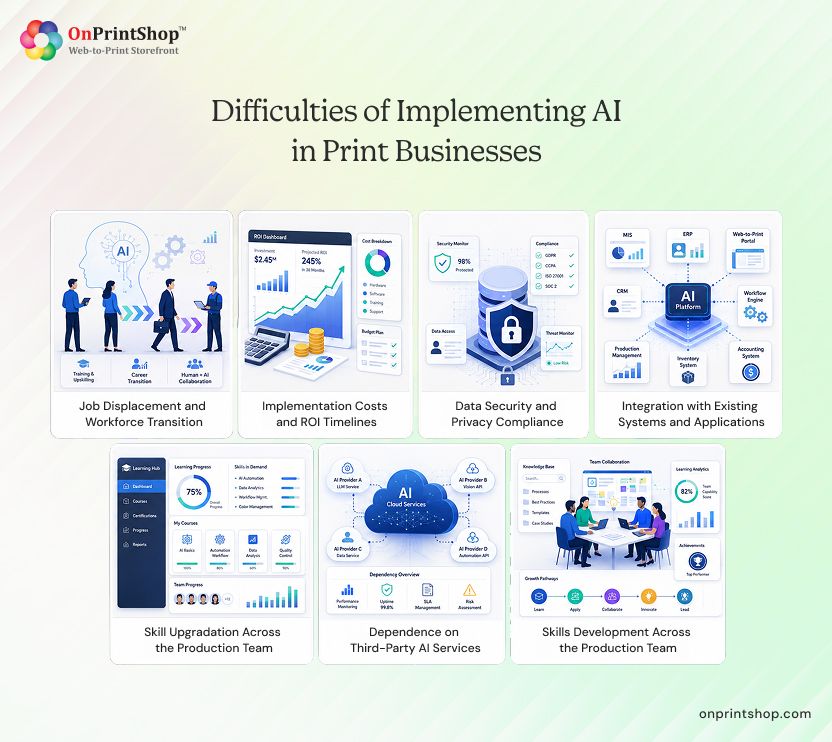
1. Job Displacement and Workforce Transition
AI automates high-volume, repetitive tasks, impacting roles in data entry, manual preflight, and basic customer service. For print businesses, the practical response is retraining staff for AI-adjacent roles: system operators, data analysts, and customer experience managers.
2. Implementation Costs and ROI Timelines
Off-the-shelf AI modules integrated into web-to-print platforms offer a lower entry cost than bespoke AI development. However, even preconfigured AI tools require infrastructure investment, integration work, and change management. Print businesses should model ROI across a 12–24 month horizon rather than expecting immediate returns.
3. Data Security and Privacy Compliance
Next-gen direct mail W2P software, particularly those handling personalized direct mail, process significant volumes of personal data. Compliance with GDPR, CCPA, and sector-specific data regulations requires regular audits, data minimization practices, and clearly defined data retention policies.
4. Integration with Existing Systems and Applications
Connecting AI tools to legacy MIS platforms, prepress workflows, and ERP systems requires careful technical planning. API compatibility, data format standardization, and user adoption are recurring friction points. Phased integration, starting with one workflow stage before expanding, reduces disruption risk.
5. Skill Upgradation Across the Production Team
Effective AI adoption requires staff who can configure, monitor, and interpret AI outputs, not just operate the machinery AI controls. Training investment is non-negotiable. Businesses that combine technology adoption with parallel skills development see faster returns and fewer implementation setbacks.
6. Dependence on Third-Party AI Services
Many AI capabilities available to print businesses today are delivered through third-party APIs and cloud platforms. This creates vendor dependency risk: pricing changes, service discontinuations, or outages can affect production. Print businesses should understand the SLA terms and data portability provisions of any AI service they embed into critical workflows.
7. Skills Development Across the Production Team
Effective AI adoption requires staff who can configure, monitor, and interpret AI outputs, not just operate the machinery AI controls. Training investment is non-negotiable. Businesses that combine technology adoption with parallel skills development see faster returns and fewer implementation setbacks.

The Future of AI in the Printing Industry: What to Expect
Print businesses leveraging artificial intelligence and emerging print industry trends in 2026 can experience smart automation, predictive maintenance, and strategies for providing tailored prints.
AI enables personalized messaging & campaign creation by adapting with individual preferences and behaviours, which is very useful in print marketing. As per reports, nearly 32% of marketers in the printing industry utilize AI to automate complex marketing campaigns, while 31% of marketers plan to leverage AI in the future.
AI-Based Tools that’s Making an Impact: Future trends of artificial intelligence in the printing industry might encompass a variety of innovations, such as AI-assisted design tools, environmentally friendly inks & materials, and AI-managed printer networks.
As artificial intelligence and machine learning algorithms continue to advance, more and more businesses in the printing industry will start adopting these technologies.
What’s the Issue with Using AI: Although, there are numerous benefits that AI can offer, there are chances for data vulnerability.
Solution to Mitigate the Issue: There is ongoing research by experts to safeguard users from the potential threats of AI and leverage its limitless possibilities for print business growth.
To simply put, the role of AI in the printing industry is magnificent and can create a transformative impact on print businesses that adopt AI-powered systems.
OnPrintShop's AI Capabilities: Practical Tools for Print Businesses Today
OnPrintShop has integrated a suite of AI-powered capabilities directly into its web-to-print platform, removing the need for print businesses to source, integrate, or manage separate AI tools.
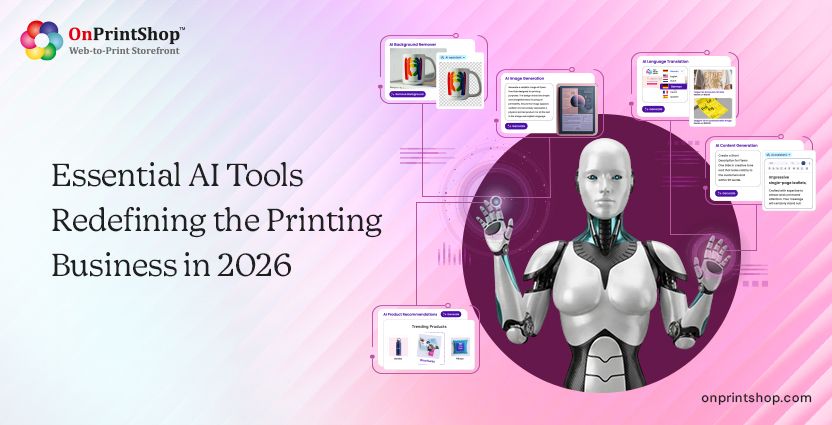
AI-Generated Product Images and Descriptions - Print businesses can generate high-quality product images and copy from a simple prompt, cutting storefront setup time by up to 70% compared to manual production. New product lines reach the storefront faster, with consistent quality across the catalogue.
Website Language Translator (19+ Languages) - The AI-powered translation tool converts storefront content into more than 19 languages, allowing print businesses to serve multilingual markets without manual localization overhead.
Designer Studio Text Translation - Print buyers working in the Designer Studio can translate the text content of their print files directly within the tool, removing the friction of switching between platforms for multilingual print jobs.
Background Remover and Photo Enhancer - AI-powered background removal and image enhancement tools allow print businesses and their customers to prepare print-ready artwork in fewer steps, improving prepress efficiency and reducing back-and-forth over file quality.
AI-Based Product Recommendation Engine - OnPrintShop's recommendation engine analyses customer behavior and purchase history to surface relevant products and upsell opportunities, improving average order value without additional manual effort from the sales team.
By combining the power of AI and W2P, OnPrintShop's AI features revolutionize web to print technology, amplifying its benefits and delivering superior print outcomes.
Wrapping It Up!In conclusion, the incorporation of artificial intelligence into the printing sector is altering old processes and propelling considerable advances. In such a progressive print landscape, leveraging a next-gen web to print solution for printers with AI driven capabilities is the need of the hour. As technology advances, the importance of AI in the printing industry will expand, making it critical for print businesses to carefully incorporate these developments while maintaining their core values and ethical standards.If you want to learn how OnPrintShop can make a difference to your print business, then schedule a demo with us right away. Our team will help you leverage the power of artificial intelligence-enabled web to print capabilities to maximize your business potential.