


Summary: Print price calculations that rely on spreadsheets or manual judgment often lead to underquoting, missed costs, and slow turnaround. AI powered print estimating software solves this by generating instant, accurate quotes from real time data, so print businesses can price jobs correctly the first time and protect their margins. This blog explains how AI driven estimating tools help print service providers quote faster, reduce errors, and increase profitability in 2026.
Estimating print prices without artificial intelligence is like using a Global Positioning System (GPS) that gets you to your destination but never by the fastest or most cost effective route. It gets the job done, but it leaves value on the table.
It's a sure thing that automated print cost estimating software has already improved how printers calculate job costs. But the modern printing industry now expects a faster, smarter approach that adjusts to changing material costs, labor rates, and order complexity without manual intervention.
By adding AI to the estimation process, print businesses can generate precise, real time cost predictions in seconds instead of relying on static rules and manual checks. According to a MarketsandMarkets report, the global artificial intelligence market was valued at approximately USD 601.93 billion in 2026 and is projected to reach USD 3,638.08 billion by 2033, growing at a CAGR of 29.3% during that period.
This scale of growth shows that AI adoption is no longer a differentiator; it is becoming a baseline expectation from print buyers who are already used to instant, accurate pricing in other industries.
Keep reading to see how AI is changing print estimating, from eliminating common calculation errors to enabling real time, dynamic pricing across web to print platforms.
Understanding AI in Print Estimation
AI in print estimation refers to the use of machine learning algorithms to analyze data such as material usage, labor costs, and real time price fluctuations, then generate accurate cost calculations for print jobs. Unlike static, rule based systems, AI adjusts its output as conditions change, so quotes stay accurate even when material costs or production capacity shift.
Traditional automated systems rely on fixed pricing rules that need manual updates whenever costs change. AI based systems, in contrast, learn from historical order data and continuously refine their estimates, which is one of the ways AI revolutionizes the print industry for businesses handling varied print volumes, substrates, and job specifications.
In short, AI powered print estimators combine data analysis and automation to deliver consistent, error free calculations, giving printers a measurable edge in a market where speed and accuracy directly influence win rates.
Common Challenges in Ordinary Print Estimating Methods
Manual print estimating relies on spreadsheets, individual judgment, and multi step approval chains. This approach introduces four recurring problems that AI is specifically designed to solve.
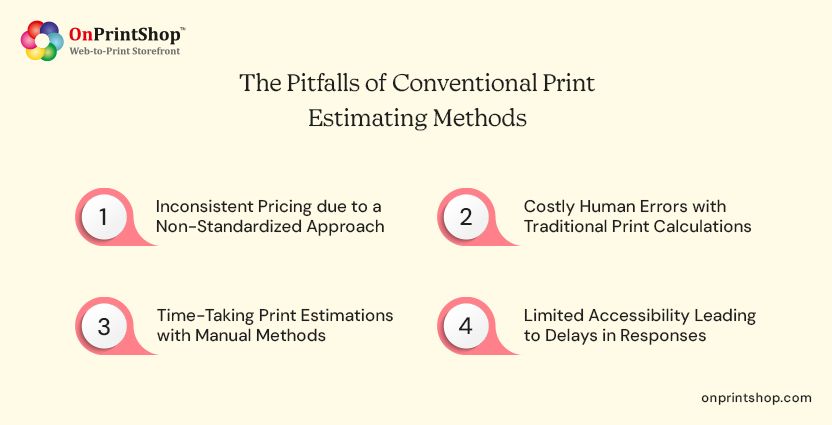
1. Inconsistent Pricing due to a Non-Standardized Approach
When multiple staff members handle quote calculations, whether because of high request volume or shift based workflows, the absence of a standardized process leads to inconsistent pricing. Judgment differences between estimators and frequent price fluctuations mean the same print job can receive two different quotes depending on who calculates it.
2. Costly Human Errors with Traditional Print Calculations
Print businesses using manual print estimations often have hidden costs that rarely get discussed openly, including financial losses, higher error rates, and reduced customer trust. A simple oversight, such as forgetting to add an embossing charge, forces the printer to either absorb the loss or go back to the customer for additional payment, which damages the relationship.
3. Time-Consuming Print Estimations with Manual Methods
Manual estimations, or estimations with only minimal automation, take longer because each one requires a specific framework for evaluating job specifications, material costs, and labor costs. When a print buyer requests quotes from two competing print businesses, they typically choose the one that responds faster, so slow estimating directly costs sales.

4. Limited Accessibility Leading to Delays in Responses
When a quote request comes in and the estimator is unavailable, the task usually falls to a sales or customer service representative. These team members often lack direct access to current pricing data and have to wait for the estimator's approval, which delays the response the print buyer receives.
What Makes AI-Powered Print Estimating More Efficient?
Manual cost estimation is outdated, and basic automation only solves part of the problem. AI powered print estimating tools close the remaining gaps in three main ways.
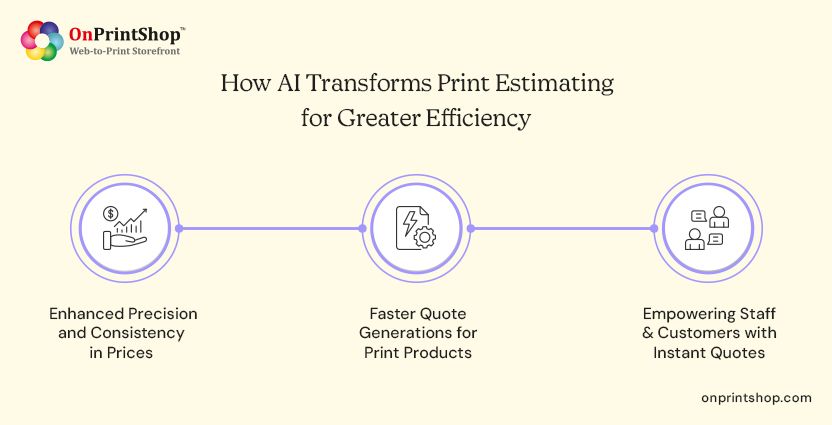
1. Enhanced Precision and Consistency in Prices
AI-powered print estimating software uses predictive analytics to deliver real time, error free calculations. By analyzing historical cost data along with current pricing, labor, and material trends, the system produces accurate and consistent quotes regardless of who initiates the request.
2. Faster Quote Generations for Print Products
Research shows that AI can help to cut around 30% to 70% of the time required for quote generation, producing precise estimates within seconds. Cutting quote turnaround time this significantly reduces wait times for print buyers and gives printers a clear edge over competitors still relying on manual pricing.
3. Empowering Staff & Customers with Instant Quotes
AI-driven self-service portals reduce dependency on dedicated print estimating staff and let both sales teams and customers generate instant quotes on their own. AI powered print shop estimating software removes the need for specialized technical expertise, so users can enter job details and receive a precise price estimate immediately.
Conversational AI assistants and chat based copilots are increasingly built into these portals, letting print buyers describe a job in plain language and receive an accurate quote without navigating a complex form, a trend that is becoming standard across web to print platforms in 2026.
The Synergy Between Web-to-Print and AI-Powered Print Estimators
Web to print and AI are two technologies that, when combined, change how a modern print business prices, quotes, and fulfills orders. Here is how an AI enhanced web to print estimating tool solves the problems that persist even in automated systems.
1. AI Eliminates Human Errors and Ensures Accurate Pricing
The Problem:
Delivering error-free cost estimation is a must for modern PSP’s, and automated web-to-print systems get most of the way there. What they often miss is the ability to react to fluctuating material and production costs in real time.
How AI Fixes It:
Integrating web to print systems with AI driven print quote automation allows printers to analyze historical order data, catch inconsistencies with machine learning, and generate quotes that reflect current conditions rather than outdated assumptions.
The Benefit:
Printers avoid underquoting and pricing inconsistencies, which protects profitability and builds stronger customer trust over time.
2. AI Enables Real-Time Dynamic Pricing
The Problem:
W2P based estimating software refines print job price calculations through pre-defined settings and standard automation rules. Without AI, the system struggles to predict prices based on live market fluctuations, which can result in overpriced or underpriced quotes.
How AI Fixes It:
AI combined with web-to-print technology allows print buyers to receive real-time cost estimates based on raw material prices, order complexity, production capacity, and customer-specific factors such as order history and loyalty discounts.
The Benefit:
Printers protect their margins with pricing that reflects current conditions, and print buyers benefit from fair, competitive quotes.
3. AI Automates Reordering for Print Buyers
The Problem:
Modern print order management software makes reordering easy by keeping order history accessible. However, when prices change, customers often have to go through the full estimation process again for what should be a simple repeat order.
How AI Fixes It:
AI-enabled web to print system recognizes patterns in past orders, analyzes the original job settings, and applies updated pricing automatically, removing the need to request a new quote from scratch.
The Benefit:
This approach saves time for both the print provider and the buyer, speeds up order placement, and increases the likelihood of repeat business.
4. AI-Powered Chatbots Provide Instant Quotes
The Problem:
Web to print systems typically follow a systematic process for quote approvals. This structured, collaborative approach is reliable, but it can also slow down response times when a customer is waiting for a quick answer.
How AI Fixes It:
AI-based web-to-print tools solve this with chatbots powered by natural language processing that respond directly to a customer's requirements and return an accurate quote without human intervention.
The Benefit:
Faster chatbot response times give print buyers 24/7 access to instant quotes on the print ecommerce site, while sales teams can redirect their time toward growing the business instead of manually processing routine requests.
5. AI Handles Low Stock Levels
The Problem:
Web to print systems typically update stock levels on the storefront automatically, but most lack the intelligence to analyze procurement needs, forecast stock trends, or suggest material alternatives.
How AI Fixes It:
AI-based W2P systems can predict future stock requirements so print providers can restock proactively, and they can recommend cost effective material alternatives to print buyers whenever stock runs low.
Benefit:
Printers gain stronger procurement planning and cost control, while print buyers receive accurate estimates that include substitute material options instead of order delays.
6. AI Optimizes Pricing Decisions
The Problem:
W2P systems typically include top-notch reporting and analytics tools for tracking sales performance, productivity, and inventory. What most lack is the ability to turn that data into real time predictions about pricing trends.
How AI Fixes It:
AI-enabled W2P systems analyze demand patterns, past orders, market trends, customer behavior, and production bottlenecks, which helps printers refine pricing strategy and identify cost saving opportunities before they become urgent.
The Benefit:
This data-driven approach allows printers to deliver accurate estimates based on current conditions, avoid misquoting, and protect long-term profitability.
Wrapping It Up!Using AI for print calculations does more than speed up quoting. It improves the overall experience for print buyers, helps them make better purchasing decisions, and strengthens profitability for the print business behind the quote.By adopting advanced Web-to-Print software built for printing companies, printers gain access to automation and predictive pricing capabilities that generate accurate estimates in seconds rather than hours.OnPrintShop already gives print buyers AI enabled tools for design personalization and a streamlined product launch process. As we continue refining our web to print solutions, printers can expect more AI driven pricing and workflow capabilities in the near future.If you haven't seen how our print estimators deliver pinpoint accurate calculations, request a demo with OnPrintShop today.