



Blog Summary: Printers are moving beyond MarketDirect and PrintReach because modern print businesses need faster, more flexible, and integration-ready platforms. This blog explains what has changed in print, where legacy systems fall short, and what today’s printers expect from modern Web-to-Print and commerce solutions.
Printers are moving beyond MarketDirect and PrintReach because today’s print businesses need faster, more flexible, and more scalable digital platforms than legacy systems were built to support. As customer expectations rise and print operations become increasingly digital-first, traditional tools are no longer enough to keep pace with modern demands.
In a rapidly evolving print industry, this shift is accelerating. The global Web-to-Print software market continues to expand, with the market projected to grow at a CAGR of 7.4% from 2026 to 2035, as printers adopt cloud-based and automated platforms to meet customer expectations and streamline operations.
In this blog, you’ll discover why MarketDirect and PrintReach, once pioneers in print’s digital transition, no longer fully address the needs of modern print businesses, what has changed in the industry landscape, and what next-generation Web-to-Print and commerce platforms are delivering instead. If you want to understand how successful printers are navigating today’s competitive, digital marketplace, keep reading. This is the insight shaping the future of print commerce.
The Role MarketDirect and PrintReach Played in Print’s Digital Phase
When the print industry began moving from manual, email-based ordering to online workflows, MarketDirect and PrintReach emerged as early digital enablers. They introduced the idea that print could be ordered, managed, and tracked through centralized systems rather than handled entirely through phone calls, spreadsheets, and in-person interactions.
MarketDirect Storefront
MarketDirect, built within EFI’s ecosystem, became a foundational digital storefront for many larger commercial printers and in-plant facilities. Its strength lay in connecting customer-facing ordering with backend MIS systems, allowing printers to bring structure to pricing, job ticketing, and production tracking. For many organizations, MarketDirect represented their first serious step toward integrated, web-based print workflows rather than fragmented, manual processes.
PrintReach
PrintReach gained traction, particularly with mid-sized printers and mailers by blending MIS capabilities with customer-facing storefront tools. Its approach made it easier for print businesses to manage orders, proofs, inventory, and fulfillment from a single operational environment. By providing both backend management and online ordering, PrintReach helped many printers reduce manual touchpoints and offer basic self-service portals to their customers.
Together, these platforms helped normalize online print order management software and moved the industry from purely analog operations toward a more connected digital model, an important transition phase in print’s modernization journey.

What Has Changed in the Print Business Landscape
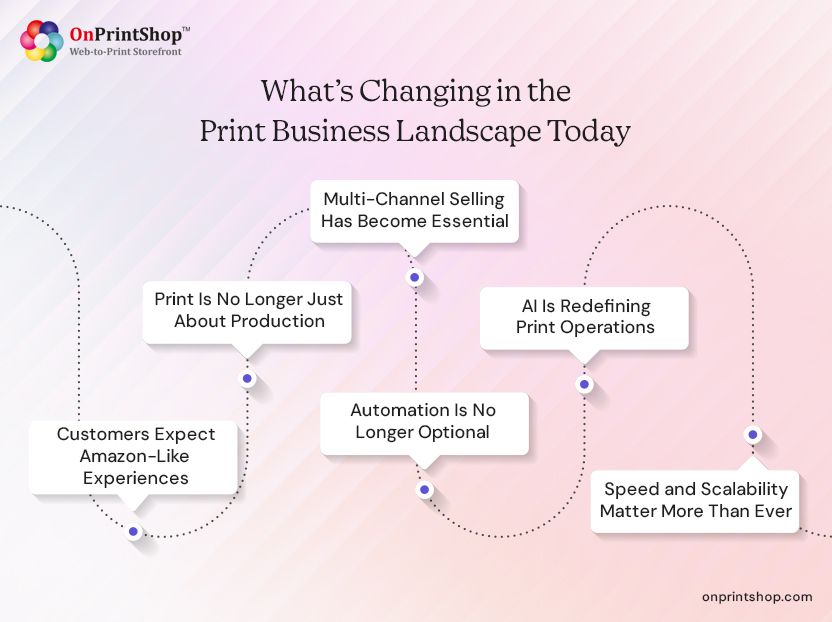
The print industry today looks very different from the era in which MarketDirect and PrintReach first gained prominence. What began as a shift toward basic online ordering has evolved into a much broader transformation, one that blends eCommerce, automation, data, and customer experience. Several key changes have reshaped what printers now need from their technology stack.
Customers Expect Amazon-Like Experiences
Modern print buyers, whether B2B or B2C, expect fast, intuitive, and self-service digital experiences. They want instant pricing, real-time previews, transparent order tracking, seamless checkout, and a W2P solution with easy customization. This shift in buyer behavior has pushed printers to move beyond basic portals toward more sophisticated, consumer-style storefronts that feel closer to eCommerce platforms than traditional print ordering systems.
Print Is No Longer Just About Production
Print businesses are increasingly competing on digital experience, not just print quality or turnaround time. Success now depends as much on software, integrations, and online usability as it does on presses and finishing equipment. This has turned many print providers into hybrid print-tech businesses rather than purely manufacturing operations.
Multi-Channel Selling Has Become Essential
Printers are no longer relying on a single storefront or customer portal. Many now sell through multiple channels, branded web stores, B2B portals, franchise storefronts, marketplaces, and enterprise accounts. This requires robust print workflow management systems that can support multiple storefronts, roles, and something older platforms were not originally designed to handle.
Automation Is No Longer Optional
Manual processes that were once acceptable, such as rekeying orders, generating quotes by hand, or managing approvals via email, are now major bottlenecks. Modern printers need end-to-end automation from order to intake production, shipping, and invoicing. This has raised expectations for deeper integrations with MIS, production tools, payment systems, and logistics providers.
AI Is Redefining Print Operations
AI-driven capabilities such as automated product descriptions, smart design tools, background removal, image enhancement, and website translation are becoming standard expectations rather than experimental features. Printers now look for platforms that embed intelligence directly into workflows instead of treating AI as an add-on.
Speed and Scalability Matter More Than Ever
As online demand grows, printers need platforms that can scale with their business, handling higher order volumes, larger catalogs, and more complex workflows without slowing down. Legacy systems built for smaller digital footprints often struggle to keep up with today’s fast-paced, data-driven print environment.
Together, these shifts explain why many printers are reassessing their legacy systems and exploring newer, more flexible Web-to-Print storefronts that align with today’s digital-first reality.
Where MarketDirect and PrintReach Start Falling Short
As customer expectations, technology, and business models have evolved, the very strengths that once made MarketDirect and PrintReach valuable have begun to feel limiting for many modern print businesses. What worked well in print’s early digital phase now struggles to keep pace with today’s demand for speed, flexibility, and seamless integration.
MarketDirect Storefront
MarketDirect’s deep connection to the EFI ecosystem has been both its strength and its constraint. While the integration with EFI MIS systems benefits large in-plant and enterprise environments, many printers find the platform rigid, slow to adapt, and difficult to extend beyond its native architecture. Customizations often require specialized expertise, lengthy implementation cycles, and high costs, making innovation hard for growing print businesses.
From a customer experience perspective, MarketDirect storefronts frequently feel more like operational portals than modern eCommerce experiences. Limited design flexibility, clunky UI, and slower performance can frustrate today’s digitally savvy buyers who expect intuitive, consumer-grade interfaces. As a result, printers relying heavily on MarketDirect often struggle to compete with newer, more agile storefront experiences.
PrintReach
PrintReach’s combined MIS and storefront approach initially helped streamline operations for mid-sized printers and mailers, but many users now report that the platform can feel outdated compared to cloud-native Web-to-Print solutions. Its storefront capabilities are often viewed as functional rather than innovative, making it harder for printers to deliver highly engaging, branded, or conversion-optimized online experiences.
Integration has also become a growing pain point. As printers adopt more third-party tools like payment gateways, shipping platforms, marketing automation, or AI-driven design tools, PrintReach’s ecosystem can feel restrictive. This makes it harder for businesses to build a best-of-breed technology stack, leaving them dependent on a single system that may not evolve as quickly as the market demands.
In short, both platforms are now showing their age: MarketDirect through rigidity and complexity, and PrintReach through limited modernization and integration flexibility, prompting many printers to look for more adaptable, cloud-based alternatives.

What Printers Are Actively Looking for Instead
As print businesses reassess legacy platforms, their expectations from Web-to-Print technology have become far more concrete and outcome-driven. Today’s printers are not just replacing software; they’re rethinking how technology supports growth, efficiency, and customer experience. Here’s what they are actively prioritizing.
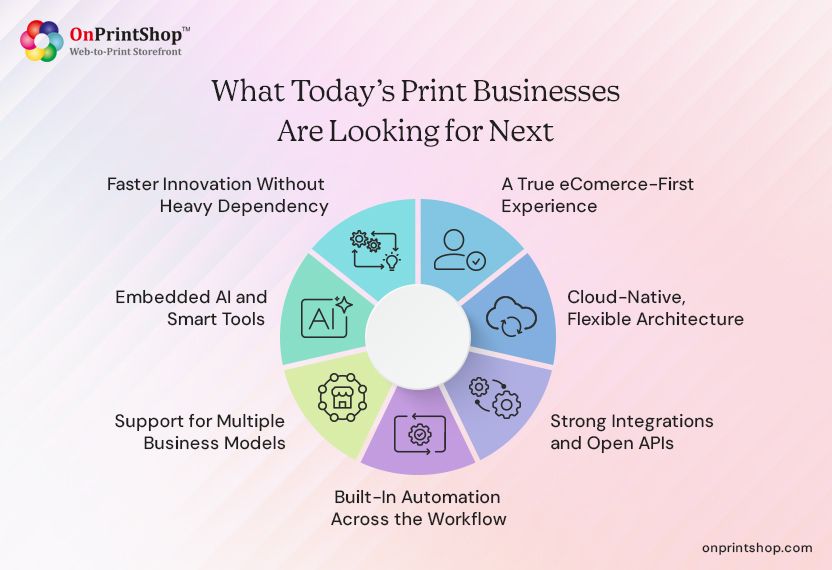
A True eCommerce-First Experience
Printers want a storefront that feels like a modern eCommerce platform for selling personalized print products, not internal order portals. This includes intuitive navigation, mobile responsiveness, fast load times, real-time pricing, instant previews, and frictionless checkout. The goal is to make ordering print as easy as buying any other product online, especially for repeat and B2B customers.
Cloud-Native, Flexible Architecture
Instead of rigid, on-premise or tightly locked ecosystems, printers are looking for cloud-based platforms that are easier to deploy, update, and scale. Flexibility matters, whether it’s launching new storefronts, adding products quickly, or adapting workflows as the business evolves.
Strong Integrations and Open APIs
Modern print businesses rely on multiple systems, not just one. Printers now expect a versatile web-to-print platform that supports integrations with MIS, CRMs, payment gateways, shipping carriers, marketing tools, and production software. Open APIs and pre-built integrations are no longer “nice to have”; they are essential for eliminating manual work and data silos.
Built-In Automation Across the Workflow
Automation is a top priority. Printers want platforms that automatically handle quoting, file checks, approvals, job routing, production updates, invoicing, and order notifications. The less human intervention required, the faster and more profitably they can operate.
Support for Multiple Business Models
Today’s printers often serve a mix of B2C customers, B2B accounts, franchises, resellers, and enterprise clients. They are actively seeking solutions that can support multiple storefronts, pricing rules, user roles, and approval workflows, all from a single platform.
Embedded AI and Smart Tools
Rather than bolt-on features, printers are increasingly looking for AI built directly into their Web-to-Print experience. This includes smart product setup, AI-assisted design tools, image enhancement, automated translations, and intelligent recommendations that improve speed, accuracy, and conversion rates.
Faster Innovation Without Heavy Dependency
Finally, printers want platforms that evolve quickly without forcing them into long upgrade cycles. The ability to adopt new features, respond to market changes, and experiment digitally, without vendor lock-in, has become a key decision factor.
Together, these priorities explain why many printers are no longer just upgrading their storefronts, but actively moving toward modern, commerce-driven Web-to-Print platforms designed for today’s digital-first print businesses.
The Competitive Risk of Staying on Outdated Web-to-Print Systems
In today’s digital-first print market, staying on an outdated Web-to-Print system is no longer a neutral decision; it’s a competitive risk. As more printers adopt modern, commerce-driven platforms, the gap between legacy systems and next-generation solutions continues to widen.
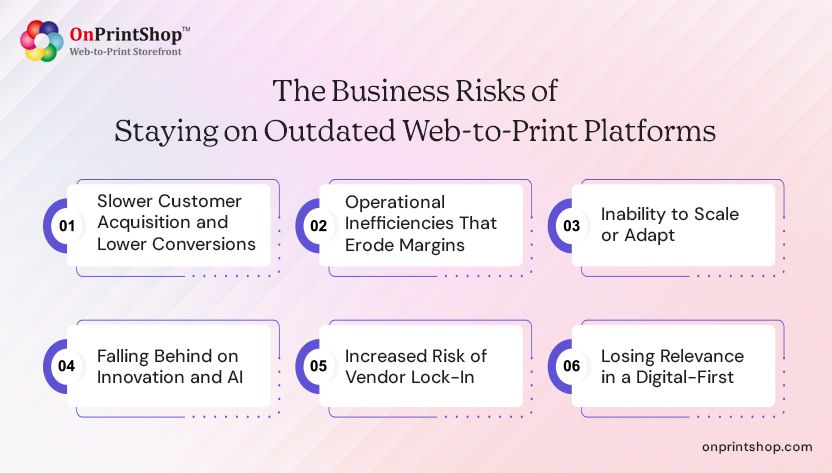
Slower Customer Acquisition and Lower Conversions
Outdated storefronts often deliver clunky user experiences, slow load times, and limited customization options. This directly impacts conversion rates, especially as buyers compare print ordering experiences across vendors. When ordering feels complicated or unintuitive, customers are more likely to abandon carts or switch to competitors offering faster, simpler online journeys.
Operational Inefficiencies That Erode Margins
Legacy Web-to-Print systems typically rely on manual interventions, disconnected tools, and workarounds. Over time, this increases labor costs, slows turnaround times, and introduces errors into production workflows. While competitors automate end-to-end processes, printers using outdated systems struggle to maintain healthy margins and operational consistency.
Inability to Scale or Adapt
As order volumes grow or business models evolve, older platforms often become bottlenecks rather than enablers. Limited flexibility makes it harder to launch new products, add storefronts, support enterprise accounts, or expand into new markets. This lack of agility prevents printers from responding quickly to changing customer demands.
Falling Behind on Innovation and AI
Modern Web-to-Print platforms are rapidly embedding AI, analytics, and intelligent automation into everyday workflows. Printers tied to legacy systems risk missing out on innovations that improve speed, accuracy, personalization, and decision-making. Over time, this innovation gap compounds, making it harder to compete with digitally advanced print providers.
Increased Risk of Vendor Lock-In
Outdated systems often come with rigid architectures and limited integration options, forcing printers to remain dependent on a single vendor’s roadmap. This restricts freedom of choice and slows digital transformation, especially as the broader technology ecosystem evolves faster than the platform itself.
Losing Relevance in a Digital-First Market
Ultimately, printers that delay modernization risk becoming less relevant to today’s buyers, particularly digitally native businesses that expect seamless online experiences. As competitors continue to modernize, staying on outdated Web-to-Print systems can quietly but steadily weaken a printer’s market position.
In a market where speed, experience, and automation define success, standing still with legacy technology often means falling behind.
ConclusionThe shift away from legacy platforms like MarketDirect and PrintReach isn’t about abandoning what once worked; it’s about aligning with what today’s print businesses truly need to compete and grow. As customer expectations rise and operations become increasingly tech-driven, a modern Web-to-Print platform must deliver speed, flexibility, deep integrations, and built-in intelligence.Printers that modernize their digital storefronts are better positioned to scale, automate, and differentiate in a crowded market. If you’re evaluating what’s next for your print business, now is the right time to explore smarter alternatives. Book a demo with OnPrintShop to see how a modern, commerce-first Web-to-Print platform can support your growth and future-proof operations.