


Blog Summary: Print companies must think like tech firms in 2026 because growth now depends on technology, automation, AI, data, and Web-to-Print, not just equipment and relationships. This blog explains the tech-first mindset, customer expectations, integrated systems, and how forward-thinking printers are already winning. Keep reading to see what the future of print truly looks like.
Print service providers have to shift their mindset from being a print service provider to being an online print service provider. The new-age customers expect instant quotes, online ordering, and seamless communication, which cannot be possible without new-gen tech solutions. In fact, 75% of B2B buyers now prefer digital self-service over traditional sales interactions, which means print companies can no longer rely only on presses, people, and relationships.
Growth today depends on technology like an AI-powered Web-to-Print solution that automates business operations, streamlines workflows, and improves margins. This shift is redefining what it means to run a modern print shop and pushing more owners to think like tech-first print businesses rather than traditional service providers.
In this blog, we’ll explore what that mindset really looks like, why it matters, and how forward-thinking printers are already benefiting, so keep reading to see what the future of print truly holds.
The Print Industry Has Already Become a Tech Business
Having a phone is more important than having a brick-and-mortar print shop in this day and age. The modern SaaS Web-to-Print solutions are revolutionizing the way the print industry functions by automating every print production workflow and digitalizing every process.
With such sophisticated print order management software, you can literally operate an entire print shop without even entering the print shop physically. Thus, you’d not be shocked to see print businesses having fully remote teams and cloud-based systems running the entire operation, all without traditional front-desk interactions or manual coordination.
This isn’t the future anymore. It’s already how the most efficient print companies operate today.

What “Thinking Like a Tech Firm” Actually Means for Printers
Over the past decade, the printing industry has quietly undergone one of the biggest shifts in its history. It’s no longer enough to simply invest in the latest digital printing technology trends or upgrade your presses every few years. Today, the most successful players are starting to reposition themselves not just as printers, but as print companies and tech firms.
That doesn’t mean abandoning craftsmanship or replacing people with machines. Instead, it’s about adopting a tech mindset for print businesses, where software, automation, data, and AI are seen as growth engines just as important as sales teams or production floors. This is the real story of print industry digital transformation: evolving from a production-first mindset to a technology-first business model that scales, adapts, and thrives even as customer expectations accelerate.
Why Print Businesses Need a Tech-First Mindset
A decade ago, print businesses could rely heavily on relationships, equipment investments, and local dominance. But the market has changed. With robust print estimation software, now compare prices online, expect instant quotes, and assume Amazon-like ordering experiences, even for B2B print.
This is why tech-first print businesses are pulling ahead. They treat software platforms, automation tools, and print tech innovation as the foundation of their business, not an add-on. Technology isn’t seen as a “project” or a “tool,” but as the core strategic layer that drives every area of the business, from sales to production to delivery.
In other words, digital transformation in printing has become a business strategy, not a technology upgrade.
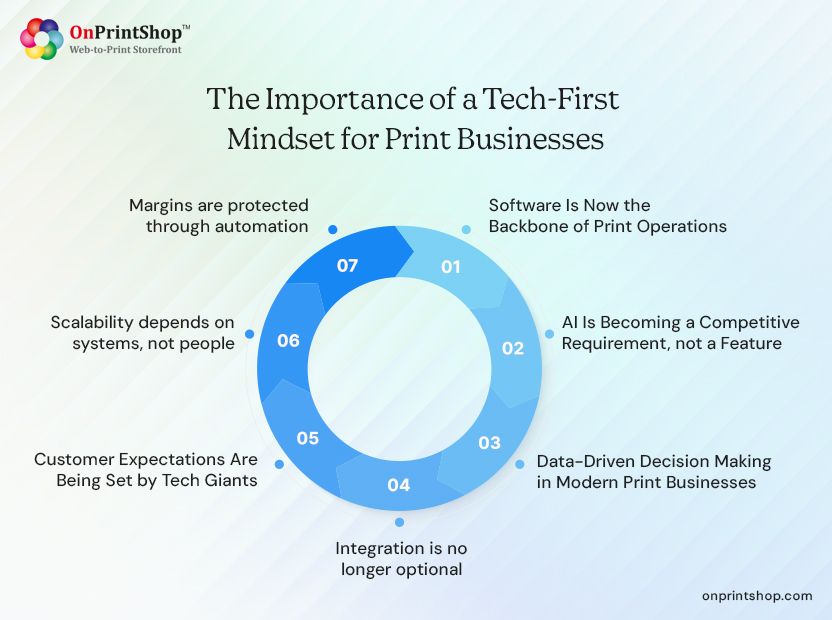
Software Is Now the Backbone of Print Operations
Walk into any modernized print shop, and you’ll notice something different. Yes, there are presses, finishing equipment, wide-format devices, and mailing systems. But behind all of that is a tightly connected layer of software holding everything together.
Estimating, job onboarding, customer portals, proofing, scheduling, artwork handling, order tracking, invoicing, shipping, nearly every step now runs through software. And as print company tech adoption continues to increase, owners are realizing that the efficiency, accuracy, and scalability of their workflows depend less on individual staff members and more on the systems that support them.
This is the real engine of digital print transformation.
AI Is Becoming a Competitive Requirement, not a Feature
AI is no longer a futuristic concept for Silicon Valley. It is already reshaping technology in the printing industry, from integrating AI in print workflows to predictive job scheduling, customer analytics, and AI-powered web-to-print solutions.
Automation in the print industry is streamlining artwork processing, improving personalization, assisting design processes, removing production bottlenecks, and even predicting demand trends. What started as experimentation is now becoming a competitive requirement.
Soon, AI won’t be what differentiates you; it will be the baseline expectation.
Data-Driven Decision Making in Modern Print Businesses
Print owners have always relied on instincts, experience, and gut feel. Today, the leaders are combining business wisdom with data.
With connected systems and analytics, print companies’ digital transformation now means being able to answer questions instantly:
- Which jobs make the best margins?
- Which customers reorder most frequently?
- Which products have the highest service costs?
Data is beginning to replace guesswork, making profitability more predictable and growth more strategic.
Integration is no longer optional
In the past, you could tolerate disconnected tools and manual hand-offs. Today, friction costs real money.
Modern print companies, as tech firms, are moving toward fully integrated ecosystems, MIS, CRM, Web-to-Print, financial tools, and production systems all talking to each other. That means fewer errors, fewer touches, and fewer delays.
Integration is the difference between a smooth, scalable growth engine and a business constantly chasing paperwork.
Customer Expectations Are Being Set by Tech Giants
Your customers now measure your experience against Amazon, Shopify, Uber, and Apple, not just other printers.
That means they expect:
- Self-service ordering
- Instant visibility
- Live communication
- Seamless repeat ordering
- Transparent pricing
This is why modernizing print business processes is no longer an internal operations decision; it is a customer experience requirement.
Scalability depends on systems, not people
People remain essential. But the only way to grow without burning out your team is to let systems carry the load.
Tech-first print businesses design workflows that allow volume to scale without adding headcounts at every stage. That’s the power of automation, cloud-based systems, and connected software.
Growth becomes smoother, steadier, and far more profitable.
Margins are protected through automation
Labor pressure. Rising material costs. Short-run ordering trends. Faster turnaround demands.
Margins are constantly under attack. And the best defense has become automation.
By eliminating manual entry, reducing proofing errors, automating customer updates, and systemizing production workflows, print tech innovation now directly protects profitability.
Tech-First Print Companies Are Winning Already
You don’t have to look far to see who is building momentum in the market.
Faster turnaround with fewer staff
Automated workflows and real-time job tracking mean time is saved at every hand-off. Owners report faster throughput without expanding payroll. That’s print industry digital transformation in action.
Higher order volumes without increasing overhead
Once systems handle repetitive processes, the ceiling on order volume lifts. That’s when true scalability begins.
Stronger client retention due to a better experience
Customers stay with vendors who feel easy, responsive, and predictable. Technology makes that consistency possible.

How Forward-Thinking Print Companies Are Preparing Today
Forward-thinking shops are no longer waiting for disruption to arrive. They are proactively reshaping how they operate by embracing digital transformation in printing, investing in AI-powered web-to-print solutions, and building a technology roadmap that supports growth over the next decade, not just the next year.
They are re-training teams. Upgrading systems. Eliminate manual chokepoints. Testing AI tools. And most importantly, shifting the mindset from “print production business” to a technology-enabled service partner.
ConclusionThe future of the industry doesn’t belong only to the largest companies or the most capital-intensive operations. It belongs to the tech-first print businesses, the ones who see that presses and production tools are only half the story. The other half is data, automation, AI, connected systems, and a digital-first customer experience.This is what true digital print transformation looks like. And for printers ready to evolve, our AI-driven web-to-print solution is the right choice for scaling business with the pioneering technology in the printing industry. Schedule a one-on-one demo with OnPrintShop and get one step ahead of the future trends.