


Summary: Building a one-stop print shop experience means aligning technology in a way that simplifies end-to-end print ordering journey for customers while giving printers full control over their operations. This comprehensive blog gives practical insights into how to make this possible with innovative technologies like web-to-print.
A one-stop print shop experience can be built by unifying all print operations in a single place. It eliminates the need for print buyers to juggle between multiple vendors, tools, and platforms, centralizing the entire print journey from start to end.
Utilizing a modern web-to-print storefront allows printers to accomplish this goal. Keep reading the blog to know how print business owners can do this in action.
What Defines a One-Stop Print Shop Experience?
A one-stop print shop experience means digitizing your print business with web-to-print technology by providing a unified print ordering journey for customers. While the one-stop print shop solution enables printers to get all information in a centralized platform, the integration of all systems keeps all data connected.
Why Print Buyers Are Actively Looking for All-in-One Print Solution?
Print buyers are looking for an all-in-one print solution because they want a single platform that brings ordering to delivery into one easy-to-manage workflow.
As the print buying behavior of customers has shifted towards digital-first experiences, customers experience increased convenience and speed. Working with multiple print vendors requires switching between multiple systems.
Driven by factors like packaging demand, inkjet innovation, shorter runs, sustainability requirements, and supply-chain modernization, the global printing market is anticipated to reach $969.7 billion by 2030. This makes it evident that the print industry is rapidly evolving, and printers need a robust solution that focuses on all touchpoints to deliver a unified print ordering experience for customers.
As the absence of centralization leads to fragmented communication and provides limited visibility into print orders, an all-in-one print shop platform provider can solve this need. It offers a unified platform to streamline print operations from order intake to delivery, while keeping communication and data in a centralized manner.

Core Pillars of a One-Stop Print Shop Solution
The core pillars of a one-stop print shop solution are unified web-to-print storefronts, online design and print preview capabilities, centralized print order management, automated end-to-end print workflows, and integrations with existing and third-party systems.
This type of solution is established on a set of foundational capabilities that ensures every stage of the print journey works in synchronization. Let’s discuss the core pillars that make a successful one-stop print shop solution.
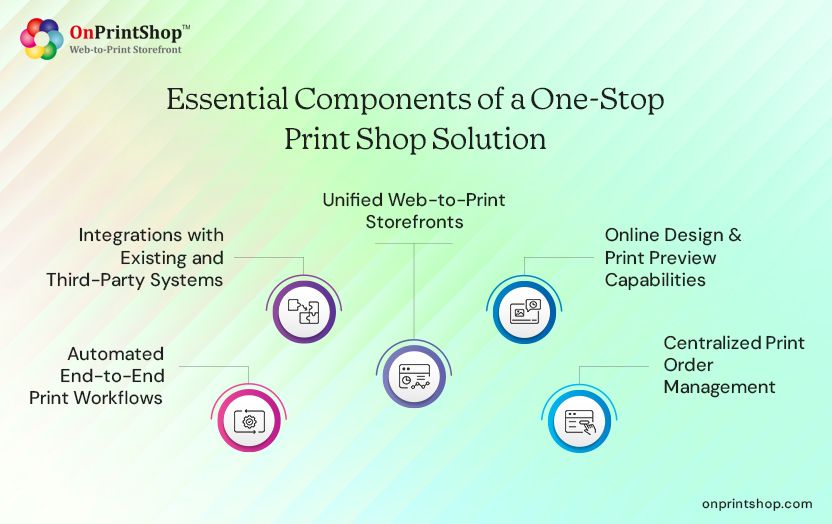
Unified Web-to-Print Storefronts
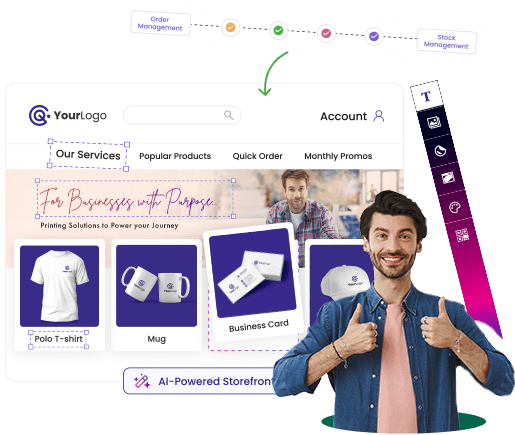
A centralized print management storefront backed by web-to-print technology acts as the foundation for the print shop, making it essential for success. By using the web-to-print storefront, printers can allow print buyers to browse products, personalize them, get accurate pricing, and place orders with ease.
Online Design and Print Preview Capabilities
Design creation tools and preview options allow customers to personalize designs easily and visualize them in real-time. Pre-designed templates and AI tool using smart web-to-print online designer simplifies design creation while 3D previews enhances decision making.
Centralized Print Order Management
Print order management with centralization of orders, approvals, production, invoicing, and delivery is essential for a print shop. It ensures smooth internal coordination between systems and prevents errors, eliminating operational complexity.
Automated End-to-End Print Workflows
End-to-end print workflow automation streamlines operations from order intake, file validation, approvals, production routing, invoicing, and shipping. It allows you to handle higher order volumes without increasing operational overhead.
Integrations with Existing and Third-Party Systems
Seamless integration of the complete print management platform with MIS, ERP, payment gateways, shipping providers, and accounting systems is necessary. These intelligent web-to-print integrations makes sure that there is uninterrupted data flow across systems and smooth running of print operations.
Role of Multi-Storefront Strategy in Building an All-in-One Print Shop
A multi-storefront strategy allows print businesses to operate in multiple online storefronts. Each of these storefronts caters to specific customer types or region, while allowing the print business to operate from a centralized platform.
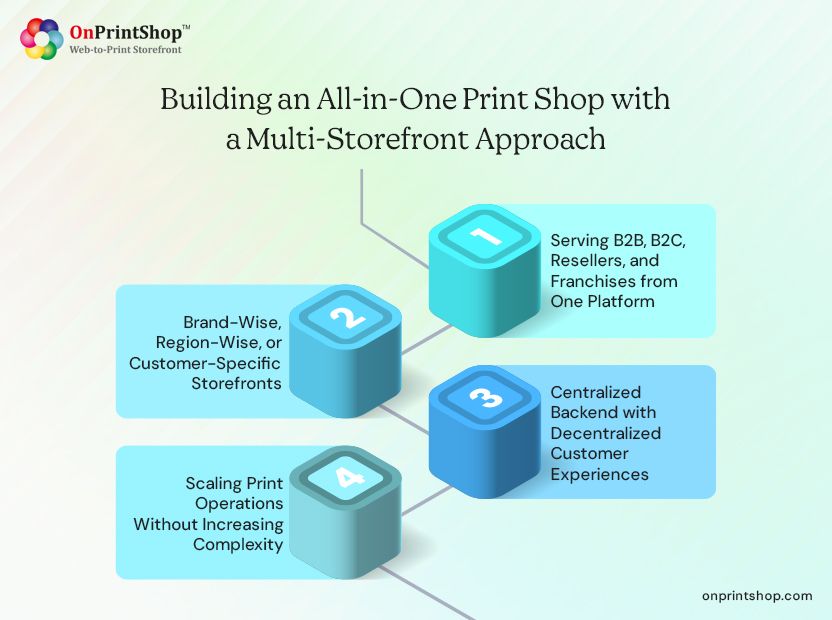
Serving B2B, B2C, Resellers, and Franchises from One Platform
A single platform allows printers to manage different customer types including B2B, B2C,resellers, and franchises having varied requirements like unique pricing and personalization.
Brand-Wise, Region-Wise, or Customer-Specific Storefronts
This strategy involves enabling print business owners to create varied storefronts tailored to different brands, regions, or customers – each with its unique appearance, currency, and catalog.
Centralized Backend with Decentralized Customer Experiences
While multi-storefront strategy involves the use of multiple storefronts for different purposes, all operations from order management to fulfillment can be controlled using one unified dashboard.
Scaling Print Operations Without Increasing Complexity
This approach enables printers to reuse the same infrastructure to achieve business scalability such as acquiring new customers of varied types, reaching new markets, and expanding product range.
How a Centralized Print Management Platform Enables Convergence?
A centralized print management platform enables convergence by bringing multiple print related operations into a single unified system. Let’s see how it does this efficiently by understanding the below-given pointers.
1. Single System for Connecting all Storefronts
It connects all storefronts of B2B,B2C, franchise, and reseller together. It ensures consistent supply of data across all storefronts, enabling printers to provide a unified print ordering experience for customers.
2. Improved Visibility and Control Across Departments
The unified print management platform provides printers with real-time visibility into order, production, and inventory levels. This accurate visibility enables printers to run operations faster and achieve better control over operations.
3. Reduced Manual Touchpoints and Operational Silos
Automated workflows enable printers to independently run multiple storefronts while ensuring fully connected workflows. This eliminates manual errors, speeds up manual operations, and eliminates fragmented print operations.
Common Challenges Print Service Providers Face Today
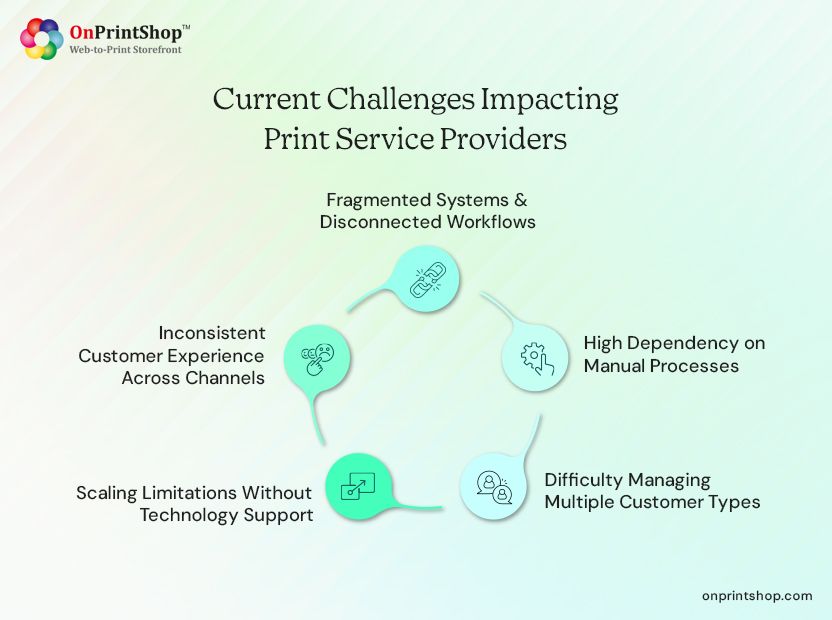
Print service providers face challenges like disconnected workflows, increased dependency on manual processes, difficulty in managing multiple customer types, limitations in scalability, and difficulty in managing multiple sales channels. Let’s understand in detail about these challenges that hinder the print shop experience for printers and customers, and see how web-to-print can solve printing challenges like them.
Fragmented Systems and Disconnected Workflows
Many print service providers rely on multiple tools for estimating to fulfillment. When these systems don’t have proper flow of data, it creates workflow gaps, increasing the risk of errors, and delays. This makes it difficult to manage print jobs from order placement to delivery.
High Dependency on Manual Processes
Manual tasks consume significant time and resources, causing manual errors, rework, and deadlines. Heavy reliance on manual workflows increases the need for manual labor, limits productivity, and the efficiency of print operations. This further negatively impacts print business growth.
Difficulty Managing Multiple Customer Types
Printers usually serve diverse customer types including B2B,B2C, franchises, resellers, and trade printers. Each of these customers has varied printing requirements in terms of pricing, personalization, quantity, and shipping types. Managing these needs through a single system becomes complex and time-consuming.
Scaling Limitations Without Technology Support
As your print business grows, the demand for print products increases. The rise in order volume may require more manual labor for order completion. A robust system limits the ability of print business to handle more order volumes, expand print offerings, or enter new markets effectively.
Inconsistent Customer Experience Across Channels
When orders come in through multiple channels including online, email, phone, or in-person, printers find it difficult to offer varied customer experience. This lack of standardization leads to inconsistent communication, weakens customer trust, and negatively impacts customer relationships.

How OnPrintShop Supports a One-Stop Print Shop Model?
OnPrintShop supports a one-stop print shop model by enabling print businesses to bring all print operations on a centralized platform. Let’s see how it does this in action.
Multi-Storefront and Multi-Business Support
Printers can run multiple storefronts for varied brands or customer segments from a single and unified solution. Each storefront can be personalized while having centralized control over print operations.
End-to-End Print Order Management
OnPrintShop offers innovative print order management software to help printers move orders seamlessly from order submission to production and delivery. This eliminates manual print operations, improves visibility into orders, and speeds up turnaround times.
Integration-Ready Ecosystem for Print Businesses
OnPrintShop's web-to-print solution supports integration with MIS, ERP, payment gateways, shipping providers, accounting, and more. It allows printers to ensure seamless data flow between systems and streamline operations.
Business Benefits of Adopting a One-Stop Print Shop Approach
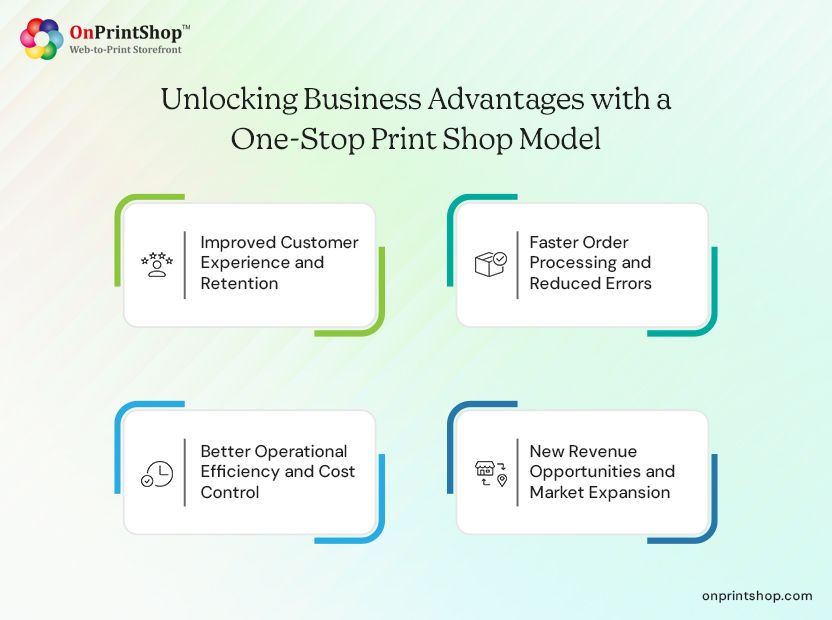
A one-stop print shop approach can deliver several benefits to print businesses including better customer experience, improved order processing, better operational efficiency, and increased revenue opportunities. Let’s look at a few of them to help you understand why this approach can be a game-changer for your print business.
Improved Customer Experience and Retention
A one-stop print shop delivers a transparent experience for print buyers, builds trust in the print business, encourages repeat orders, and strengthens long-term customer relationships.
Faster Order Processing and Reduced Errors
Automation-based workflows and standardized workflows using a print shop solution accelerate order handling and processing, while reducing manual errors, rework, and speeding up turnaround times.
Better Operational Efficiency and Cost Control
The centralized system provides complete visibility into the print business operation, real-time visibility into production performance, reduces tasks having manual labor, allowing team to focus on other value-added tasks.
New Revenue Opportunities and Market Expansion
With the web to print one stop solution that allows to serve multiple print segments, printers can unlock new revenue opportunities by expanding into new market segments and the ability to handle increased order volumes.

Getting Started: Steps to Build Your One-Stop Print Shop
Establishing a print shop requires assessing current workflows, identifying target audiences, choosing the right platform, phase-wise implementation, and change management. The step-by-step process with detailed information to build a one stop print shop is given below.
Assess Current Workflows and Gaps
Map your existing workflows and identify bottlenecks to define what needs to be changed and improved for your print shop growth.
Identify Target Customer Segments
Since B2B, B2C, or a mix of customer types may have different requirements, knowing your target customer segments can help you cater to your customers effectively.
Choose the Right All-in-One Print Shop Solution
Make sure to choose the right print shop solution that aligns with your current needs while allowing support for business scalability to achieve maximum success.
Plan Implementation and Change Management
Roll out the implementation in phases and train teams regularly to ensure smooth adoption of the all-in-one print shop solution.
Wrapping It Up!An all-in-one print shop experience can help modern print businesses deliver better customer experiences and get maximum ROI. As discussed in this blog, printers can utilize advanced web-to-print storefront to build a one-stop print shop experience.Choosing a reliable w2p provider like OnPrintShop and implementing the solution effectively can help you achieve this goal with long-term impact. To learn more, request a demo with OnPrintShop today and experience the difference for yourself.