



Summary: The commercial printing industry in 2026 is navigating a period of real change, shaped by digital transformation, rising personalization demands, sustainability pressures, and new production technologies. This blog covers the current state of the commercial print market, the key challenges print businesses face, the trends driving growth, and the emerging product segments worth targeting.
The commercial printing market has shifted considerably in recent years. Digital technology adoption, changing buyer behavior, and evolving expectations around personalization and sustainability have all pushed traditional print operations to adapt.
Print businesses that are investing in the right technologies, including the modern commercial printing solutions built specifically for this sector, are finding genuine opportunities for growth within that change. This blog covers what the commercial print landscape looks like in 2026 and what print businesses need to know to stay competitive.
The Current State of the Commercial Printing Industry in 2026
The commercial printing industry is in a period of steady, measured growth alongside ongoing structural change. The market was valued at USD 594.24 billion in 2026 and is projected to reach USD 704.07 billion by 2031, growing at a CAGR of 3.45%. While growth is moderate compared to faster-moving sectors like print-on-demand, the scale of the market and the breadth of its applications across packaging, retail, healthcare, education, and corporate communications make it a substantial and durable industry.
The more significant story is not just size but transformation. Commercial printers that are integrating digital workflows, automation, and web-to-print ecommerce capabilities are gaining ground, while those relying on traditional bulk production models are facing increasing margin pressure.

Key Challenges in the Commercial Print Sector in 2026
Before addressing opportunities, it is worth understanding the operational and market challenges that commercial print businesses are actively managing in 2026.
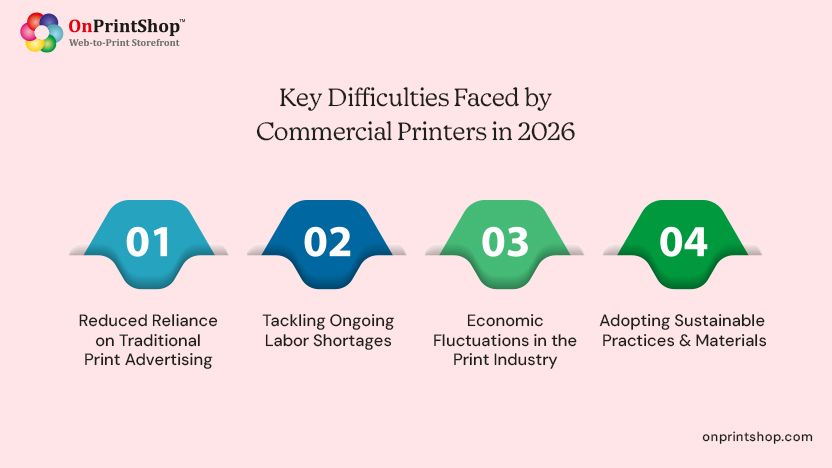
1. Reduced Reliance on Traditional Print Advertising
The continued shift of marketing budgets toward digital channels and the latest top web-to-print software in 2026 has reduced demand for some traditional commercial print categories, particularly mass-market print advertising. For commercial printers, this means repositioning away from commodity print runs and toward higher-value, personalized, and digitally integrated print products that justify their place alongside digital marketing efforts.
2. Tackling Ongoing Labor Shortages
An aging skilled workforce, difficulty attracting new talent, and rising wage expectations are creating real capacity constraints for commercial print operations. The practical response for most print businesses is investing in AI-driven automation and print workflow software that reduces dependence on manual labor for repetitive tasks, freeing staff to focus on higher-skill work like client management and quality oversight.
3. Economic Fluctuations in the Print Industry
Volatile input costs, including paper, ink, and energy, combined with broader economic uncertainty, make financial planning challenging for commercial printers. Businesses that have diversified their product mix, built flexible production capacity through print-on-demand models, and reduced waste through better workflow automation are better insulated from these pressures than those operating with fixed, high-overhead production models.

4. Adopting Sustainable Practices & Materials
Client demand for sustainable printing options is growing, but implementing eco-friendly materials and processes while maintaining profitability is a genuine operational challenge. Digital proofing, eco-certified substrates, water-based and UV-curable inks, and waste reduction through on-demand production are practical starting points, but they require upfront investment and process change that many commercial printers are still working through.
Now that we have discussed the challenges, let's have an in-depth look at the opportunities in this industry.
Trends Shaping the Commercial Printing Industry in 2026
The following print industry current trends are defining where commercial printing is heading in 2026. Understanding them helps print businesses decide where to invest, what to upgrade, and which market segments to pursue.
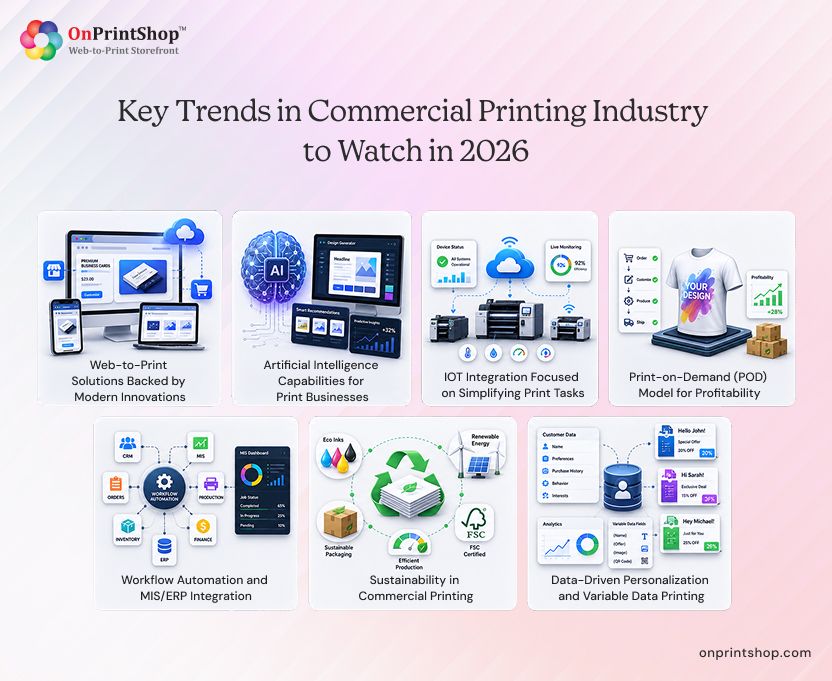
1. Web-to-Print Solutions Backed by Modern Innovations
Web-to-print adoption in commercial printing is accelerating because it addresses multiple print industry challenges simultaneously. It enables personalized print ordering through ecommerce storefronts, automates job management from order receipt through production, and reduces the manual coordination that slows down complex print workflows.
Commercial printers integrating W2P platforms built with automation, AI, and machine learning capabilities are seeing measurable improvements in order accuracy, turnaround times, and customer satisfaction.
2. Artificial Intelligence Capabilities for Print Businesses
AI adoption among commercial printers is growing steadily. According to a survey by NAPCO Research and PRINTING United Alliance, 38.3% of commercial printers are already using AI, with a further 23.5% planning to adopt it within the coming year. Current use is concentrated in content creation and design personalization, but printers plan to expand AI usage into operations management, customer analytics, sales support, customer service, and risk management.
As the technology matures, AI will become a standard operational layer across commercial print workflows rather than a specialist capability.
3. IOT Integration Focused on Simplifying Print Tasks
Integrating Internet of Things (IoT) connectivity into commercial print environments gives businesses real-time visibility into production status, equipment performance, and inventory levels. Combined with web-to-print technology, IoT data enables smarter scheduling decisions, proactive equipment maintenance, tighter quality control, and more efficient energy use.
The longer-term direction is toward fully connected print facilities where production data flows automatically between machines, management systems, and customer-facing platforms.
4. Print-on-Demand (POD) Model for Profitability
The print-on-demand model is gaining traction in commercial printing because it enables cost-effective short-run production across a wide product range, from business cards, brochures, and flyers to labels, packaging, and promotional materials. For commercial printers, POD reduces inventory risk, improves cash flow, and allows them to serve clients who need small quantities or frequent design updates without the overhead of traditional bulk production. The flexibility this model provides is particularly valuable in uncertain economic conditions.
5. Workflow Automation and MIS/ERP Integration
Commercial printers are investing in workflow automation and integrated MIS/ERP systems to simplify production management and improve operational scalability. Connecting estimating, order management, prepress, invoicing, shipping, and production workflows within a centralized system helps reduce manual errors, improve turnaround times, and provide better visibility into production costs and profitability.
6. Sustainability in Commercial Printing
Sustainability is becoming a major operational priority in commercial printing as businesses adopt recyclable substrates, low-VOC inks, energy-efficient equipment, and waste reduction practices. Digital workflows and print-on-demand production also help reduce overproduction and material waste, making sustainable printing both an environmental and operational advantage for modern print businesses.
7. Data-Driven Personalization and Variable Data Printing
Demand for personalized print communication continues to grow as businesses seek more targeted marketing campaigns. Variable data printing (VDP) allows commercial printers to customize text, images, offers, and messaging within the same print run, helping brands improve engagement while maintaining production efficiency at scale.
As seen in this section, several trends like AI technology is being utilized to boost creativity and simplify design personalization. From design to print, each of these trends is being leveraged and will continue to be utilized in the future for optimizing print operations.
Emerging Niches and High-Growth Segments in Commercial Printing
Several product segments within commercial printing are growing faster than the overall market. For print businesses looking to expand revenue, these are the areas with the strongest near-term opportunity.
1. Packaging Printing
Packaging printing is one of the highest-growth segments in commercial printing, driven by ecommerce expansion, consumer demand for distinctive unboxing experiences, and growing requirements for sustainable packaging materials across retail, food and beverage, and cosmetics categories.
High-Growth Areas
- Personalized corrugated boxes
- Eco-friendly packaging made of recycled materials
- Smart packaging with QR codes and NFC tags
Innovation to Tap into this Niche
Commercial printers wanting to expand into the packaging market segment can adopt modern web-to-pack software that is developed to simplify the personalization and printing of all types of packages.
2. Labels & Stickers Printing
Demand for short-run, customized labels and stickers is rising across food and beverage, cosmetics, pharmaceuticals, and retail, where variable data printing, brand-specific finishing options, and fast turnaround are standard requirements.
High-Growth Areas
- Die-cut stickers
- Waterproof labels
- Security labels
Innovation to Tap into This Niche
Opt for a next-level label & sticker printing software to expand into this niche, offering a wide variety of labels and stickers, including die-cut stickers, sheet stickers, and clear stickers, as well as varied finishing options.
3. Large Format Printing
Large format printing is expanding alongside growth in retail display, event marketing, ecommerce-driven demand for custom signage, and the textile sector's adoption of digitally printed fabrics.
Fabric-based soft signage, sustainable rigid media, and custom wallcoverings are among the fastest-growing product categories within this segment.
High-Growth Areas
- Fabric-based soft signage
- Sustainable rigid media (PVC-free boards)
- Wall murals and custom wallpaper printing
Innovation to Tap into This Niche
With various printing software available in the market, adopting a new-age large format printing software can help commercial printers to effectively meet the changing needs of customers.

4. Textile Printing
Digital textile printing is growing on the back of on-demand fashion, personalized home furnishings, and custom apparel. The ability to produce short runs with complex patterns and precise color matching, without the setup costs of traditional screen printing, has made digital textile printing accessible to a broader range of commercial print businesses.
High-Growth Areas
- On-demand fashion and T-shirt printing
- Upholstery fabric printing
- Custom curtains, tablecloths, and cushions
Innovation to Tap into This Niche
There are several innovations, like advanced pattern design software, that can help commercial printers to easily offer eye-catching textile products with unique repetitive patterns.
Wrapping It Up!The commercial printing industry in 2026 is not declining. It is restructuring. The businesses gaining ground are those investing in web-to-print automation, AI-driven production capabilities, flexible POD models, and higher-margin product segments like packaging, labels, and large format printing.The operational and market challenges are real, but so are the opportunities for print businesses that are equipped with the right technology and a clear view of where demand is heading.OnPrintShop offers robust commercial printing solutions built to address the specific workflow, personalization, and ecommerce needs of commercial print businesses. To see how the platform applies to your operation, request a demo with OnPrintShop today.