


Summary: Customer demands are shifting and printing technology is advancing faster than ever. For print businesses looking to stay relevant and competitive, understanding which trends will define the industry in 2026 is essential. This blog covers the top printing industry trends to watch, with context on why each one matters and how to act on it.
Print businesses in 2026 are navigating three converging shifts at once: rising demand for sustainable and personalized products, AI moving from pilot projects into daily production workflows, and customers expecting the same self-serve, real-time ordering experience they get everywhere else online. Not every trend on this list applies equally to every print shop, a sign shop and an in-plant department will use different web-to-print solutions that suit distinct business models.
Below, we break down the 18 trends reshaping the print industry in 2026, which ones matter most depending on your business type, and how to act on them without chasing every new technology at once.

Category#1: Customer-Centric Printing Trends Transforming the Buying Experience
Today's print buyers expect convenience, speed, and personalized experiences. From online ordering and product customization to connected ecommerce systems, these trends help print businesses deliver a seamless customer journey while expanding into new markets.
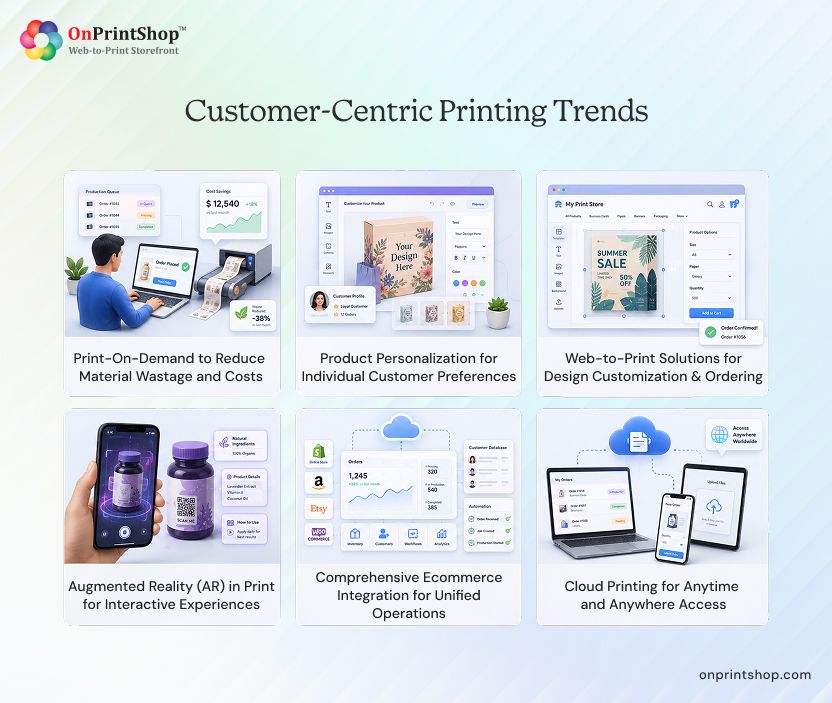
1. Print-On-Demand to Reduce Material Wastage and Costs
Print-on-demand (POD) allows businesses to produce print products only when an order is placed, in the exact quantity required. This eliminates overproduction, reduces inventory costs, and minimizes material waste. For businesses entering the custom print market, POD is one of the most accessible and capital-efficient models available. Learning the operational steps to launch a print-on-demand business is a practical first move for those exploring this segment.
2. Product Personalization for Individual Customer Preferences
Personalization has become a baseline expectation across consumer product categories. Customers increasingly prefer brands that offer products tailored to their preferences, from custom text and imagery to individualized color schemes and finishes. Print businesses using capable print personalization software can offer this experience at scale, through self-service design tools and AI-assisted customization features that require minimal manual intervention.
3. Web-to-Print Solutions for Design Customization and Ordering
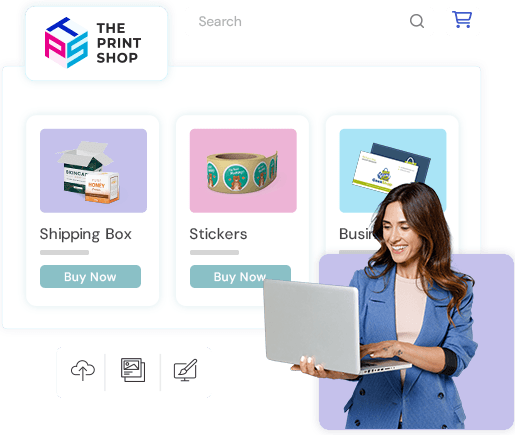
The new-age custom web-to-print (W2P) solutions allow customers to design, configure, and order print products directly through an online storefront. For print businesses, this means reduced manual order handling, fewer errors, and broader reach beyond local markets. The technology also gives customers real-time order tracking and management, improving the overall buying experience.
If you are evaluating this technology, comparing the leading web-to-print software platforms is a practical starting point. For a full breakdown of how the technology works, our complete guide on web-to-print covers implementation in detail.
4. Augmented Reality (AR) in Print for Interactive Experiences
Augmented reality bridges physical print and digital content by allowing users to scan printed materials and trigger interactive digital experiences, such as product demonstrations, 3D visualizations, or video content.
With a projected global market value of $289.05 billion by 2030, AR in print is gaining traction in retail (virtual try-ons), marketing (interactive ads), and education (enhanced textbooks). For print businesses, offering AR-integrated print products adds a measurable layer of customer engagement that standard print cannot replicate.
5. Comprehensive Ecommerce Integration for Unified Operations
Ecommerce integration connects a print business's online storefront with back-end systems including ERP, CRM, accounting, inventory management, and marketing platforms via APIs.
By enabling real-time data synchronization, it eliminates duplicate data entry, reduces fulfillment errors, streamlines order management, and provides a unified view of business operations. As print businesses expand across multiple sales channels, seamless ecommerce integration has become a foundational requirement for scalable growth.

6. Cloud Printing for Anytime and Anywhere Access
It is a new trend in the printing industry that allows users to print from any device using the internet, eliminating the need for driver installation. The global market of cloud printing services is expected to reach USD 4374.6 million by 2035.
Category #2: Print Production Technologies Driving Efficiency and Automation
As order volumes grow and turnaround expectations tighten, print businesses are investing in technologies that improve production efficiency, automate workflows, and support new print applications. These innovations help reduce operational costs while increasing output quality and scalability.
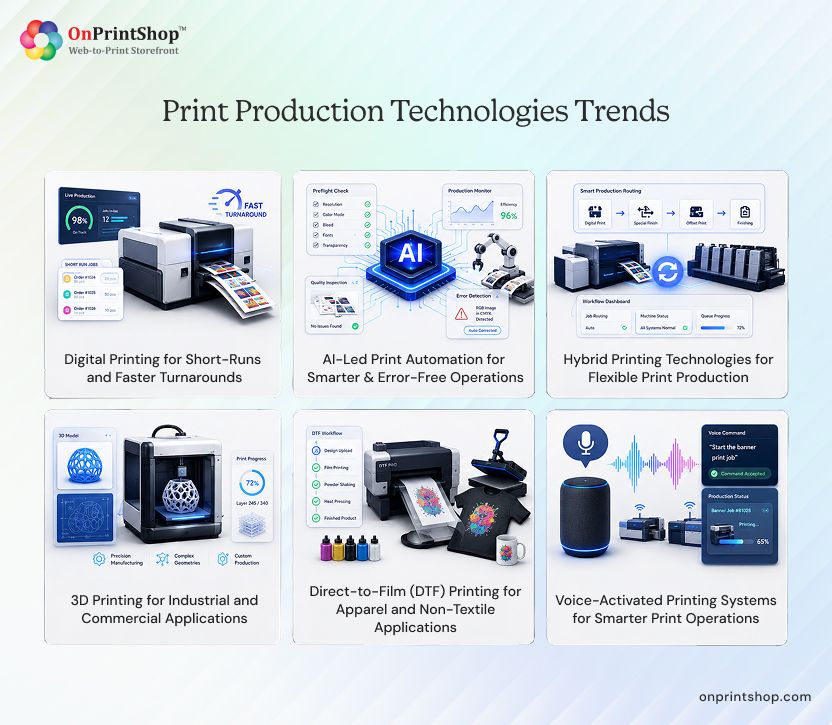
7. Digital Printing for Short-Runs and Faster Turnarounds
Digital printing transfers images directly from a digital file to the print substrate, bypassing the need for traditional printing plates or cylinders. This makes it particularly well-suited for short print runs, where setup costs with conventional offset printing would be prohibitive. For print-on-demand businesses, digital printing delivers cost savings, reduced waste, and significantly faster order turnaround times compared to traditional methods.
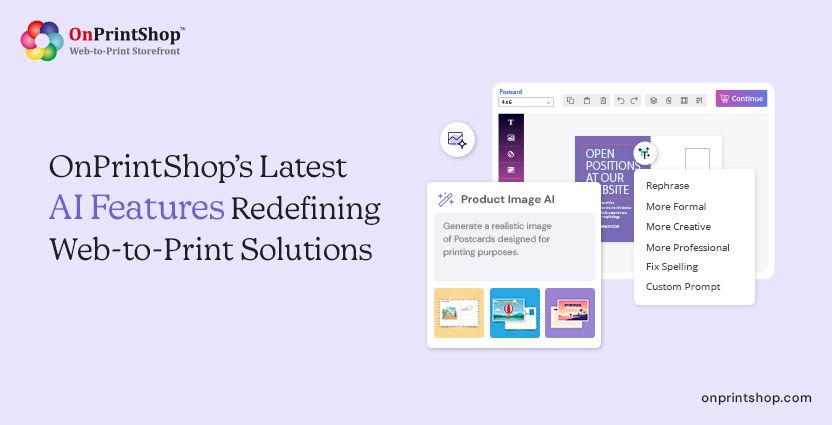
8. AI-Led Print Automation for Smarter & Error-Free Operations
AI-driven web-to-print capabilities are being adopted across the print production lifecycle, from content and design generation to job ticket creation, production scheduling, and workflow analysis.
Unlike traditional rules-based automation, AI-powered systems can adapt to changing order volumes, identify potential issues before they reach production, and optimize resource allocation based on real-time conditions. For print businesses handling high order volumes, this results in fewer production errors, reduced labor costs, faster fulfillment, and improved operational efficiency.
9. Hybrid Printing Technologies for Flexible Print Production
It combines multiple technologies including traditional and modern methods to leverage both their advantages. The market size of hybrid printing technologies is anticipated to reach USD 10.2 billion by the year 2028, rising at a CAGR (compound annual growth rate) of 13.2%.
10. 3D Printing for Industrial and Commercial Applications
Additive manufacturing or 3D printing is the latest innovation that utilizes digital design files for creating three-dimensional objects with applications in aerospace, healthcare, automative, and many other industries. Research indicates that the global 3D printing market will reach USD 35.79 billion by 2030.

11. Direct-to-Film (DTF) Printing for Apparel and Non-Textile Applications
DTF printing has established itself as a leading technology for custom apparel decoration, but its applications are expanding. Print businesses are now using DTF techniques on non-textile substrates including ceramics, glass, and metals, opening new product categories beyond clothing.
This flexibility allows print businesses to grow their product range while maintaining the high-resolution output and eco-friendly ink formulations that DTF is known for.
12. Voice-Activated Printing Systems for Smarter Print Operations
Voice-enabled printing systems allow users to perform tasks such as initiating print jobs, checking printer status, or managing workflows through voice commands integrated with virtual assistants or enterprise applications. While still an emerging trend, hands-free operation can improve convenience, accessibility, and productivity in environments where operators need faster, touch-free interaction with print devices.
Category #3: Emerging Print Industry Trends Shaping the Future
Beyond improving day-to-day operations, the print industry is evolving through sustainability initiatives, smart technologies, stronger security, and innovative materials. These emerging trends are helping businesses prepare for future customer expectations, regulatory requirements, and competitive market demands.
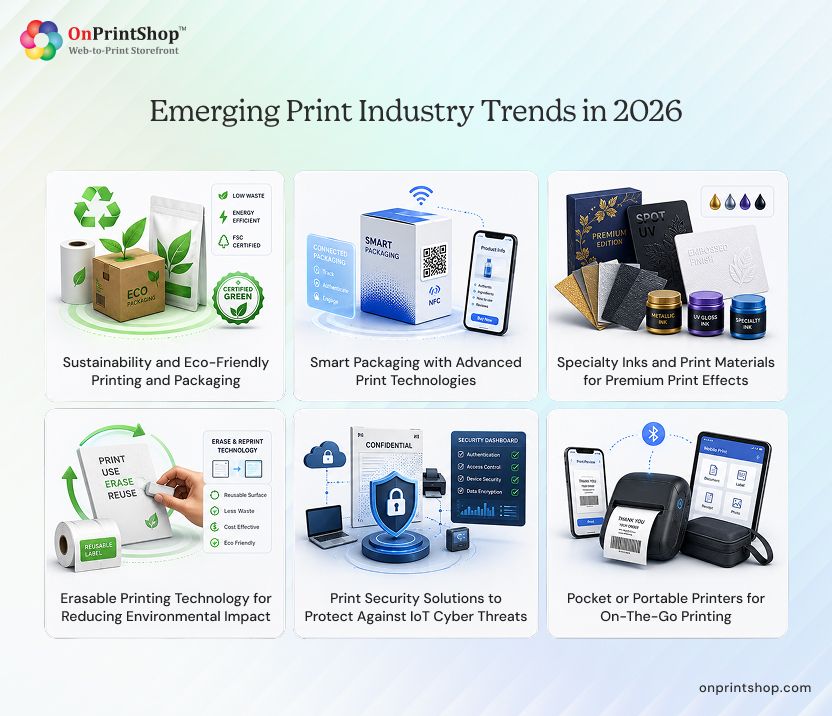
13. Sustainability and Eco-Friendly Printing and Packaging
Print businesses are shifting to sustainable printing and packaging methods to reduce their carbon footprint, paving the way for an eco-friendly environment. The sustainable packaging market is valued at USD 334.43 billion in 2026 and is anticipated to reach USD 594.46 billion by 2035, rising at a CAGR of 6.6% from 2026 to 2035.
14. Smart Packaging with Advanced Print Technologies
This type of packaging involves utilizing an innovative approach by integrating new printing technologies like RFID tags, sensors, and QR codes. Research shows that the global smart packaging market is anticipated to grow from USD 46.62 billion in 2026 to USD 84.27 billion by 2035, rising at a CAGR of 6.8%.
15. Specialty Inks and Print Materials for Premium Print Effects
Utilization of advanced ink and substrates with eco-friendly formulations like water-based and UV-curable inks are trending as it allows brands to stand out. Modern varnishes, premium finishes, and coatings with textured, metallic, thermochromic, glow-in-the-dark effect, allow print businesses to meet the print personalization demands of customers.
16. Erasable Printing Technology for Reducing Environmental Impact
This technology uses an erasable ink for printing on paper and later erases it by exposing it to ultraviolet light, enabling the paper to be re-used up to five times. This leads to a significant reduction in paper wastage, reduces the negative impact on the environment, and saves costs.
17. Print Security Solutions to Protect Against IoT Cyber Threats
As printing infrastructure becomes increasingly connected through IoT-enabled devices, print businesses face growing exposure to cybersecurity risks, including unauthorized access, data interception, and firmware vulnerabilities. Investing in managed print services with a cloud-based patch management, continuous security monitoring, and regular vulnerability assessments is now a practical necessity, not just a precaution.
18. Pocket or Portable Printers for On-The-Go Printing
Such printers are compact devices that can be easily connected using Bluetooth or USB, popularly used for applications in healthcare, manufacturing, retail, hospitality, logistics, and ecommerce sectors. As per IMARC Group, the worldwide market size of portable printers is anticipated to reach US$ 24.6 Billion by 2033.
Real-World Example: Putting Multiple Print Trends into Action
Roadrunner Print & Ship adopted OnPrintShop's web-to-print storefront and workflow automation to streamline online ordering, reduce manual touchpoints, and improve operational efficiency. By combining self-service print ordering with automated workflows, the company achieved a 70% improvement in efficiency, enabling faster order processing and a better customer experience. The success story of Roadrunner Print & Ship demonstrates how these technologies helped modernize its print operations.
Why Should Printing Businesses Keep Up with Industry Trends?
Keeping pace with print industry trends is not just about staying current. It directly affects a business's ability to compete, grow into new markets, and manage operational risk. Here is why it matters in practice.
Identify and Capture New Markets
Monitoring print industry trends helps businesses identify growth segments before they become saturated. Whether it is the rise in demand for sustainable packaging, personalized promotional products, or DTF apparel printing, businesses that act on emerging demand early can establish a market position before competitors do.
Better Risk Management
Awareness of industry direction allows print businesses to anticipate disruption rather than react to it. Businesses that track technology adoption curves and shifting customer preferences are better equipped to make proactive infrastructure and investment decisions, reducing the operational risk of being outpaced by faster-moving competitors.
Adaptation of New Methods
Adopting new production methods and technologies, whether digital printing for short runs, AI-driven scheduling, or cloud-based print management, directly improves operational efficiency, reduces waste, and raises output quality. Staying informed is what makes timely and well-targeted adoption possible.
The BottomlineThe printing industry in 2026 is defined by the convergence of automation, personalization, sustainability, and connected print technology. Print businesses that align their operations with the trends most relevant to their market and customer base are better positioned for consistent, long-term growth.OnPrintShop provides an all-in-one web-to-print platform that scales with your business, covering everything from online storefront management and design customization to print automation and ecommerce integration. To see how the platform fits your specific business needs, request a demo with OnPrintShop today.