

How the Web-to-Print Market is Evolving: Key Trends and Challenges in 2026

Summary: Struggling to keep up with the fast-evolving web-to-print market? You're not alone. This blog walks you through the latest trends shaping the W2P industry in 2026, the key challenges web-to-print solutions address, and research-backed insights to help your print business grow and stay competitive.
Digital transformation has pushed print business owners to adopt modern solutions, and web-to-print (W2P) technology has emerged as one of the most impactful. As customer expectations shift and online commerce grows, staying updated on W2P trends is no longer optional for print businesses aiming to scale profitably.
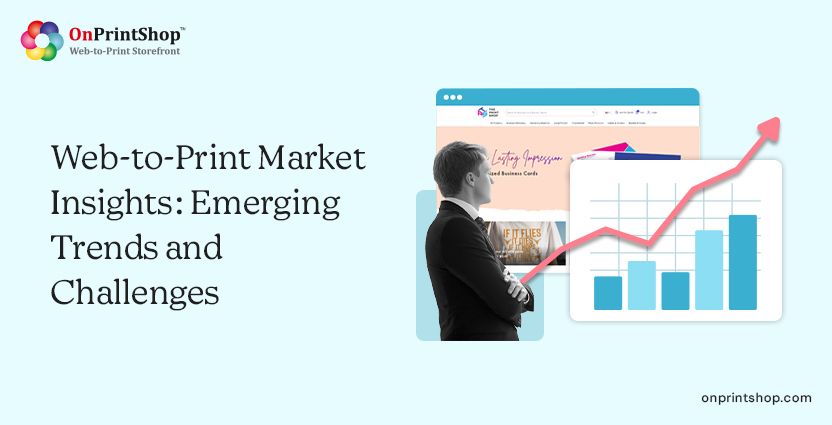
According to a study by Polaris Market Research, the global web-to-print market is projected to reach $44,650.55 million by 2032, reflecting strong and sustained demand across commercial, packaging, and on-demand print segments.
This statistical data proves that utilizing advanced web-to-print software and adapting to the changing market can make a huge difference in the growth of a print business.
In this blog, we cover research-backed data on the future of the W2P market, the defining 2026 trends, and the operational challenges that web-to-print solutions are built to solve.
What does the Future of the Web to Print Market Look Like?
The web-to-print market is expanding rapidly, driven by the growth of print ecommerce, rising demand for product customization, and the widespread adoption of cloud-based print systems. Here is a snapshot of where the market is heading.
Global web-to-print software sales revenue is expected to reach $3.21 billion by 2030.
One of the primary growth drivers is the rising adoption of the print-on-demand (POD) business model. There are approximately 228,000 print-on-demand stores worldwide, most operating with an established online presence and digital sales channels.
According to a report by IMARC Group, Europe currently holds the largest share of the web-to-print market, fueled by strong demand for customized products, rapid e-commerce sector growth, and continued technology innovation.
The trends reshaping the W2P software market include the adoption of cloud-based print solutions, integration of AI and machine learning into print workflows, and increasing consumer demand for personalization. Print businesses that adopt these capabilities early are better positioned to scale than those still relying on traditional print production methods.

What are the Biggest 2026 Trends of the Web to Print Industry?
The biggest 2026 trends of the web-to-print industry are driven by the introduction of new innovations in printing technology and the changing demands of customers. Let’s quickly learn what these web to print market trends include -
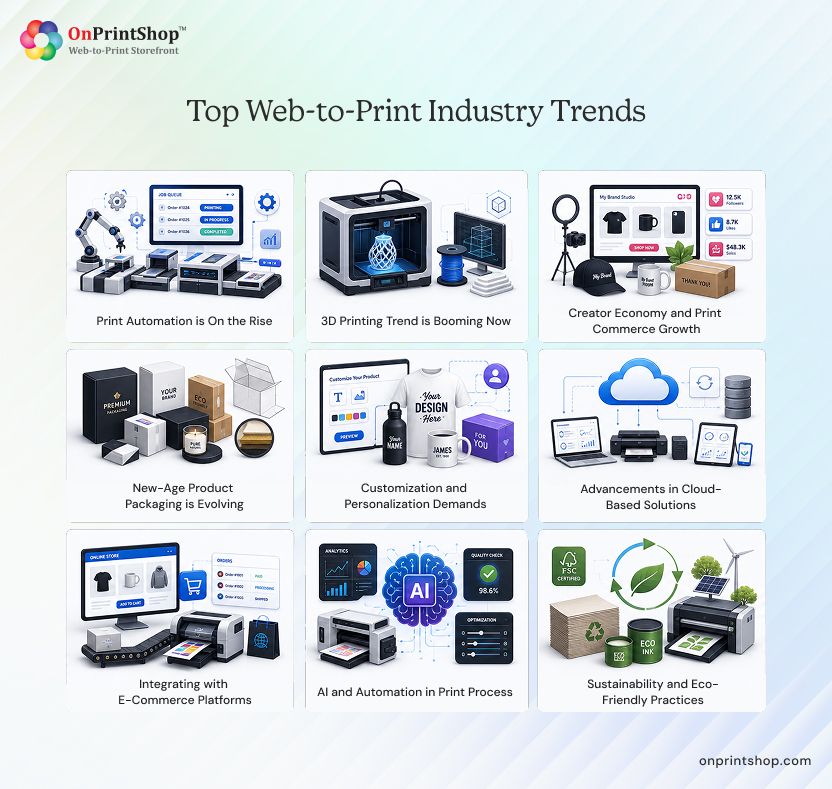
Print Automation is On the Rise
Print automation has moved from a competitive advantage to an operational necessity. Print businesses are now automating critical workflow stages including order management, prepress processing, design customization, and inventory management using dedicated print workflow automation software. The result is improved output quality, lower production costs, reduced material waste, and faster order fulfillment.
3D Printing Trend is Booming Now
3D printing has been gaining traction in industries like consumer goods, fashion, and healthcare since the past few years due to its ease of creating 3 dimensional products with precision and detailing. Modern print businesses have started adopting cost-efficient options like industrial desktop 3D printers to create large-scale 3D products and integrating it with W2P to print customizable items.
Creator Economy and Print Commerce Growth
The growth of the creator economy is creating new opportunities for print businesses as influencers, artists, entrepreneurs, and niche brands increasingly launch their own online merchandise stores. Web-to-print technology makes it easier for these businesses to offer customized products without investing in inventory or managing complex fulfillment operations.
For print service providers, supporting creator-led commerce opens access to a rapidly growing customer segment that values flexibility, personalization, and direct-to-consumer selling.
New-Age Product Packaging is Evolving
The trend of advancing product packaging using intelligent methods is growing rapidly and will continue to stay popular due to the personalized experience it provides. The use of a modern web to pack solution makes it possible to monitor aspects like product's information, add tailored designs and messages as well as customize packaging with sustainable materials like recycled paper or eco-friendly plastics.
Customization and Personalization Demands
Consumer demand for personalized print products continues to grow across categories like apparel, promotional items, packaging, and stationery. Print businesses are responding by deploying personalized print software that lets customers build their own designs using AI-assisted tools or pre-built templates, often with real-time previews. This self-service design capability reduces production bottlenecks and increases order conversion rates.
Advancements in Cloud-Based Solutions
Cloud-based web-to-print platforms enable print businesses to operate without geographic constraints. Design teams, clients, and production staff can collaborate on artwork, approvals, and feedback in real time, regardless of location. For print businesses managing multiple storefronts or serving international clients, this operational flexibility is a significant advantage over locally hosted legacy systems.
Integrating with E-Commerce Platforms
Due to the increase in online shoppers and mobile-using customers, integrating your print business with mobile-optimized print ecommerce platforms is trending and a must-choose option in today’s digital world. Utilizing a high-tech web-to-print storefront with new age functionalities can maximize your online reach, help you win more customers and provide complete control over your online presence.
AI and Automation in Print Process
AI is being integrated into print workflows at multiple touchpoints: accelerating product launches, simplifying design generation, enabling predictive maintenance for printing equipment, and automating quality control checks. The core benefit of utilizing AI for print business operators is straightforward: automating repetitive, time-intensive tasks frees staff to focus on higher-value work like client relationships, new product development, and business growth.
Sustainability and Eco-Friendly Practices
With the invention of web-to-print technologies, the adoption of sustainable methods and eco-friendly practices has gotten easier for print business owners. Allowing customers to digitally proof designs by collaborating with graphic designers and receiving feedback, eliminates the requirement for physical proofs, saves materials and ultimately lowers the carbon footprint.

What are the Challenges Web to Print Solution Will Solve in 2026?
Web-to-print solutions in 2026 are designed to address both longstanding operational inefficiencies and newer challenges that come with scaling a print business in a digital-first environment. Here are the key challenges W2P technology is built to solve, many of which overlap with the challenges faced by print service providers in North America.
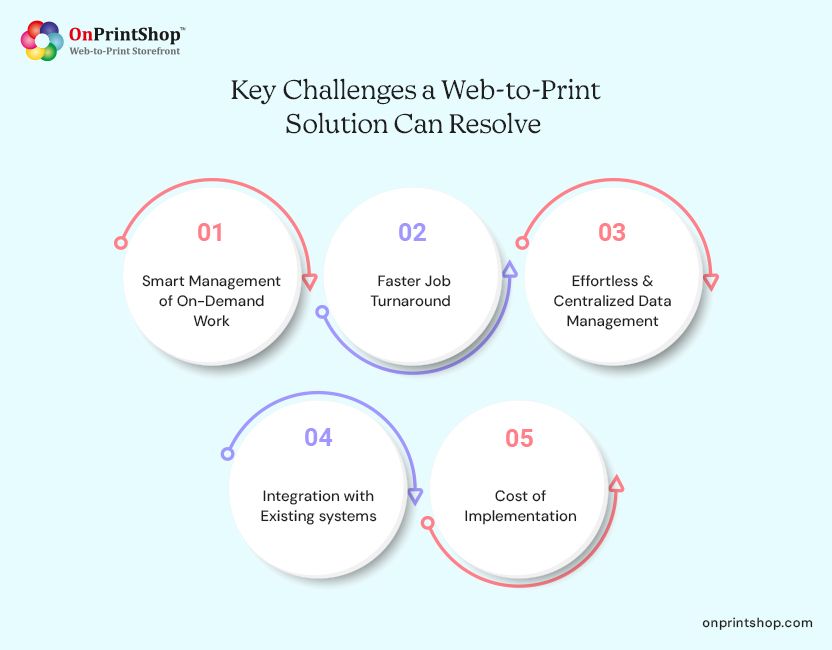
Smart Management of On-Demand Work
Managing a high volume of on-demand print orders manually is time-consuming and error-prone. Modern web-to-print ecommerce solutions streamline print-on-demand operations through AI-based design recommendations, automated image enhancement tools like instant background removal, automation-driven proofing, and predictive analytics for demand forecasting. These capabilities reduce production delays and improve order accuracy at scale.
Accelerated Print Job Turnaround Times
Print business owners can utilize web-to-print solutions to remove inefficiencies in workflow management, reduce errors in order processing and effectively meet tight deadlines. With automatic approvals, AI-driven job scheduling to prioritize urgent orders, intelligent resource allocation, effortless integration with shipping and logistics provider, web-to-print solutions can ensure faster turnaround times.
Effortless & Centralized Data Management
Print businesses managing orders across multiple sales channels often struggle with fragmented data, delayed updates, and fulfillment errors. Next-gen print order management software solve this by centralizing all order data, design assets, and customer information in a single system with real-time synchronization. This unified approach to print order management reduces operational overhead and makes multi-channel selling far more manageable.
Integration with Existing Systems
Many print business owners utilizing traditional printing methods struggle to integrate new technologies with their existing systems like CRM, ERP and MIS, making it difficult to centralize data and operations. However, modern systems support powerful web to print integrations with existing as well as third-party applications, ensuring a smooth transition and providing opportunities for scalability.
Cost of Software Implementation
The upfront cost of adopting new print technology is a genuine concern, particularly for small and mid-sized print businesses. The advantage of modern web-to-print platforms is a modular pricing model, where businesses pay only for the features they need and scale their subscription as their operations grow. The long-term efficiency gains, reduced manual labor, and increased order capacity typically offset the initial investment within a reasonable timeframe.
The Bottom LineThe web-to-print industry is evolving quickly, and the gap between businesses using automated, cloud-based W2P platforms and those relying on traditional print workflows is widening. Print businesses that adopt these technologies gain measurable advantages in speed, personalization capability, cost efficiency, and customer experience.OnPrintShop offers end-to-end print automation and scalable W2P features built to address the specific needs of commercial print businesses, trade printers, and print-on-demand operations. With regular platform updates that reflect current market trends, OnPrintShop helps businesses stay operationally relevant in a competitive print landscape.If you are evaluating a web-to-print partner, request a demo with OnPrintShop to see how W2P technology can restructure your print workflows and support sustainable business growth.