



Blog Summary: Digital storefronts help print providers sell, customize, and manage print orders online with speed and automation. This blog explains how they solve key business challenges, boost revenue, support different print models, and leverage AI for smarter workflows. Curious how they transform print businesses? Keep reading till the end.
The print industry has quietly undergone one of its biggest shifts in decades. As buyers move online and expect the same convenience they get from ecommerce brands, traditional print shops are realizing that phone calls, PDFs, and email approvals can no longer keep up. As a result, experts have estimated that the global online print service market is expected to reach USD 59.64 billion by 2030.
This is where the custom digital storefront for print providers has emerged, not just as a website, but as the engine driving sales, efficiency, and scalability for modern printers.
Let’s walk through what digital storefronts are, why they matter, and how printers are using them to transform everyday workflows into predictable growth.
What Is a Digital Storefront in the Print Industry?
A print digital storefront is an online platform that allows customers to browse products, configure print specifications, place orders, upload artwork, approve proofs, and track jobs. Think of it as an ecommerce site that’s tailored to the complexities of print production.
Unlike a static website, a web-to-print storefront is deeply connected to pricing, production workflows, and customer preferences. A robust web-to-print solution for personalized products supports everything from business cards and booklets to wide-format signage. This is why many refer to it as a web-to-print digital storefront rather than a simple online shop.
In short, it replaces fragmented communication with a single, interactive ordering experience.
Before we dive deeper into what makes these storefronts so transformative, let’s look at why they’re quickly becoming essential, not optional, for forward-thinking printers.

Why Digital Storefronts Are Becoming the New Growth Engine for Print Providers
Digital storefronts are becoming the new growth engine for print providers, as they have made the print industry faster, as buyers can buy customized print products around the clock, and printers can easily accept orders without losing sleep. Here are the aspects that have made digital storefronts one of the leading trends in the print industry.
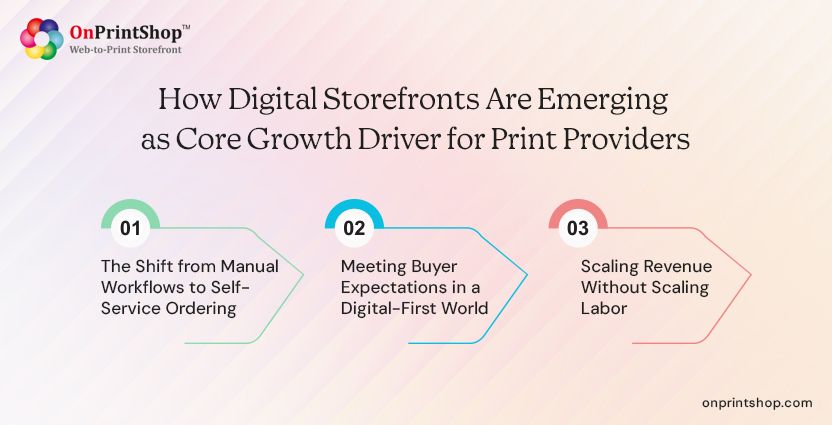
The Shift from Manual Workflows to Self-Service Ordering
Today’s print buyers increasingly prefer online print storefront experiences where they can configure, preview, and order instantly, without waiting on back-and-forth communication. This self-service nature makes a digital storefront for print providers the modern equivalent of a 24/7 sales team.
Meeting Buyer Expectations in a Digital-First World
Buyers now expect transparency, instant pricing, and easy reordering, because that’s what ecommerce has trained them to expect. A web-to-print storefront offers exactly this: a guided experience where complexity is handled behind the scenes. The ability to simplify buying while still supporting customization is how a web-to-print digital storefront becomes a core growth channel rather than just an add-on website.
Scaling Revenue Without Scaling Labor
Operational leverage is one of the biggest advantages. Once the storefront is live, additional orders don’t require proportional staff increases. Approvals happen automatically, and production files flow directly to print. That’s why many printers now see the print digital storefront as the engine driving predictable, sustainable growth.
Key Business Problems Digital Storefronts Solve for Printers
Digital storefronts address everyday operational challenges that slow print businesses down by replacing fragmented, manual processes with structured, automated workflows that improve efficiency, accuracy, and long-term customer satisfaction.
Reducing Administrative Overload
A web-to-print storefront solution that automates quoting, handling revisions, and shipping cuts enormous amounts of time from the print turnaround. Customers configure specs, view pricing instantly, and upload files directly, reducing the constant follow-ups that strain staff resources.
Eliminating Errors and Rework
A cutting-edge design proofing web-to-print solution supports proof approvals, file checks, and standardized product templates. This reduces misprints, incorrect specs, and costly do-overs. When customers approve online proofs, accountability becomes clearer, and workflows become smoother.
Improving Customer Experience and Retention
Corporate clients value ease, speed, and visibility. A digital storefront for print providers gives them role-based access, order history, and consistent pricing. For retail buyers, it delivers clarity and ease of customization. Better experiences lead to higher repeat business and stronger long-term relationships.
Features That Make a Print Digital Storefront Revenue-Driven
These features turn a digital storefront into an active sales channel by guiding buyer decisions, reducing purchase hesitation, and ensuring every order moves smoothly from selection to fulfillment without unnecessary delays.
Guided Product Configuration and Real-Time Pricing
A revenue-driven online print storefront simplifies complex print pricing. Customers can choose sizes, materials, finishes, and quantities while seeing instant pricing changes. This reduces friction, increases order confidence, and encourages upgrades.
Built-In Personalization and Design Tools
Personalization sells. A web-to-print storefront typically includes online design tools, artwork uploads, and live previews. This makes it easy for non-designers to create professional-looking products and unlock new customer segments.
Workflow Automation and Order Tracking
Automation is where printing storefront solutions truly shine. Orders flow from checkout to production with minimal manual intervention. Customers can track orders, while print shops gain visibility across every stage. The result is higher throughput with fewer touchpoints.

Digital Storefronts for Different Print Business Models
Digital storefronts are flexible by design, allowing print businesses to tailor ordering experiences, pricing logic, and workflows to match how different customer types buy, reorder, and manage print at scale.
B2C Retail Print Businesses
Retail printers benefit from easy customization, fast checkout, and visually engaging product catalogs. A new-age B2C digital storefront for print providers focuses on clarity, previews, and upsell options like finishes or bundles.
B2B Corporate Printing
Corporate clients often need branded portals, contract pricing, approval hierarchies, and repeat ordering. An advanced B2B print storefront platform makes it possible to create dedicated portals for each client, keeping workflows controlled and consistent.
Trade Printers and Wholesale
Trade printers need reseller pricing, white-label fulfillment, and bulk workflows. A web-to-print digital storefront supports role-based access and partner-friendly experiences to help scale reseller networks with less friction.
The Role of AI in Modern Digital Storefronts
AI adds intelligence to digital storefronts by continuously optimizing decisions, reducing manual intervention, and enabling print businesses to respond faster to customer needs and market demand without increasing operational complexity.
Smarter Workflows and Faster Decisions
AI-powered tools embedded in printing storefront solutions can automate pricing assistance, suggest configurations, and recommend related products. This helps customers complete orders faster while increasing average order values.
AI-Enhanced File and Content Handling
AI improves artwork prep, translation, and content generation that making it easier for customers to place orders and for printers to manage global storefronts. This enhances both operational efficiency and customer accessibility.
Data-Driven Personalization
A modern web-to-print storefront can learn from customer behavior, suggesting reorder reminders, personalization prompts, and optimized pricing. AI turns data into real-time business intelligence.

Common Mistakes Printers Make When Launching Digital Storefronts
Many digital storefront challenges arise not from the technology itself, but from a lack of planning, unrealistic expectations, and insufficient internal and customer readiness during the launch and adoption phase.
Treating the Storefront as “Just a Website”
A web-to-print store is a business system, not a static website. Printers sometimes underestimate onboarding, change management, and internal training, leading to poor adoption.
Overcomplicating the Initial Setup
Trying to launch every product at once can overwhelm teams. The key is starting with high-impact, repeat-order items, then scaling gradually as confidence grows.
Forgetting Marketing and Customer Education
Even the best online print storefront needs promotion. Customers must be guided toward self-service ordering with training, email reminders, and incentives for online use.
How to Choose the Right Digital Storefront Platform
Many digital storefront challenges arise not from the technology itself, but from a lack of planning, unrealistic expectations, and insufficient internal readiness during the printing storefront launching process. So, here are the aspects you need to consider before choosing a digital storefront platform for your print business.
Evaluate Print-Specific Capabilities
Not all ecommerce systems understand print. A print digital storefront should support pricing complexity, artwork handling, proofing, and production workflows natively. Review how the top web-to-print software compare on these critical capabilities.
Consider Scalability and Integration
Your print storefront platform should grow with your business. APIs, MIS/ERP integrations, and modular features help ensure long-term adaptability rather than constant reinvestment.
Support, Training, and Partnership Matter
The right provider isn’t just software, it’s guidance. Printers benefit most when the platform partner understands evolving print business needs and supports ongoing optimization.
Wrapping It Up!Digital storefronts have transformed from “nice to have” into the core operating system for modern printers. A customized digital storefront for print providers doesn’t just enable online ordering; it improves productivity, enhances customer experience, supports new revenue streams, and future-proofs the business.As more buyers choose digital-first interactions, printers who embrace digital storefronts for print businesses will continue to lead the industry forward. If you’re ready to see how a powerful web-to-print storefront can streamline operations and drive scalable growth, explore how OnPrintShop’s printing storefront solutions can support your journey, and book a demo today.