



Summary: Building a profitable print-on-demand business in 2026 requires more than the right equipment. It requires staying current with the trends, technologies, and market shifts defining the POD sector. This blog covers the key print-on-demand trends shaping 2026, how AI is transforming POD operations, industry-specific use cases, and what to watch out for when transitioning from traditional print models.
Customer expectations have changed significantly. Buyers now expect to decide what they want, how it looks, and when it arrives, and they prefer brands that deliver on all three. For print businesses, this shift makes the print-on-demand model not just viable but strategically necessary.
Print-on-demand gives businesses control over production timing and inventory levels while enabling the kind of personalized, on-demand ordering experience customers expect. But to run a competitive POD operation, staying informed about current industry trends is just as important as having the right web-to-print solution in place. This blog covers the POD market data, emerging trends, AI capabilities, and practical considerations that matter most for print service providers in 2026.
Global Print-on-Demand Market Overview
The print-on-demand market has expanded rapidly alongside the growth of online shopping and consumer demand for personalized products. Here is a snapshot of the market size, growth trajectory, and regional breakdown.
Print-on-Demand Market Statistics & Growth
The global print-on-demand market is projected to grow from USD 15.19 billion in 2026 to USD 46.43 billion by 2031, at a CAGR of 25.05%. This growth is driven by rising demand for personalized apparel, home décor, accessories, and drinkware across both consumer and B2B markets.
For print businesses, the POD model offers clear financial advantages over traditional bulk production: lower upfront investment, reduced inventory carrying costs, lower risk of unsold stock, and the ability to scale without major capital expenditure. Faster time-to-market and improved customer experience are additional operational benefits that compound over time.

Print-on-Demand Market by Region
Adoption rates and growth drivers vary meaningfully by region. Here is a detailed breakdown of the POD market by geography.
How AI is Transforming Print-on-Demand in 2026
AI is having a measurable impact on print-on-demand operations across three core areas: design personalization, prepress preparation, and production management. Here is how each area is changing.
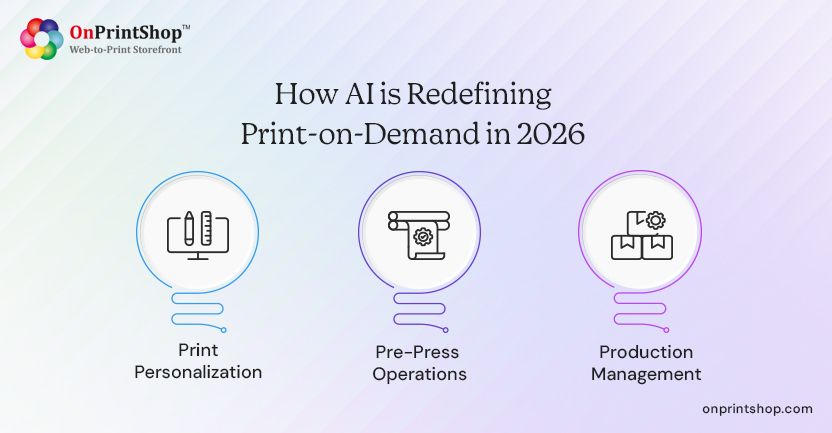
1. Print Personalization
AI tools embedded in web-to-print platforms are making design personalization faster and more accessible for both print businesses and their customers. Key capabilities include:
- Input simple commands prompts to the AI system to generate professional-grade designs in no time.
- Instantly remove background images and enhance the quality of images using AI technology.
- Leverage AI-automation for translating the content in the print designs to multiple languages.
- Identify trending design elements in the industry for the creation of unique pattern products.
2. Pre-Press Operations
AI is reducing the manual effort and error rate associated with file preparation and quality control before a job reaches production. Key capabilities include:
- AI-based file preparation and validation to fix issues like missing fonts or low-resolution images.
- Advanced proofing methods with AI-backed systems that allow you to generate accurate print proofs.
- Automated color management to achieve consistent colors across print files and equipment.
- Quality control mechanisms to ensure the design file meets the exacts quality needs before printing.
3. Production Management
On the production side, AI enables smarter scheduling, resource allocation, and equipment management. Key capabilities include:
- Smart inventory management systems to forecast demand and keep track of inventory levels via trends and buying patterns.
- Production scheduling of print jobs based on real-time print demand and analytical data.
- Automation-focused AI algorithms to optimize resources and reduce material wastage.
- AI-powered predictive maintenance to reduce equipment downtime by analyzing machine data in real time.
Print businesses that have integrated AI into their POD workflows are seeing measurable improvements in throughput, error rates, and operational costs. As AI capabilities in print technology continue to advance, the gap between AI-enabled operations and those relying on manual processes is likely to widen.
Top Print-on-Demand Trends in 2026
Several significant shifts are underway in the print-on-demand industry. Here are the key POD trends that print service providers need to understand and act on in 2026.
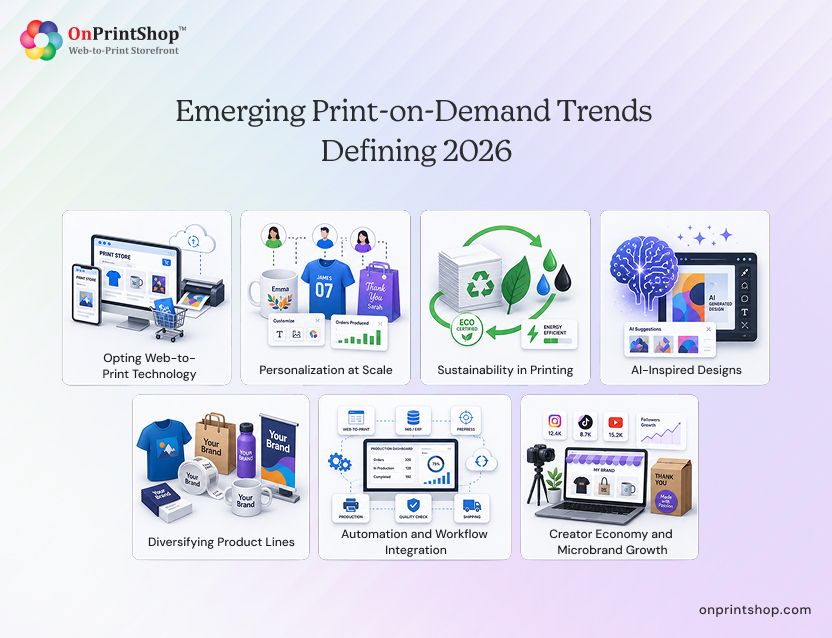
1. Opting Web-to-Print Technology
Web-to-print technology has become the operational backbone of most successful print-on-demand businesses. By providing customers with a self-service online ordering experience and automating back-end tasks like job routing, prepress, and order management, W2P platforms make it practical to run a high-volume POD operation without proportional increases in staff.
The adoption of modern print ecommerce solutions built on web-to-print is accelerating because the operational case is straightforward: fewer manual steps, fewer errors, and greater scalability.
2. Personalization at Scale
AI-driven personalization tools built into leading web-to-print platforms in 2026 are allowing print service providers to offer mass customization across product categories including apparel, packaging, and marketing materials. The practical advantage is that personalized products can now be produced at the speed and cost structure of standard print runs, making one-to-one personalization commercially viable at volume.
3. Sustainability in Printing
Environmental consciousness among consumers and businesses is pushing print service providers to adopt more sustainable production practices. In POD specifically, digital proofing eliminates the need for paper-based physical proofs, reducing material waste significantly, are some of the sustainability benefits of a POD business.
Web-to-print systems that support digital approval workflows help POD businesses reduce their environmental footprint while also cutting the time and cost associated with traditional proofing processes.
4. AI-Inspired Designs
AI design generation tools allow print businesses and their customers to produce unique, production-ready artwork from simple text prompts in seconds. For POD businesses, this reduces dependence on external design resources and lowers the barrier for customers who want fully custom products but lack design skills. It also speeds up the product creation process for print businesses expanding into new categories.
5. Diversifying Product Lines
The range of products viable for print-on-demand production has expanded well beyond the traditional categories of t-shirts, mugs, and canvas prints. Print businesses are now offering POD across textiles, labels, stickers, packaging, documents, and promotional items.
Expanding the product catalog through POD requires the right production partnerships and platform integrations but carries relatively low risk compared to traditional inventory-based product launches.
6. Automation and Workflow Integration
Automation is becoming a defining factor in the scalability of modern print-on-demand businesses. Advanced web-to-print platforms now integrate directly with production equipment, shipping providers, payment gateways, and third-party ecommerce systems to automate tasks such as job routing, file preparation, inventory synchronization, and order tracking.
For POD businesses, automated workflows reduce manual intervention, improve production accuracy, and shorten turnaround times. As order volumes continue to increase across ecommerce channels, workflow automation is helping print service providers scale operations more efficiently without proportionally increasing operational overhead.
7. Creator Economy and Microbrand Growth
The growth of the creator economy is creating new opportunities for print-on-demand businesses as influencers, independent artists, content creators, and niche ecommerce brands increasingly launch their own custom merchandise lines. POD allows these businesses to sell branded products without maintaining inventory or investing in large upfront production runs.
Modern web-to-print platforms and ecommerce integrations make it easier for creators to launch online storefronts, manage orders, and fulfill customized products at scale. For print service providers, supporting creator-led commerce opens access to a rapidly expanding market driven by direct-to-consumer selling and personalized brand experiences.
Industry-Wise Use of Print-on-Demand
Print-on-demand is a versatile model with meaningful applications across a wide range of industries. Here is how different sectors are using POD effectively in 2026.
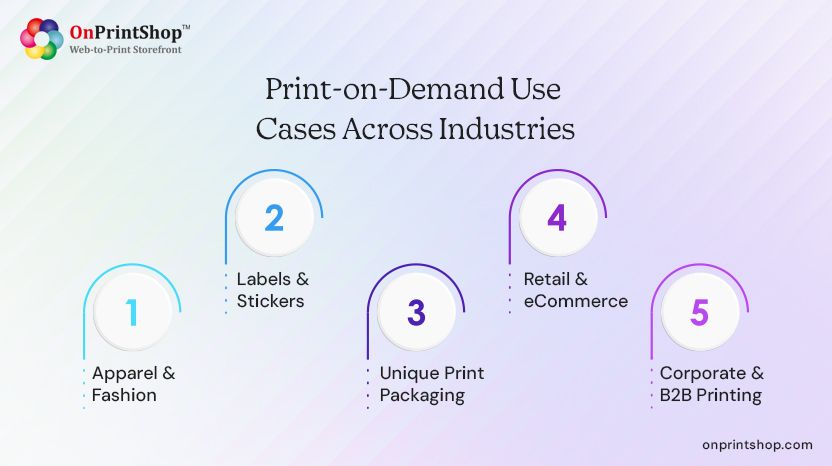
1. Apparel & Fashion
Print-on-demand model is widely used in the apparel and fashion industry to produce clothing items in small batches without holding much inventory. This approach allows businesses to quickly respond to the changing customer demands and print varied unique apparels.
Key Use Cases:
- Limited-Edition Apparel Drops: Brands can launch limited-edition apparel specific to seasons or inspired by influencers.
- Custom Sportswear and Uniforms: Gyms and sports associations can personalize sportswear and uniforms based on branding.
- On-Demand Trend-Based Fashion: Fast fashion brands can produce on-demand and viral apparels such as with meme design or a popular color trend.
2. Labels & Stickers
Printers in the labels and packaging industry are adopting POD model and leveraging high-tech label and sticker printing solutions to produce short-run and highly personalized print products. Businesses utilize this model to tailor items for specific campaigns and seasonal demands.
Key Use Cases:
- Personalized Product Labels: The POD model allows printers to print a small batch of labels for food, beverages, and cosmetics with variable data such as names and unique promotions.
- Shipping and Logistics Labels: Print ecommerce business owners can offer shipping and logistics labels with brand logos, QR codes, and product details for providing consistent branding and sharing necessary details.
- Marketing Giveaways: Since stickers and labels are low-cost but are an effective marketing tool for brand visibility, printers can print these products for applications in campaigns, tradeshows, or give as freebies with print purchases.
3. Unique Print Packaging
Driven by the demand for shorter runs, faster turnaround, and personalized packaging, the packaging industry is adopting the print-on-demand approach. Printers can produce varied types of packaging products including boxes, labels, wraps, and even corrugated packaging.
Key Use Cases:
- Personalized Packaging: Printers can provide tailored packaging to customers such as using variable data printing, special messages, and localized designs that enhance the unboxing experience.
- Limited-Edition Packaging: It allows printers to print limited edition print items for seasonal campaigns such as holidays, anniversaries, or product launches.
- Sustainable Packaging: Eco-conscious brands can print packaging made of sustainable materials in smaller quantities based on the demand.
4. Retail & eCommerce
Online marketplaces and independent retailers are turning to this model due to its increased flexibility and reduced financial risks. It enables the delivery of professional-grade prints directly to the end customer with minimal investment.
Key Use Cases:
- Customized Merchandise: Retailers utilize this model to offer customized merchandise like phone cases, mugs, apparel, tote bags, stationery, greeting cards, and more.
- Home & Lifestyle Products: Printers can offer everyday products like wall art, decor, pillows, blankets, and kitchenware items like aprons and cutting boards.
- Cross-Border & Multilingual Prints: It allows printers to offer localized products with culturally relevant and region-specific designs for international customers.
5. Corporate & B2B Printing
Businesses in the B2B and corporate sector widely adopt the print-on-demand model to deliver personalized items. This model gives printers complete control over the costings, inventory, and brand consistency.
Key Use Cases:
- Branded Merchandise: This model makes it convenient to print branded merchandise items like pens, notebooks, and t-shirts for corporate applications.
- Business Collateral: Personalized print items like brochures, flyers, and business cards are widely printed in this model.
- Event-Specific Materials: It's perfect for printing signages, banners, and posters for trade shows, conferences and other campaign-specific events.

Traditional Print vs Print-on-Demand: Pitfalls to Avoid
Traditional bulk print workflows were built for a market where volume drove unit cost down and predictable demand made large inventory practical. That model creates real operational challenges in today's environment, where product variety, short run lengths, and fast turnaround are standard client expectations.
Pitfalls of Traditional Print Models
Traditional print workflows pose challenges like -
- High upfront costs
- Inventory management
- Risk of overproduction
- Less flexibility
On the contrary, a print-on-demand model enables you to print only the required products. This prevents you from issues like overstocking unnecessary inventory and wastage on expenditures.
Pitfalls to Avoid When Switching to POD
- Use the Right Technology
When switching to a print-on-demand model, ensure to select and adopt the right technology that suits your unique needs. An advanced web-to-print software for print-on-demand automation can streamline your workflow and help you drive maximum ROI.
- Leverage Integrations for Fulfillment
While print-on-demand gives you control over your operational costs and inventory levels, it is necessary that you are partnered with the best shipping and logistics providers. This will ensure timely delivery of your products and happy customers.
- Measure and Optimize your Workflow
Use new-age reporting and analytics tools to measure the performance of your print-on-demand workflow. Track metrics like the turnaround time, reprint rate, profit margin per product, repeat purchase rate, abandoned cart rate and more.
ConclusionPrint-on-demand has become a core operating model for print businesses that want to stay competitive in 2026, not an alternative approach for edge cases. The combination of AI-driven personalization, POD specific web-to-print automation solutions, sustainable production practices, and an expanding product range has made POD viable across more industries and product categories than ever before.OnPrintShop supports print-on-demand operations with web-to-print capabilities tailored to the specific workflow and scalability needs of POD businesses. To see how the platform handles your production requirements, book a demo with OnPrintShop today.