


Summary: The large format printing industry is evolving quickly, with new technologies and production trends reshaping how printers operate and what clients expect. This blog covers the key large format printing trends to watch in 2026, along with a practical look at how AI is transforming design, production, and ecommerce in this segment.
The large format printing industry is entering 2026 with strong momentum. The global large format print market is projected to reach USD 10.36 billion by 2030, driven by shifting customer expectations, increased competition, and continued advances in print technology.
Print businesses that adopt futuristic large format printing software are better positioned to serve clients efficiently and adapt to changing market demands. For growing print providers, understanding which trends are gaining traction in this niche is a practical competitive advantage.
Below are the most important large format print trends shaping the industry in 2026, followed by a detailed look at how AI is transforming operations across the sector.
Key Large Format Printing Trends to Watch in 2026
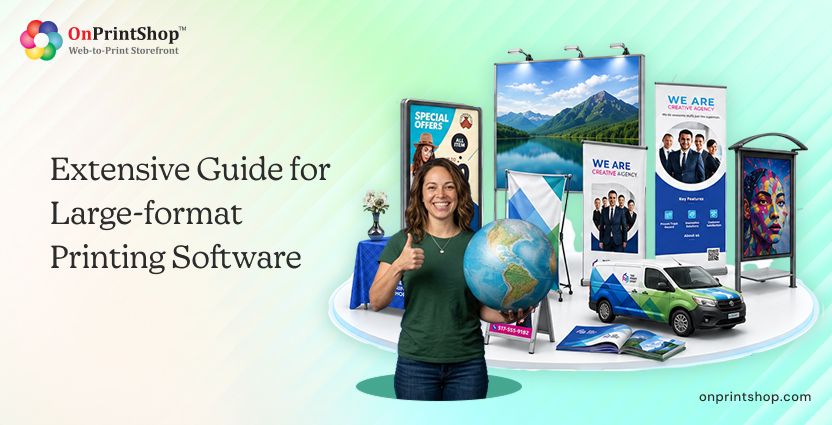
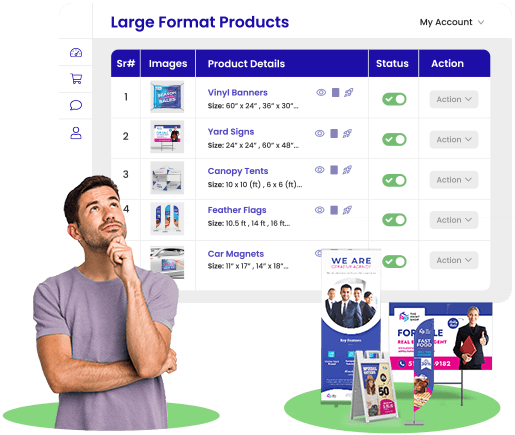
Large format prints serve a wide range of industries including retail, advertising, events, real estate, construction, hospitality, and tourism. Across all of these segments, several core trends are defining how print businesses operate and compete in 2026.
1. Personalization & Customization
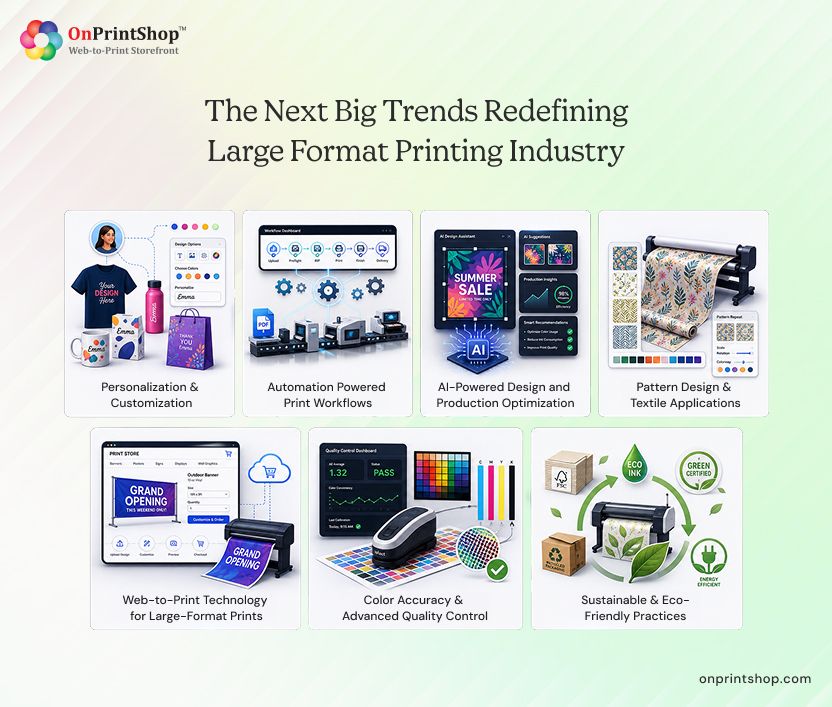
Customer demand for personalized large format prints is growing alongside the rise of online ordering. Print businesses are responding by offering pre-designed templates, advanced design personalization tools, and configurable options for material selection, dimensions, and layout. For wide format printers, the ability to deliver one-off and customized prints through a streamlined online experience is increasingly a baseline client expectation, not a premium feature.

2. Automation Powered Print Workflows
Manual steps in wide format print workflows create bottlenecks that slow turnaround times and introduce errors. Automated print workflow systems reduce these friction points by handling job routing, prepress checks, and production scheduling without manual intervention. The result is faster output, fewer reprints, and improved capacity to handle higher order volumes without proportional increases in labor.
3. AI-Powered Design and Production Optimization
Artificial intelligence is becoming an increasingly valuable tool in large format printing, helping businesses simplify both design creation and production planning. AI-powered tools can generate artwork variations, enhance image quality, remove backgrounds, and assist customers with design customization, reducing the time required to prepare print-ready files.
For print businesses, AI also supports more efficient production by improving job estimation, reducing design bottlenecks, and helping teams process a higher volume of orders with greater accuracy.
4. Pattern Design & Textile Applications
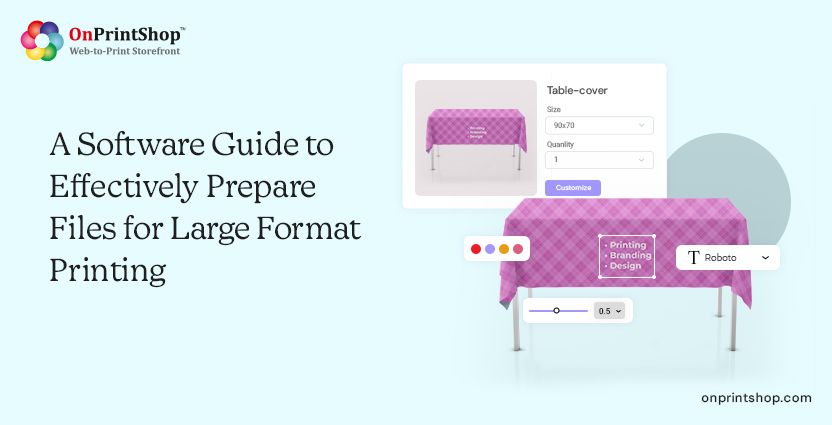
Large format printing is expanding beyond traditional signage and banner applications into patterned textile products including wallpapers, curtains, event décor fabrics, table covers, and bedding. Print businesses entering this product segment are adopting purpose-built pattern design software that handles repeat tiling, material-specific color profiles, and large-scale layout requirements. This diversification opens new revenue streams without requiring entirely new production infrastructure.
5. Web-to-Print Technology for Large-Format Prints
Clients ordering large format prints increasingly expect a fully self-service experience, from design creation and 3D visualization to approval, payment, and order tracking, all within a single online platform. Modern web-to-print software built for large format applications delivers this end-to-end experience, reducing the back-and-forth typically associated with custom print orders and minimizing production errors caused by miscommunication.
6. Color Accuracy & Advanced Quality Control
Maintaining consistent color across different substrates and large print sizes is one of the most common technical challenges in wide format production. Inconsistent file handling and the absence of centralized color profiles lead to output that does not match client-approved designs.
Print businesses are addressing this by implementing one of the wide-format printing trends 2026, i.e., advanced color management systems that enforce color precision, standardize profiles across substrates, and flag inconsistencies before a job goes to press.
7. Sustainable & Eco-Friendly Practices
Demand for sustainable large format printing is growing from both clients and production teams. Practical steps include adopting eco-certified substrates and inks, reducing overproduction through better demand forecasting, and using new-age design proofing tools to catch errors before production begins.
Fewer reprints and less material waste translate directly into a lower carbon footprint and lower production costs, making sustainability an operational advantage as much as an ethical one.

How AI is Transforming Large Format Printing in 2026
AI is being integrated into large format printing at multiple points in the production and sales process. From automating design creation to improving storefront discoverability and personalizing product recommendations, AI tools are changing how print businesses operate and how clients experience the buying process. Here is a closer look at the specific capabilities making an impact.
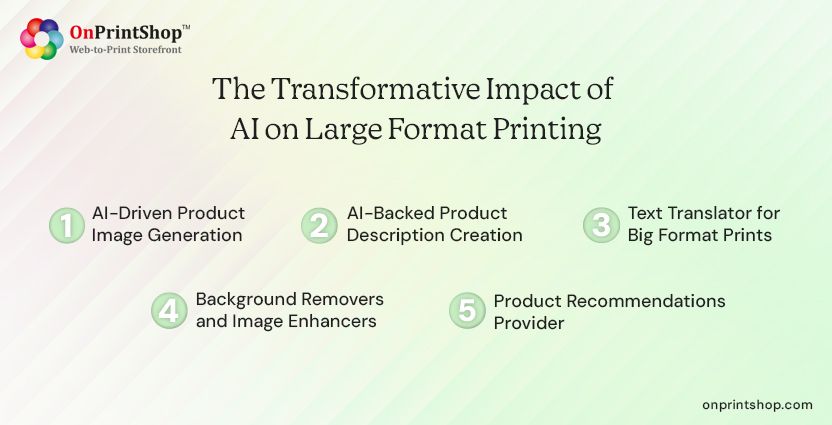
1 AI-Driven Product Image Generation
AI-powered design tools built into web-to-print platforms allow print businesses and their clients to generate professional-grade product images from simple text prompts. For large format products like banners, posters, signage, floor graphics, and wallpapers, this capability significantly reduces design time and lowers the barrier for clients who lack in-house design resources. Thus, AI implementation in w2p transformed print customization.
2. AI-Backed Product Description Creation
Generating accurate, search-optimized product descriptions for a wide format print catalog is time-consuming when done manually. AI-driven description generation tools create SEO-friendly copy based on product specifications and imagery, reducing the time required to set up or expand a print ecommerce storefront. When combined with AI image generation, these tools can cut storefront setup time by up to 70%, according to operational data from web-to-print deployments.
3. Text Translator for Big Format Prints
Large format products like billboards, trade show displays, and retail signage frequently require content in multiple languages for international campaigns. Manually retranslating and reformatting these files is labor-intensive and prone to layout errors. AI-powered translation tools automate this process, preserving the original design structure while replacing text content, making it practical for print businesses to serve multinational clients without significant additional production overhead.

4. Background Removers and Image Enhancers
Large format prints are viewed at distance, which makes image clarity and clean composition especially important. AI background removal tools allow clients to eliminate distracting or mismatched backdrops from their artwork before submitting it for production.
AI image enhancement tools improve resolution and correct quality issues in low-grade source files, enabling clients to achieve production-ready results without requiring professional design intervention.
5. Product Recommendations Provider
AI-powered recommendation tools analyze customer browsing and purchasing behavior to surface relevant large format products at the right point in the buying journey. For print businesses, this means the ability to present reorder suggestions, cross-sell complementary products, and highlight newly launched items automatically. The practical outcome is a higher average order value and more repeat purchases from existing clients.
Wrapping It Up!The large format printing industry is evolving steadily, and the businesses that track and act on emerging trends are the ones best positioned to grow their client base and protect their margins. From print automation and web-to-print ecommerce to AI-driven design tools and sustainable production practices, the operational capabilities available to large format printers in 2026 are more powerful than ever.OnPrintShop offers large format printing software built specifically for the needs of wide format print businesses, with regular updates that reflect current market and technology trends. If you have not yet explored OnPrintShop's large format capabilities, request a personalized demo to see how the platform can support your production workflow and business growth goals.