



Blog Summary: Manual order processes are quietly costing print businesses time, revenue, and customers. This complete 2026 guide breaks down what print order management software is, how it works, what to look for, and how AI is redefining the standard. Read on to future-proof your print operations.
Manual order entry errors, disconnected spreadsheets, delayed fulfillment, and inconsistent customer communication are the four silent killers of print business growth. As order volumes scale, these issues compound fast, and no amount of additional headcount fully solves them.
The global printer market is valued at $2.54 billion in 2025 and is projected to reach $5.13 billion by 2034 at a CAGR of 8.13%. Print businesses that fail to modernize their order operations risk losing ground to leaner competitors already running on automated systems.
Advanced print order management software gives print service providers centralized control over every order, from intake to invoicing, without adding operational complexity.
Understanding why print order management is necessary is the first step toward building a print operation that can scale.
This guide covers everything from the basics of the print order management system (POMS) to how AI is transforming print order management in 2026.
What Is Print Order Management Software?
Print order management software (POMS) is a specialized platform that automates and centralizes the entire print order lifecycle, from order intake and file validation through production scheduling, fulfillment, and invoicing, enabling print businesses to reduce manual errors, improve turnaround times, and scale operations efficiently.
POMS is often used interchangeably with Print MIS (Management Information System) and Print ERP (Enterprise Resource Planning), though these terms reflect distinct scopes. Print MIS focuses on internal production job costing and scheduling. Print ERP covers full enterprise functions including HR and finance. POMS specifically manages the order lifecycle from the customer's first touchpoint through delivery.
Modern platforms like OnPrintShop combine POMS and Print MIS capabilities in a single solution, giving print businesses both customer-facing order management and internal production visibility without managing two separate systems.
In 2026, POMS is no longer a back-office tool. It is the operational backbone of digital-first print businesses.
Signs Your Print Business Needs Order Management Software
Most print businesses don't realize they need POMS until the operational gaps become customer-facing problems. These are the clearest diagnostic signals:
- You manage orders through email, spreadsheets, or phone calls and regularly lose track of job status or miss production deadlines.
- Customers frequently contact you asking "where is my order?" because there is no automated status notification system in place.
- Production mistakes occur due to miscommunication between your sales team and press floor, often caused by manual job ticket handoffs.
- Quoting and invoicing are slow and error-prone, leading to pricing inconsistencies, delayed approvals, and strained customer relationships.
- You cannot absorb order volume growth without a proportional increase in headcount, indicating your process does not scale.
- You have no visibility into job profitability or turnaround time at the individual order level, making it impossible to identify where margins are being lost.
If three or more of these describe your operation, you are already behind the efficiency curve that modern print order management software addresses directly.
How Print Order Management Software Works
Print order management software works by automating each stage of the print production lifecycle through a connected, sequential workflow. Here is how each step functions in practice:
1. Order Intake:
The system centralizes orders arriving from all sales channels: web storefronts, phone, email, Shopify, WooCommerce, and direct B2B portals. This eliminates siloed order entry and gives staff a single queue to manage, reducing the risk of missed or duplicated orders.
2. Order Validation
Approval workflows verify that customer-submitted files and order specifications meet baseline requirements before advancing. This catches format mismatches, incorrect pricing configurations, and incomplete job details before they reach production.
3. AI-Powered Preflight & File Validation
Automated preflight tools check uploaded artwork for resolution, bleed, color mode, font embedding, and print-ready compliance. AI preflight catches issues that manual review misses, reducing artwork revision cycles by up to 50-60% and preventing costly reprints.
4. Job Ticket Creation
The system auto-generates structured job tickets containing all production specifications: substrate, size, finishing, quantity, delivery date, and SLA requirements. This eliminates the manual ticket writing that creates miscommunication between sales and production.
5. Production Scheduling
Jobs are automatically assigned to departments (prepress, press, finishing) based on workload, equipment availability, and priority. Integration with JDF/JMF-compatible production systems allows direct communication with press controllers, reducing scheduling delays.
6. Real-Time Order Tracking:
Both internal teams and customers receive live order status updates at each production milestone. SLA tracking flags jobs at risk of missing delivery commitments before they breach, giving production managers time to intervene proactively.
7. Shipping & Fulfillment
The platform integrates with logistics and shipping partners to generate labels, assign tracking codes, and trigger customer delivery notifications automatically. This removes the manual handoff between production completion and dispatch.
8. Invoicing & Performance Reports
Upon job completion, the system generates invoices and performance analytics covering turnaround time, order volume, job profitability, and product performance. These reports give print business owners the data needed to make operational improvements continuously.

Key Benefits of Print Order Management Software
The measurable impact of POMS extends across accuracy, speed, cost, and customer experience. Each benefit below is grounded in operational outcomes, not theoretical gains.
Improved Order Accuracy and Consistency
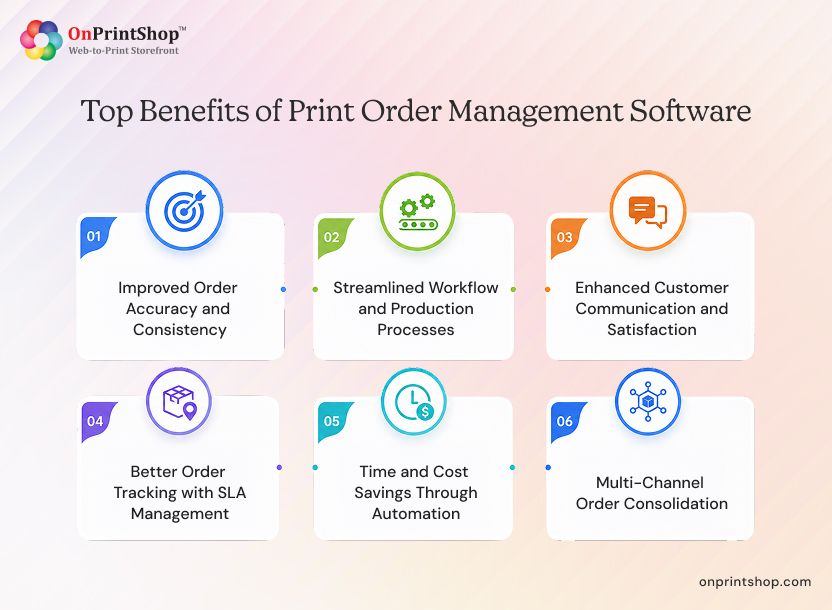
Automated workflows and AI preflight eliminate manual entry errors across the order lifecycle. Businesses implementing AI-powered file validation report up to 70-80% reduction in print-ready file errors, directly cutting reprint costs and customer complaints.
Streamlined Workflow and Production Processes
Automating order intake, job ticket creation, and production routing reduces order processing time by up to 85%. Production teams spend less time chasing information and more time running jobs efficiently through to completion.
Enhanced Customer Communication and Satisfaction
Automated order status notifications reduce inbound customer service calls by 50-60%. Customers receive proactive updates at every production milestone, which builds trust and reduces the friction that often leads to customer churn.
Better Order Tracking with SLA Management
Real-time tracking and built-in SLA monitoring give production managers early warning when jobs are running behind. Escalation alerts prevent delivery failures before they happen, protecting both client relationships and business reputation.
Time and Cost Savings Through Automation
Print businesses using POMS get all the print automation benefits and eventually save 15-20 hours per week in manual data entry and administrative coordination.
Multi-Channel Order Consolidation
Modern POMS platforms consolidate orders from Shopify, WooCommerce, direct web storefronts, B2B portals, and phone/email channels into a single management dashboard. This eliminates the operational fragmentation that occurs when each channel is managed separately, and makes it far easier to manage bulk orders at scale.
Key Features of Print Order Management Software
The right POMS platform should cover the full operational spectrum of print order management. These are the features that separate capable solutions from generic order management tools:
Order Tracking and Status Updates
Tracks each job through every production stage with configurable status labels. Customers can check order status through a branded portal without contacting your team, reducing support overhead.
Automated Quoting and Estimating
Generates accurate pricing automatically based on substrate, quantity, finishing, and turnaround requirements. Smart print estimating software eliminates the back-and-forth quoting cycle that delays order confirmation and frustrates customers.
Inventory and Supply Chain Management
Monitors stock levels for substrates, consumables, and finished goods in real time. Automated low-stock alerts prevent production stoppages caused by unexpected material shortages.
System Integrations (MIS, CRM, Shipping, Payment)
Connects with CRM platforms, accounting systems, shipping gateways, payment processors, and eCommerce platforms. Deep integrations eliminate manual data re-entry between systems and create a continuous operational data flow.
Reports and Analytics
Provides visibility into order volume trends, product performance, turnaround time metrics, and job profitability. Data-driven reporting enables management to identify bottlenecks and optimize resource allocation.
AI-Powered Preflight and File Validation
Automated artwork review checks uploaded files against print specifications without manual intervention. This catches resolution issues, missing bleeds, incorrect color profiles, and font problems before they reach the press, protecting both quality and margins.
Customer Self-Service Portal
A branded portal where customers can place orders, upload artwork, approve proofs, track order status, and access order history independently. Self-service portals reduce customer service workload while improving the buyer experience significantly.
Multi-Channel Order Sync
Consolidates incoming orders from Shopify, WooCommerce, Magento, and branded storefronts into one management interface. Eliminates channel-specific order management silos and enables centralized production planning across all revenue streams.
Role-Based Access Controls
Defines user permissions by role (CSR, production operator, manager, finance) so each team member sees only the data and functions relevant to their responsibilities. This improves data security and reduces the risk of accidental order modifications.
How AI Is Transforming Print Order Management in 2026
AI has moved from optional enhancement to operational necessity in print order management. Businesses using AI-driven order processing report 40-50% faster order turnaround within the first month of deployment. Explore the full landscape of AI tools for printing businesses to understand how AI is reshaping the entire print workflow stack.
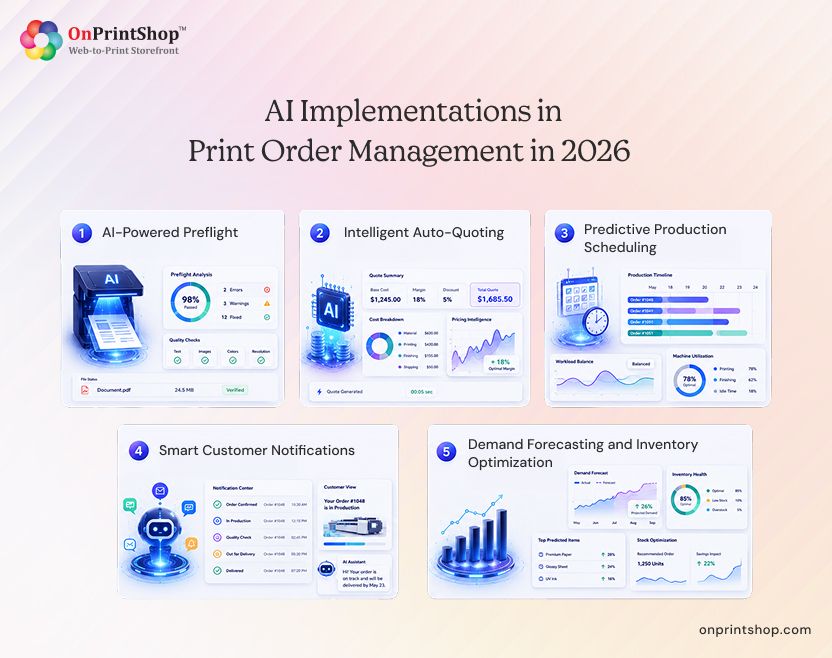
AI-Powered Preflight is the most immediately impactful application. Instead of a CSR manually checking each uploaded file, AI preflight engines analyze artwork against print specifications automatically, flagging resolution failures, incorrect bleed settings, and color mode mismatches in seconds. This reduces artwork revision cycles by up to 50-60% and prevents production errors that lead to costly reprints.
Intelligent Auto-Quoting uses AI to parse incoming quote requests, apply pricing rules, and generate accurate estimates instantly. This eliminates the manual quoting queue that slows sales velocity, particularly for B2B customers placing complex or variable specifications.
Predictive Production Scheduling analyzes current job queues, equipment availability, and historical throughput data to suggest optimal job sequencing automatically. This minimizes press downtime, reduces overtime, and helps production managers hit delivery commitments more consistently.
Smart Customer Notifications trigger personalized order status updates based on actual production milestones rather than pre-set time intervals. Customers receive relevant, accurate updates without any manual staff intervention, which reduces inbound status inquiries significantly.
Demand Forecasting and Inventory Optimization uses historical order data and seasonal patterns to model substrate and consumable requirements ahead of demand peaks. Print shops that pre-stock materials based on AI forecasting avoid the production delays and emergency purchasing costs that frequently erode margins during peak seasons.
OnPrintShop's modern print workflow automation integrates these AI capabilities directly into the order management workflow, enabling print businesses to automate the decisions that previously required constant manual oversight.
Types of Print Order Management Software
Print businesses can deploy POMS in four configurations, each suited to different infrastructure needs and organizational scales.
On-Premises
Installed and operated on the print business's own servers and infrastructure. On-premises POMS provides maximum control over data security, customization, and system performance. It is best suited to large enterprises with strict data sovereignty requirements or complex custom workflows that cannot be accommodated in a standardized cloud environment.
Pros: Full data control, deep customization, predictable long-term costs. Cons: High upfront investment, ongoing IT maintenance overhead, slower feature updates.
Cloud-Based / SaaS
Hosted and managed by the software vendor, accessible via browser from any location. Cloud POMS requires no infrastructure investment and updates automatically. Most modern print businesses prefer SaaS due to zero upfront infrastructure cost, automatic feature releases, and built-in vendor support.
Pros: Low upfront cost, remote access, automatic updates, scalable pricing. Cons: Requires reliable internet connectivity, less customization depth than on-prem.
SaaS / Subscription-Based
A specific delivery model within cloud POMS where businesses pay a monthly or annual subscription with no hardware requirements. Deployment is near-instant, support is included, and pricing scales with usage. This is the preferred model for growing SMBs and mid-market print operations.
Pros: Predictable monthly cost, fastest deployment, vendor-managed security. Cons: Ongoing subscription cost over time may exceed one-time license cost at scale.
Hybrid
Combines on-premises infrastructure for sensitive data or legacy systems with cloud-based modules for customer-facing functions and remote access. Hybrid deployments offer flexibility but require management of two integrated environments.
Pros: Flexible, leverages existing infrastructure investments alongside cloud capabilities. Cons: Integration complexity, dual environment management overhead.
Print Order Management Software vs. Print MIS vs. Print ERP
Buyers frequently confuse POMS, Print MIS, and Print ERP because these systems share functional overlap. The distinctions matter when evaluating which solution fits your operational requirements.
When to use POMS
Your primary need is managing the customer order lifecycle, consolidating multi-channel intake, and providing order visibility to customers and staff. Best for commercial printers, trade printers, and web-to-print businesses.
When to use Print MIS
Your primary need is job costing, internal production scheduling, and press utilization analytics. Best for production-heavy operations that already have functional order intake processes.
When to use Print ERP
Your organization requires full financial management, HR, procurement, and supply chain integration within a single enterprise platform. Best for large-format or high-volume print manufacturers.
Modern web-to-print platforms combine POMS and Print MIS capabilities in one solution, eliminating the integration overhead of running two separate systems.
How to Choose the Right Print Order Management Software
Selecting POMS is a multi-criteria decision that varies significantly based on business size, order complexity, and integration requirements. Use this framework to evaluate your options objectively.
Evaluation Checklist
For SMBs
Prioritize ease of setup, transparent pricing, pre-built eCommerce integrations, and a live demo or trial. Avoid solutions with heavy upfront implementation costs or extended deployment timelines.
For Enterprise
Prioritize API access, configurable approval workflows, dedicated implementation support, and demonstrated compliance with SOC2 and GDPR standards. Evaluate the vendor's track record with comparable operations at scale.
Always request a structured demo. A capable vendor will walk you through your specific order types, not a generic product tour. The demo reveals how the system handles your edge cases: variable data orders, multi-location fulfillment, or B2B customer portal configurations.
Automated print fulfillment software with native order management capabilities reduces the integration overhead between order capture and logistics execution.
How Much Does Print Order Management Software Cost?
Print order management software pricing varies significantly based on deployment model, feature scope, order volume, and number of users.
SaaS / Cloud-Based
Typically ranges from $200 to $2,000 per month depending on the number of users, order volume thresholds, and included feature modules. Entry-level plans cover core order management for small-to-mid-volume shops. Higher tiers include AI preflight, advanced analytics, and multi-storefront management.
On-Premises License
One-time license fees typically range from $5,000 to $50,000 or more, depending on the vendor and feature set, with annual maintenance fees of 15-20% of the license cost. Total cost of ownership over three years usually exceeds the equivalent SaaS cost at comparable feature levels.
ROI and Payback Period
Businesses adopting POMS typically report recouping implementation costs within 3 to 6 months, primarily through labor savings from reduced manual data entry and customer service overhead. The 15-20 hours per week saved on administrative tasks alone represents significant annual cost recovery for most print operations.
Total Cost of Ownership (TCO)
Evaluate TCO over a 36-month period, not just the first-year cost. Factor in onboarding, training, integration development, and the cost of not having a system (error rates, reprint costs, lost orders, and customer churn).
Avoid vendors that obscure pricing behind multiple sales calls. Pricing transparency is a signal of vendor maturity and confidence in their product's value.

Implementation Steps for Print Order Management Software
A successful POMS implementation follows a structured six-step process. Rushing any stage, particularly data migration and user acceptance testing, creates adoption problems that slow ROI realization.
1. Requirements Gathering
Document your current order workflow in detail: how orders arrive, how they move through production, where handoffs fail, and which integrations are non-negotiable. This forms the specification baseline for system configuration and vendor scope discussions.
2. Data Migration Planning
Map existing customer records, product catalogs, order history, and pricing rules to the new system's data model. Conduct a controlled migration test before the full cutover to identify and resolve data integrity issues.
3. System Configuration
Set up order workflows, approval rules, notification templates, pricing rules, and production routing logic within the platform. This phase requires close collaboration with the vendor's implementation team to translate your documented requirements into system behavior.
4. Integration Setup
Connect POMS with your CRM, accounting software, shipping carriers, payment gateways, and eCommerce platforms. Test each integration with real transaction data before going live. Integration failures discovered post-launch cause significant operational disruption.
5. UAT and Pilot Testing
Run a controlled batch of live orders through the new system while your legacy process remains available as a fallback. This identifies workflow gaps, configuration errors, and training needs before full deployment.
6. Staff Training and Go-Live
Conduct role-specific training sessions: CSR training, production operator training, and management reporting training should be separate and targeted. Begin with a soft launch on a subset of order types, then expand to full volume over the first 30 days post-launch.
Post-Implementation: Maximizing Your Print Order Management Software
Implementation is day one, not the finish line. The print businesses that extract the most value from POMS treat the first 90 days as an optimization sprint, not a stabilization period.
KPIs to Track from Week One
- Order accuracy rate (target: above 98%)
- Average order turnaround time by product type
- Customer portal adoption rate (percentage of orders placed self-service vs. through staff)
- Quote-to-order conversion rate (tracks whether faster quoting improves close rates)
- Inbound support ticket volume (should decline within 60 days as customer notifications reduce status inquiries)
Common Post-Implementation Mistakes
Incomplete staff training is the most common failure point. If CSRs revert to manual processes for edge cases, data integrity in the new system degrades quickly. Address this by designating internal POMS champions in each department.
Ignoring the analytics dashboard is the second most common mistake. POMS generates operational data that most print businesses have never had before. Scheduling a monthly analytics review in the first quarter ensures this data actively informs decisions.
90-Day Optimization Roadmap
Month 1: Focus on stabilization. Ensure all order types process correctly, all integrations function reliably, and staff are comfortable with core functions.
Month 2: Review analytics data. Identify the top three bottlenecks by turnaround time or error frequency. Configure SLA alerts for at-risk job categories.
Month 3: Activate advanced features. Roll out the customer self-service portal, enable AI preflight for all incoming artwork, and configure demand forecasting if available.
Real-World Success Story: Best Printing USA
Best Printing USA, a B2B commercial printer specializing in booklets, magazines, and calendars, implemented OnPrintShop to address chronic operational challenges that were limiting their growth trajectory.
Before OnPrintShop, the business faced:
- Manual price calculation delays that slowed quote turnaround
- Inability to reach customers beyond their immediate geographic market
- Fragmented payment processes that created friction at checkout
- Manual order management consuming disproportionate staff time
After implementing OnPrintShop:
The Best Printing USA success story demonstrates that the operational gains from POMS extend beyond internal efficiency. The 130% increase in online order sales reflects how removing customer-facing friction, through automated quoting, self-service ordering, and integrated payments, directly accelerates revenue growth.
The 80% reduction in manual order management time freed production staff to focus on press operations rather than administrative coordination, directly improving throughput capacity without adding headcount.

ConclusionNew-age print order management software has evolved from a workflow convenience into a core operational requirement for competitive print businesses. In 2026, the question is no longer whether to adopt POMS, but which capabilities are non-negotiable for your operation.The most effective implementations combine centralized multi-channel order intake, AI-powered preflight and scheduling, customer self-service portals, and deep integrations with the eCommerce and logistics platforms your business already uses. The result is an operation that handles more volume with fewer errors, faster turnaround, and stronger customer relationships.AI-driven print order management is the baseline that growth-oriented print businesses of every size are building on in 2026. The difference between a print shop that scales and one that stagnates often comes down to whether the operational infrastructure can keep pace with demand. If you are looking for a print order management software that works the best with your print business operations, book a live demo with OnPrintShop today.