


Blog Summary: Choosing between B2B, B2C, and hybrid web-to-print affects far more than storefront features. It influences pricing, customer access, workflows, marketing, and growth. This guide breaks down the differences and gives you a practical framework for choosing the model that fits your print business.
Every print service provider eventually has to decide which storefront model fits the way it sells. That choice affects pricing, customer access, workflows, and growth.
For PSPs comparing B2B web-to-print, B2C web-to-print, or a combination of both, the choice is less about picking the platform with the longest feature list and more about matching technology to the buyer relationship.
The global web-to-print market was valued at USD 26.59 billion in 2025 and is projected to reach USD 35.07 billion by 2030, according to Mordor Intelligence.
You will see where B2B, B2C, and hybrid B2B2C models differ, what each requires operationally, and how to narrow the decision without treating B2B and B2C as mutually exclusive.
What Is B2B Web-to-Print?
B2B web-to-print is designed for PSPs whose customers are businesses, organizations, agencies, or departments. It supports account structures, approval chains, and repeat ordering patterns that corporate buyers expect.
A corporate buyer may reorder branded materials every month, while different people within the organization may need different permissions. The storefront must support that relationship, not just process the transaction.
Here is what makes W2P platform a strong B2B storefront setup:
- Account-based access with different roles for buyers, approvers, and administrators.
- Private storefronts or customer portals that expose approved products and templates.
- Bulk and recurring order management for larger print requirements.
- Brand-controlled templates that protect approved logos, fonts, colors, and layouts.
- Multi-step approval workflows before jobs move into production.
- Account-specific, negotiated, or volume-based pricing.
- ERP and API integrations that connect ordering with procurement, accounting, or other back-office systems.
These top B2B Web2Print capabilities make print storefronts useful for corporate print programs, promotional merchandise, branded stationery, office supplies, and franchise environments.
What Is B2C Web-to-Print?
B2C web-to-print starts with a different customer journey. A shopper may discover the print shop through Google, social media, or a paid ad, personalize a product, check the price, and complete the purchase in one visit.
That makes the storefront itself part of the sales engine. Instead of managing complex account structures, the experience needs to remove hesitation at every step.
Here are the features a B2C web-to-print platform generally prioritizes:
- Self-service design tools that let shoppers personalize products without assistance.
- Clear, upfront pricing that reduces the need for quote requests.
- Fast checkout with as few barriers as possible.
- Visual previews and proofing that help customers confirm what they are buying.
- Personalized products such as apparel, mugs, photo products, home decor, gifts, and accessories.
- Consumer-focused navigation that makes discovering, customizing, and purchasing products simple.
Other than the B2C platforms factors that bring growth, because traffic often comes from search and advertising, B2C growth is closely tied to marketing performance.
What Is a Hybrid B2B2C Web-to-Print Model?
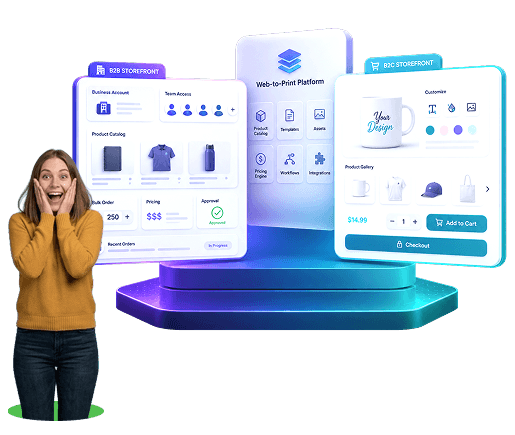
Not every print business fits neatly into one category. A hybrid B2B2C web-to-print model allows a PSP to serve business accounts and individual shoppers through the same underlying platform.
Think of it as two storefront experiences sharing one operational backbone. A public storefront serves retail shoppers while approved business customers access private portals with their own catalogs, pricing, templates, and order history.
This model suits PSPs serving corporate and retail customers, franchise networks, trade printers, and resellers.
A hybrid model can also be tailored around unusual product catalogs, pricing rules, or approval structures through a custom web-to-print solution.
B2B vs. B2C Web-to-Print: Key Differences
The clearest comparison looks at what happens before, during, and after an order. B2B is built around established accounts and operational control. B2C is built around discovery, personalization, and fast purchasing.
A hybrid storefront preserves these distinctions while applying B2B rules to business accounts and B2C rules to consumer visitors.
B2B vs. B2C Web-to-Print: Which One Is Right for You?
The right choice starts with your business model, not with a software feature list. Use the criteria below to identify which customer experience and operating model best match the work you already sell.
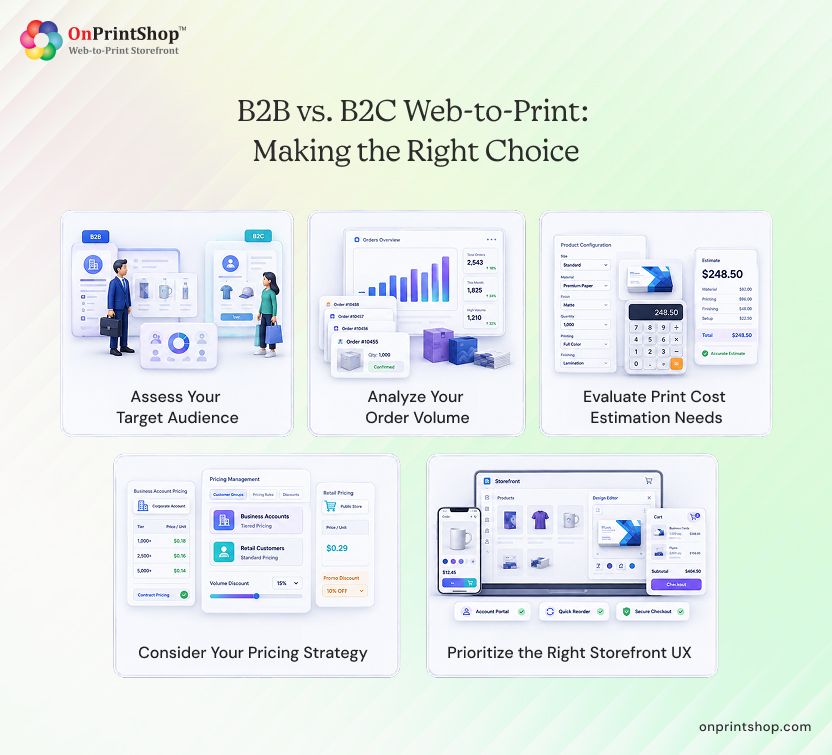
1. Assess Your Target Audience
B2B is a strong fit when your customers are businesses, agencies, institutions, or organizations that place repeat orders and care about brand consistency.
B2C is a stronger fit when you want individual shoppers to discover, customize, and purchase products with little or no assistance.
Hybrid is worth considering when both customer groups are already part of your business or when you want to add a retail channel beside established accounts.
If personalized consumer products are central to your strategy, personalized print software can support a self-service buying journey.
2. Analyze Your Order Volume
Order volume changes the operational equation. If you handle recurring, high-volume work across departments, you need tools that reduce manual order processing and simplify repeat purchases. Print order management software helps structure those workflows.
If most jobs are smaller and highly customized, the priority shifts toward a fast design-to-checkout experience. Businesses serving both patterns may benefit from a hybrid setup rather than forcing one workflow to handle everything.
3. Evaluate Print Cost Estimation Needs
B2B pricing can become complicated when a job involves multiple specifications, quantities, negotiated rates, or account rules. A reliable print estimating tool reduces the time between a request and an accurate quote.
B2C buyers expect the price to update as they customize the product and want to know what they will receive before paying. A clear design proofing tool reduces uncertainty and post-order disputes.
4. Consider Your Pricing Strategy
B2B pricing is commonly shaped by contracts, volume breaks, customer-specific rates, and long-term account relationships. B2C pricing usually works better when the shopper can see a straightforward per-item price without requesting a quote.
A hybrid storefront can separate those rules by customer type. A logged-in business account can receive negotiated pricing while a retail visitor sees standard consumer pricing from the same underlying catalog.
5. Prioritize the Right Storefront UX
B2B UX should make repeat work easier. Buyers need quick access to approved products, previous orders, templates, and account controls. Print workflow automation software can reduce manual handoffs between ordering and production.
B2C UX has a different job. Shoppers should understand the product, personalize it, preview the result, see the price, and check out without unnecessary friction.
Quick Decision Checklist: B2B, B2C, or Hybrid?
If you need a fast answer, start here. Match your current business conditions to the model that solves the biggest operational or commercial need.
Choose B2B if:
- Your customers are businesses, agencies, institutions, or organizations.
- Orders are large, recurring, or distributed across departments.
- Multiple people need to review or approve orders.
- Pricing depends on contracts, customer accounts, or volume.
- ERP, procurement, accounting, or API connectivity matters to your workflow.
Choose B2C if:
- Your primary buyers are individual consumers.
- Orders are typically smaller, one-off, and personalized.
- Search, social, or paid advertising is a major source of demand.
- Customers expect transparent pricing and fast checkout.
- Self-service design and minimal account setup are important.
Consider hybrid if:
- You already serve corporate and retail customers.
- You want to add B2C sales without disrupting B2B accounts.
- You operate a franchise network and need centralized catalogs and brand controls.
- You are a trade printer or reseller serving business customers through online ordering.
- You need different catalogs, prices, and access rules on one platform.
How OnPrintShop Supports Both B2B and B2C Web-to-PrintOnPrintShop supports more than 2,000 print service providers across 50+ countries, giving PSPs a platform for B2B, B2C, and hybrid storefront strategies. Its web-to-print technology has also received Pinnacle Award recognition.The leading web-to-print platform for managing B2B operations supports private storefronts, account-based ordering, print order management, workflow automation, and estimating.For B2C businesses, it supports personalization.AI can support both models differently. In B2B, recommendations and assisted reordering can help account buyers find products faster. In B2C, AI-assisted content and product recommendations can simplify personalization and discovery.A next-gen B2B and the latest B2C web-to-print platform solve different commercial problems. B2B is built around established relationships, repeat orders, controlled access, and complex pricing. B2C is built around discovery, personalization, transparent pricing, and low-friction purchasing.Some PSPs will benefit from B2B, others from B2C. Businesses serving both groups can use a hybrid B2B2C model to manage both experiences through one platform.The goal is a storefront that fits how customers actually buy. Explore web-to-print storefront solutions and book a demo to see how the right model can support your business.