


Blog Summary: Managing everyday banner orders is straightforward. Managing complex signage projects is not. This guide explains how sign shops can handle both standard online purchases and custom quote requests within one system to improve responsiveness, visibility, and revenue opportunities. Read on to discover how a unified workflow works in practice.
Many sign and graphics businesses have moved standard products such as banners, yard signs, and coroplast boards online, allowing customers to configure products and place orders through a self-service storefront.
The challenge of how to manage standard sign orders and custom quotes online inside a single, coherent system is one of the most practical operational problems facing sign and graphics businesses today. According to research by McKinsey, B2B buyers now expect the same self-service convenience as consumer purchases, and sign shops that cannot deliver it risk losing accounts to competitors who can.
However, complex projects such as vehicle wraps, channel letters, and monument signs still require custom pricing, consultations, and approvals. By combining a powerful sign designing software with integrated quoting and order management, sign shops can support both workflows from a single platform. This guide explains how.
Why Most Sign Shops Still Operate Two Separate Workflows
Sign shops split their workflows for a logical reason: standard products and custom projects genuinely behave differently. A repeat order for 10ft vinyl banners in a fixed size with two substrate options can be set up with straightforward online pricing and sent straight to production. A vehicle wrap for a 40-vehicle corporate fleet, with site surveys, design consultations, substrate decisions, and installation scheduling, simply cannot follow the same path.
So shops reach for two separate tools. An eCommerce store or basic sign shop online ordering system handles the repeat, predictable work. Email threads, spreadsheets, and PDF quotes manage everything else. Each system makes individual sense. Together, they create a structural problem.
The split happens because most sign printing software platforms are built around one use case or the other. Platforms designed for self-service online ordering lack the quote management logic needed for complex custom projects. Quote and estimating tools built for fabrication shops often have no customer-facing ordering portal at all.
The result is a sign shop operating two parallel administrative tracks with no shared visibility, no unified customer account, and no clean handoff between the two.
The Real Cost of Managing Orders and Quotes in Different Systems
Operating separate systems for standard orders and custom quotes creates friction at every stage of the business. The costs are operational, financial, and relational.
On the operations side:
- Production managers cross-reference two systems to build daily job queues, increasing the chance of missed deadlines on wide-format print jobs.
- Sales teams re-enter job specifications manually when converting an approved email quote into a production order, which introduces errors on substrate type, finish, size tolerances, and quantity.
- Customer service cannot give clients a single login to track both their standard signage orders and open custom project quotes.
On the revenue side:
- Custom quote requests submitted through a contact form can go unanswered for 24 to 72 hours when no structured workflow routes them to the right person.
- Quotes approved verbally over the phone are never formally recorded in the system, creating disputes over specifications at the production stage.
- B2B corporate signage clients who want a self-service ordering portal for approved items have no way to request custom additions in the same account.
On the customer relationship side:
- Clients ordering both standard and custom signage have fragmented account histories, making reordering, proofing, and invoicing harder than it needs to be.
- Approval delays on custom quotes slow entire campaigns, particularly for trade show displays and event signage where deadlines are fixed.
The true cost of the split workflow is not just administrative time. It is the custom quote revenue that stalls or disappears because there is no structured system to catch and convert it.
How to Manage Standard Sign Orders and Custom Quotes Online from One Platform
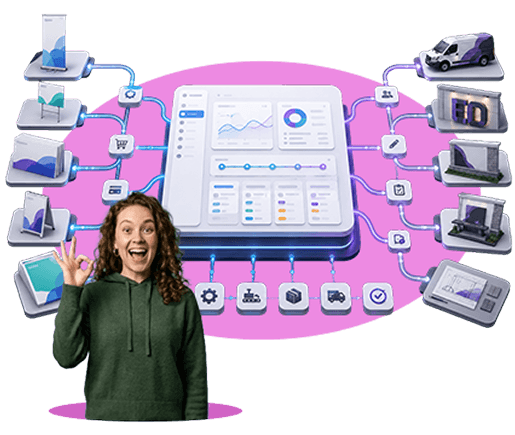
A unified sign shop platform handles both order types through a branching workflow architecture. Standard products and custom quote requests live under the same storefront, are tracked in the same order management dashboard, and are accessible through the same client account.
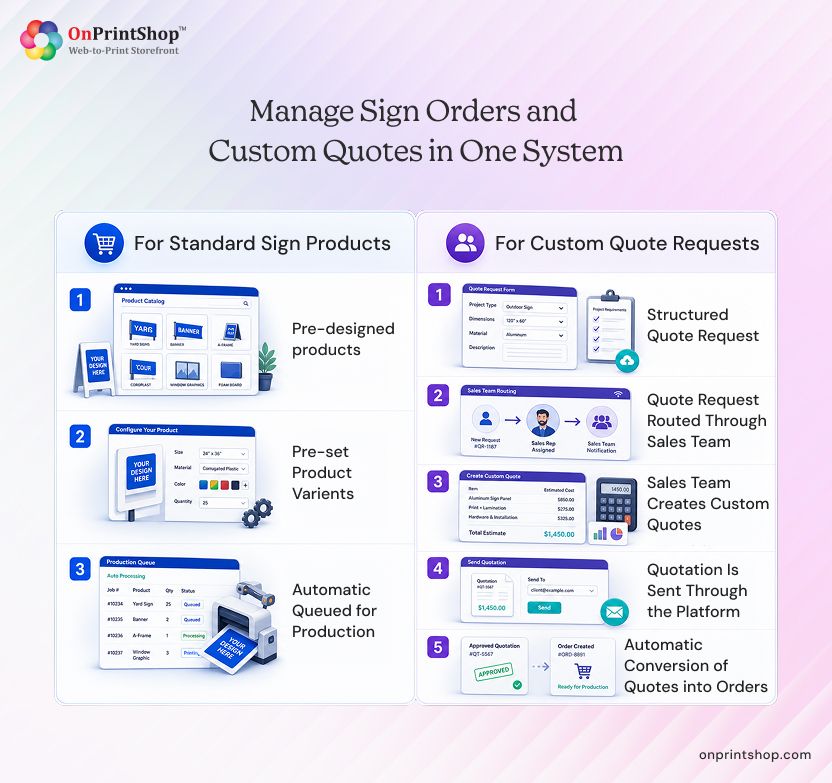
Here is how a unified system works in practice:
For standard sign products:
- Products are configured with pre-set size options, substrate selections, finish choices, and quantity-based pricing tiers.
- Customers select options, receive instant pricing through a real-time sign pricing calculator, upload artwork or use an online design tool, and check out directly.
- The order enters the production queue automatically, with job specifications locked at the point of purchase.
For custom quote requests:
- Customers submit a structured quote request form, specifying project type, approximate dimensions, substrate preferences, quantity, installation requirements, and timeline.
- The quote request is routed to the sales or estimating team through the sign shop order management dashboard.
- The sales team builds a formal quote inside the platform using sign printing software with quoting capabilities, applying custom pricing rules for material, fabrication, and labor.
- The quote is sent to the client through the platform. The client reviews, approves, and pays through their same account portal.
- Upon approval, the platform converts the quote into a production-ready order automatically, without the sales team re-entering any specifications.
This automated quote to order conversion is the operational step that eliminates the biggest source of manual error and delay in sign shop workflows.
Both the standard order history and the custom project quote history are visible in one account for the client and one dashboard for the shop. Online quote management for signage, standard reorders, proofing approvals, and invoice history sit together rather than across separate platforms.
How Sign Shops Can Structure Products for Both Standard and Custom Orders
Not every sign product belongs in the same workflow. Structuring products correctly from the start determines whether your platform reduces or increases operational complexity.
The following table shows the recommended handling for common sign shop product types:
The key principle is this: any product where price can be reliably calculated from known variables belongs online as a self-service item. Any product where scope, substrate, fabrication complexity, or installation requirements vary significantly belongs in a structured quote workflow.
Using advanced sign design software integrated into the storefront, clients can self-serve on standard items while still submitting design files or specifications for complex projects without switching platforms.

5 Features Your Sign Shop Platform Must Have to Handle Both Order Types
A web to print for sign shops platform that genuinely handles both standard orders and custom quote workflows needs more than a product catalogue and a contact form. The following five features are non-negotiable for sign shops managing both order types at volume.
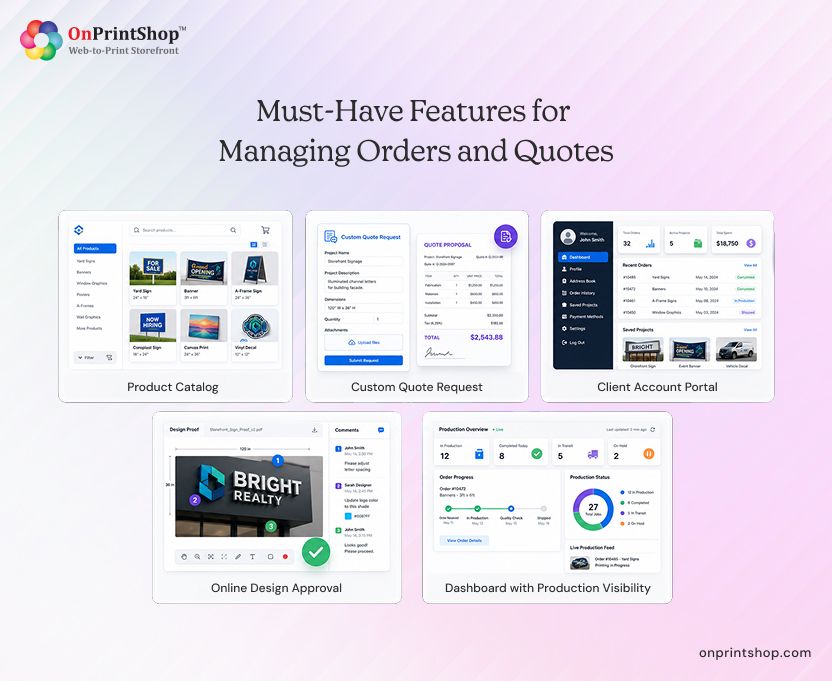
1. A Configurable Product Catalog with Real-Time Pricing
Standard sign products must support multi-variable pricing logic. A vinyl banner product, for example, should calculate price based on width, height, substrate type (vinyl, mesh, blockout), finish (hemmed edges, grommets, pole pockets), and quantity, in real time, without any manual calculation by the sales team.
The pricing engine should handle:
- Size-based pricing matrices (price per square foot or fixed size tiers)
- Substrate and finish upcharges as configurable rules, not manual line items
- Quantity discount breaks applied automatically at checkout
- Rush production fees triggered by turnaround selection
Without this, every standard order still requires sales team involvement, which defeats the purpose of a sign shop online ordering system.
2. A Structured Custom Quote Request and Management Workflow
The platform must provide a formal quote management workflow, not just a contact form that sends an email. This means:
- A structured quote request form that captures project type, substrate, dimensions, quantity, design status, and installation requirements
- An internal quote builder where estimators apply custom pricing, add line items for fabrication and installation, and attach supporting documents
- Automated quote delivery to the client through their account portal
- Quote status tracking visible to both the client and the shop
- One-click conversion of an approved quote into a production order without re-entry of specifications
This is the foundation of online quote management for signage. Without a structured workflow, quote requests fall into email and revenue is lost when follow-up does not happen.
3. A Unified Client Account Portal
B2B sign clients, in particular, need a single login that shows everything: active orders, past orders, open custom project quotes, pending design approvals, invoices, and reorder options. A fragmented account experience where the client logs into a separate system for standard orders and receives custom quotes by email is a client retention problem, not just an operational inconvenience.
A proper sign shop online ordering system gives each client account a unified order history, combining self-service standard orders with custom quote projects under one account view. For B2B corporate signage clients managing multiple locations or recurring campaigns, this account structure is essential.
An advanced B2B web-to-print storefront takes this further by allowing corporate clients to place approved standard sign orders independently while flagging non-standard requirements for sales team review, all within the same account.
4. Online Design Approval and Proofing
Both standard and custom sign orders require artwork approval before production. The platform must support online design approval for signs with a tracked, auditable workflow.
This means:
- Clients receive a digital proof through their account or a direct link, without requiring email attachments
- Clients can approve, reject, or request revisions with comments, directly in the platform
- Approval status is visible in the production queue so jobs do not enter wide-format printing before sign-off is confirmed
- Revision history is stored against the order record for dispute resolution
For custom projects, the proofing workflow may include multiple rounds with design drafts for monument signs, channel letter layouts, or vehicle wrap artwork before final approval. The platform should handle multi-round proofing without reverting to email threads.
5. A Sign Shop Order Management Dashboard with Production Visibility
Once orders enter production, whether from a standard checkout or a converted custom quote, the production team needs a single dashboard showing all active jobs. This dashboard should provide:
- Job status across all order types (received, in production, quality check, shipped, installed)
- Substrate and specification details without requiring staff to open each order individually
- Wide-format print job tracking by machine or production station, where applicable
- Flagging for jobs with pending artwork approvals or outstanding balance on custom projects
Without production visibility across both order types, the operational benefit of a unified platform is incomplete. The goal is a shop where the sales, production, and customer service teams see the same information without switching systems.

What This Looks Like in Practice: A Sign Shop Story
The following scenario is a composite based on common operational patterns in B2B sign and graphics businesses.
Before: Two Workflows, Two Systems, Constant Friction
A mid-sized sign shop serving B2B clients across retail, real estate, and corporate sectors was processing roughly 150 standard sign orders per month through an eCommerce platform, alongside 30 to 40 custom project enquiries arriving by email.
Standard orders moved efficiently. Vinyl banners, yard signs, and coroplast prints were configured online and processed without sales team involvement.
Custom projects were a different story. Quote requests arrived by email, were manually assessed by the estimating team, built as PDF documents in a separate costing tool, and sent back to clients. Approved quotes were then re-entered into the production system by hand. Jobs with outstanding artwork approvals were tracked on a shared spreadsheet. Invoicing for custom projects was handled separately from the eCommerce platform.
The operational cost: the estimating team was spending roughly a third of its time on administrative tasks related to quote creation and data re-entry. Several custom quote requests went unanswered for more than 48 hours during peak periods. Two clients had placed jobs with a competitor after not receiving a timely quote response.
During Transition: Mapping Products to the Right Workflow
The shop began by categorizing their product catalogue using the hybrid framework described earlier in this article. Standard products were mapped to online self-service with real-time pricing. Vehicle wraps, channel letters, monument signs, and high-value fabrication projects were mapped to the structured quote request workflow.
The transition involved configuring pricing matrices for each standard product category, building a custom quote request form that captured the specific variables their estimating team needed to price jobs accurately, and migrating client account data so that existing customers had a single login for both order types.
The most significant change was internal: the estimating team moved from building quotes in a standalone costing tool to using the platform's built-in quote builder, which stored all quote history against the client account and enabled one-click conversion to production order on approval.
After Implementation: One System, Full Visibility
Within two months of the transition:
- Standard sign orders continued processing without sales team involvement, as before.
- Custom quote requests were being responded to within the same business day because each submission triggered an automated notification to the estimating queue.
- Sales teams converted approved quotes into production orders without re-entering any job specifications, eliminating the primary source of substrate and size errors in custom jobs.
- B2B corporate clients could log in to a single account and see their standard fleet signage reorders alongside open custom project quotes.
- The shared spreadsheet for tracking outstanding artwork approvals was retired, replaced by status visibility in the order management dashboard.
Business Impact
The most measurable change was in custom quote conversion rate. By reducing response time and giving clients a formal quote approval process through their account portal rather than a PDF email chain, the shop's custom quote acceptance rate improved. This is the direct business case for unified workflow management: not just operational efficiency, but revenue capture on project work that previously stalled in an unstructured process.

ConclusionRunning standard sign orders and custom project quotes through separate systems is not a scalable model for a growing sign and graphics business. The operational cost shows up in manual re-entry, delayed quote responses, fragmented client accounts, and missed revenue on complex projects.A unified AI-powered web-to-print platform solves this by giving standard products a self-service online path with real-time pricing and automatic production entry, while giving custom projects a structured quote workflow that routes requests, builds formal estimates, manages multi-round proofing, and converts approved quotes into production orders without duplication of effort.The five features outlined in this guide, including configurable pricing, structured quote management, unified client accounts, online design approval, and a single production dashboard, are the foundation of a system that handles both order types at scale.Sign shops ready to bring both workflows under one roof can explore an AI-powered web-to-print storefront as a starting point.To see how the platform handles both standard orders and custom quotes in a live environment, book a personalised demo with the OnPrintShop solutions team.