



Blog Summary: Catalog drift, pricing gaps, and slow artwork approvals quietly erode brand control as a print franchise network grows. Here is how operators centralize all three without stripping franchisees of the local flexibility they need to compete.
A print franchise network that starts with two or three locations can usually keep its product catalog, pricing, and artwork approval process consistent through email and good habits. Past six or eight locations, that approach breaks down. Franchisees begin adding their own products, adjusting prices without a shared rulebook, and approving artwork through whatever channel is fastest, not the one that protects the brand.
Franchisors trying to centralize product catalogs, pricing, and artwork approval across a print franchise network are also racing against real market momentum. Franchise output is projected to rise from $907.3 billion to $921.4 billion, a 1.6 percent increase, according to the 2026 Franchising Economic Outlook by the International Franchise Association.
Growth at that pace only raises the cost of inconsistency. The good news is centralization does not have to mean rigidity, especially with a dedicated print franchise web-to-print platform built for exactly this problem.
The Three Breaking Points in Franchise Print Operations
Every franchise print network hits the same three friction points of maintaining brand consistency once it scales past a handful of locations: product catalog drift, pricing inconsistency, and slow, uneven artwork approval. Named individually, each seems minor. Together, they slowly pull a network away from a single brand experience and toward a loose collection of independently run print shops.
The Three Breaking Points at a Glance
- Catalog drift: locations add or edit products without a shared source of truth
- Pricing inconsistency: markups and discounts vary shop to shop with no guardrails
- Artwork approval delays: proofing happens over email with no shared record
The rest of this guide addresses each breaking point in order, then walks through what a centralized system looks like once all three are solved.
None of these three problems shows up as a single dramatic failure. They show up as a slow accumulation of small exceptions: one location's price list that never got updated, one franchisee's habit of approving artwork over text messages, one product page that still lists a discontinued substrate.
A network can absorb a handful of these exceptions. It cannot absorb them at scale across dozens of locations without losing the operational consistency that makes it a franchise in the first place, rather than a group of independently branded shops.
Why Product Catalog Drift Happens Across Franchise Locations
Catalog drift happens when each location manages its own product list independently, with no single master catalog feeding every storefront. One shop adds a new large-format product under its own naming convention. Another discontinues a line but never removes it from its site. A third quietly changes specs to match local equipment without telling anyone.
The consequence is that customers see different products, specs, and turnaround times depending on which location they order from. That inconsistency undermines the single-brand promise that print franchise brand consistency depends on, and it makes it harder for the franchisor to forecast demand or negotiate supplier pricing at scale.
What Catalog Drift Looks Like in Practice
- Different SKUs or product names for the same item across locations
- Discontinued products still live and orderable at some stores
- New products missing from stores that could sell them
- Inconsistent specs, substrates, or finishing options for identical products
None of this is usually intentional. Local managers are trying to serve their market well, often with good reason to adjust a product for local demand. The problem is not that locations adapt. It is that they adapt without a shared system to track what changed, why, and whether the rest of the network should know about it.

Centralizing the Product Catalog Without Killing Local Flexibility
Centralizing a product catalog means managing one master catalog at the franchisor level, then assigning only the relevant products to each location, instead of forcing every store to sell an identical list. This is what separates true multi-location print catalog management from simply emailing everyone a spreadsheet.
How a Master Catalog Model Works
- The franchisor builds and maintains one master catalog with standardized SKUs, specs, and pricing rules.
- Each location is assigned only the products relevant to its market and equipment.
- Local managers can request additions, but changes route through the franchisor before going live.
- Updates to specs or descriptions made once propagate automatically to every assigned location.
This approach solves franchisor product catalog propagation without stripping out local relevance.
Centralizing Pricing Without Losing Local Control
Centralized pricing for a print franchise sets base pricing at the network level, then gives local managers a defined markup or discount band to adjust within, rather than a single fixed price across the network or no rules at all. Both extremes cause problems: a rigid one-price model ignores real cost differences between markets, while an unmanaged approach lets pricing drift until margins and brand perception both suffer.
For networks that span regions or currencies, tax and currency handling is a real, practical pain point worth solving centrally rather than location by location.
What a Tiered Pricing Model Typically Includes
- A base price set centrally for every product
- A markup or discount range each location manager can adjust within
- An approval step for any exception outside the defined band
- Currency and tax rules applied automatically by location
Standardizing Artwork Approval Across Every Location
Standardizing print franchise artwork approval means every location uses the same online proofing workflow, so approvals, revisions, and sign-offs are tracked identically no matter which store handled the order. Inconsistent proofing, scattered across email threads and manual approvals, is where delays and brand or design errors tend to start, and the problems compound as the network grows.
A centralized design proofing software keeps every approval, revision, and comment in one auditable record, regardless of which location handled the order. That record matters both for resolving disputes and for spotting recurring artwork problems before they repeat across the network.

What a Centralized Franchise Print System Looks Like in Practice
The three pieces work together in practice more than they work in isolation. Franchisors sometimes describe this as a two-tier structure: one master dashboard the franchisor controls, and a location-level dashboard each store operates within. The franchisor sets the boundaries; the location works freely inside them. A short scenario shows how that plays out day to day.
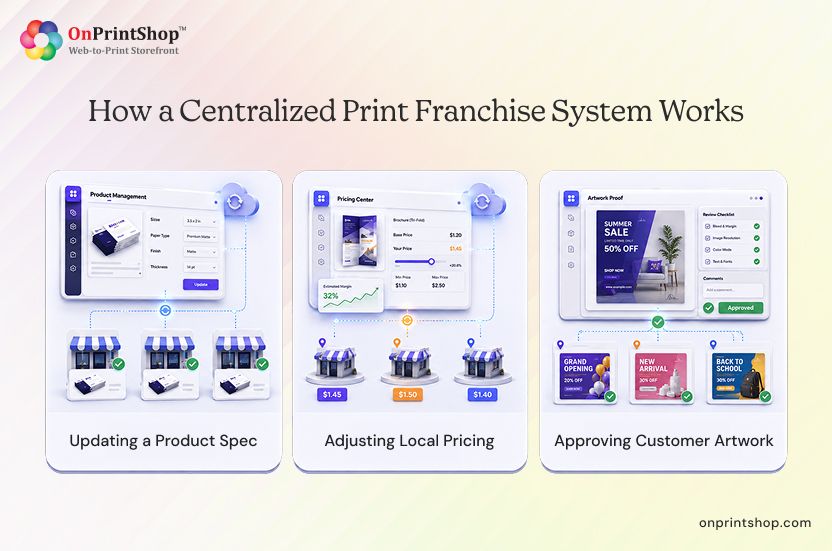
Updating a Product Spec
The franchisor updates a substrate option on a signage product once, in the master catalog. Every location assigned that product sees the updated spec immediately, with no manual follow-up required.
Adjusting Local Pricing
A location manager in a higher-cost market adjusts the price of a business card product within the approved markup band, without needing sign-off for a routine, in-range change.
Approving Customer Artwork
A customer submits artwork through the storefront. It routes through the same proofing workflow used at every other location, with the full approval history retained regardless of which store the order came from.
Key Features to Look for in a Franchise Print Management Platform
A platform built for franchise print management software needs, at minimum, the following controls in place before a network can centralize with confidence. Evaluating a platform against this list before signing a contract saves a network from discovering gaps only after catalog data is already migrated.
Core Features Checklist
- Master catalog with store-level assignment controls
- Tiered, rule-based pricing controls
- Centralized proofing and approval workflow
- Role-based access permissions per location
- Brand-compliance and template controls
- Centralized reporting across all locations
Platforms built for multi-location operations, such as OnPrintShop's comprehensive commercial printing solution, bundle these controls into a single system instead of stitching together separate tools for catalog, pricing, and proofing.
Real Results: How One Print Franchise Network Centralized Successfully
Print2Go, an OnPrintShop success story, centralized its product catalog, pricing, and proofing across 8 stores and 3 brands. The result was a 75 percent reduction in production errors tied directly to inconsistent specs and approvals across locations, a concrete outcome of solving the same three breaking points covered in this guide.
Rolling Out Centralization Without Disrupting Franchisees
Centralizing catalog, pricing, and artwork approval works best as a phased rollout rather than a single network-wide switch. Franchisees need time to adjust, and each piece depends on the one before it being stable.
Rolling everything out at once tends to backfire. Franchisees who are asked to learn a new catalog structure, a new pricing model, and a new proofing workflow in the same week will resist all three, even if each one individually makes their job easier. A sequenced rollout gives each change room to become routine before the next one lands, which is also why print franchise onboarding for new locations goes faster once the sequence is established: new stores step directly into a system that already works, instead of adopting three unfamiliar processes at once.
A Practical Rollout Sequence
- Pilot with one or two locations before a full network rollout.
- Migrate the product catalog first, since pricing and proofing both depend on a stable product list.
- Move pricing rules next, once catalog data is clean and consistent.
- Train on the proofing workflow last, since it is the piece franchisees and their customers interact with directly.
- Document the process so new locations can onboard directly into the centralized system from day one.
Conclusion and Next StepCatalog drift, pricing inconsistency, and slow artwork approval rarely announce themselves as urgent problems. They build quietly, one location at a time, until a franchise network looks less like a single brand and more like several loosely connected shops. An AI-driven web-to-print solution for print franchise networks closes that gap, giving franchisors one system to manage all three areas while franchisees keep the local flexibility they need to compete.Networks ready to make that shift can explore OnPrintShop's flexible web-to-print plans to see which setup fits their number of locations and brands. Book a live demo with OnPrintShop to see how catalog, pricing, and artwork approval come together in one centralized system.