



Summary The right web-to-print platform in 2026 doesn't just streamline your workflow, it wins you customers. This guide breaks down the top web to print software platforms, comparing real features, honest user sentiment, and what actually makes each tool different, so you can make a smarter, longer-term decision for your print business.
Web-to-print software in 2026 functions as a complete operations hub. It combines online ordering, design tools, production workflow, and customer retention into a single web-to-print platform, replacing what used to require separate systems.
This shift is measurable. The global web-to-print market is projected to cross $1.7 billion by 2026 and surpass $1.9 billion by 2030, growing at a 7.8% CAGR, driven by AI adoption, workflow automation, and demand for digital-first ordering.
Choosing the right platform is difficult because vendor claims rarely match real-world performance. Some platforms lead the market, some excel in narrow niches, and some run on outdated technology. Marketing pages and demo calls look similar across vendors; the differences only surface after implementation.
This guide compares the top 10 web-to-print software platforms in 2026 using verified features, real user feedback, and honest pros and cons. It covers options for mid-size commercial printers scaling operations and enterprise franchises managing hundreds of brand portals.
Quick Comparison: Top 10 Web-to-Print Platforms
Use this as a quick reference when shortlisting web-to-print platforms for your print business, along with their pricing type.
Disclaimer
This list is compiled from hands-on research, verified user reviews from top SaaS reviewing site, and industry insights. As the team behind OnPrintShop, we aim for fair and balanced comparisons, we'll be upfront where our own perspective may colour things, but we've done our best to represent every tool honestly.
1. OnPrintShop
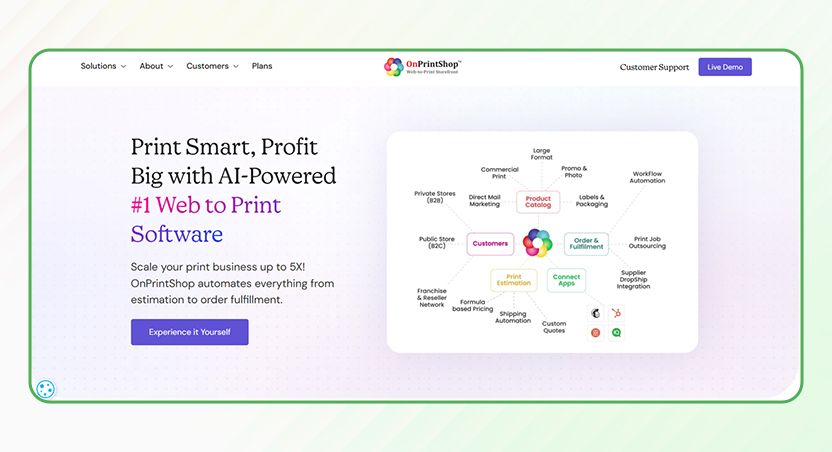
OnPrintShop is one of the leading AI-powered web-to-print software, that helps print businesses scale, not just survive. Founded in 2007, the platform has quietly grown into one of the most comprehensive AI-powered web-to-print solutions on the market, now serving 2,000+ businesses across 50+ countries. That's not a marketing number; they've got the receipts, including dual Pinnacle Awards 2025 from PRINTING United Alliance, recognizing both their AI innovation and product design excellence.
By combining AI-powered automation with real-time operational insights and 300+ ready-to-use integrations, OnPrintShop helps print businesses improve efficiency across sales channels, reduce manual dependencies, and drive measurable revenue growth.
To expand and diversify print offerings, OnPrintShop is the one-stop solution to grow in multiple print segments. This comprehensive solution serves diverse PSPs (B2B, B2C, trade printers, franchises, packaging converters, large-format, labels, etc.), unifying multiple storefronts, product lines and workflows in one scalable system.
Top Features of OnPrintShop
- AI-powered design tools: auto-generated content, background removal, image enhancement, multilingual storefront translation
- End-to-end print order management dashboard; from quote to shipping in one view
- Flexible pricing engine with support for volume-based, print-specific, and custom pricing models
- Multi-store management for B2C retail, B2B portals, resellers, and franchise networks
- Automation workflows that reduce repetitive tasks and print production delays
- 300+ Integrations with 4over, PromoStandards, HubSpot, ShipStation, QuickBooks, Zoho and more
- Translate your entire storefront accurately into Spanish, German, French, and more; offering better accuracy than traditional tools like Google Translate
What Users Appreciate
- "The pricing engine is one of the most flexible I've encountered. You can practically build and manage any type of product in their system." — Capterra reviewer
- Users consistently highlight the responsive support team and real-time chat as a differentiator
- The centralized order dashboard, tracking jobs from design approval through to shipping, is frequently cited as a time-saver for high-volume operations
- AI features that reduce content creation overheads and accelerate storefront setup by up to 70%
Where Users Feel It Falls Short
- Initial onboarding can take time; the backend configuration is feature-rich but has a learning curve
- Some advanced customization requires working with the support team rather than self-serving
Unique Positioning Insight
What genuinely separates OnPrintShop from most competitors is its diversified options without compromise. Many web to print platforms do B2B well or B2C well. OnPrintShop does both simultaneously, across commercial print, wide-format, packaging, apparel, photobooks, and trade printing, from single admin dashboard.
The consistent product version release (quarterly major updates) means you're not stuck waiting for features your print business already needed six months ago.
👉 Explore More About OnPrintShop
2. Aleyant Pressero
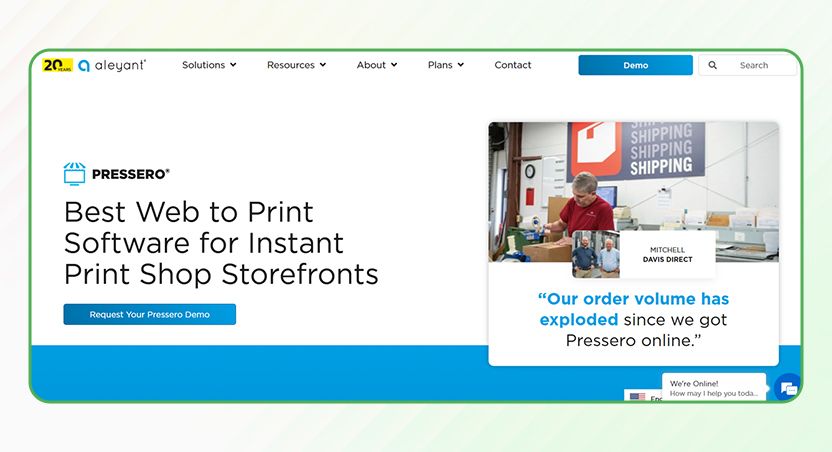
Aleyant has been in the web-to-print game since a while, and Pressero is their flagship product, SaaS-hosted storefront that aims to give commercial printers everything they need without the enterprise price tag. The core pitch is simple: unlimited B2B and B2C storefronts, solid VDP through their eDocBuilder module, and integrations with MIS/workflow tools that actually hold up in production environments.
Pressero suits the kind of shop that values rock-solid customer service and wants a system they can deploy relatively quickly and grow into. Their App Marketplace (launched 2025) now gives users easier access to third-party integrations directly within the platform.
Top Features
- Build B2B and B2C storefronts from a single platform
- eDocBuilder: browser-based VDP template editor for business cards, letterheads, labels, and more
- Automated estimating and instant online pricing
- Mobile-first responsive storefront designs
- Integration with Zapier, PayPal, Printer's Plan, Stripe, and ShipStation
- Newly launched App Marketplace for streamlined third-party integrations
What Users Appreciate
- Customer support consistently earns top marks, multiple reviewers call it the best support of any software vendor they work with
- Print-ready PDFs delivered immediately after order placement, cutting down on manual back-and-forth
- Pricing flexibility across plans allows smaller shops to start modest and scale up
Where Users Feel It Falls Short
- The platform's VB Script-based field scripting feels dated compared to JavaScript alternatives
- Limited native support for the promotional products market (though they've flagged it's on the roadmap)
- Some MIS integrations (e.g., Tharstern) have restricted functionality compared to other platforms
Unique Positioning Insight
Pressero punches above its price point for small-to-mid commercial printers. The eDocBuilder VDP system is genuinely capable, and the customer success model — with real ROI calculators and regional support teams gives it a consultative quality that most SaaS platforms skip.
👉 Explore More About Aleyant Pressero
3. MarketDirect Storefront (Print ePS)
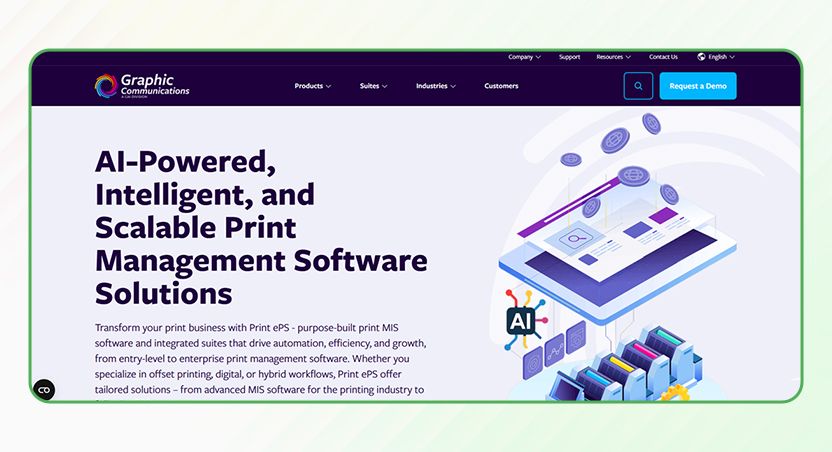
MarketDirect Storefront, offered by Print ePS, is a web-to-print solution with deep roots in the enterprise and in-plant print environment. It's built with workflow integration at its core, connecting front-end ordering to back-end production in ways that more marketing-forward platforms often gloss over.
It's particularly well-regarded in corporate in-plant environments (think internal print departments for large organizations) and for enterprise buyers who need tight control over branding, user permissions, and procurement workflows.
Top Features
- Robust B2B storefront configuration with multi-level user permissions and approval workflows
- Deep MIS integration heritage (rooted in EFI ecosystem)
- Supports static, variable, and on-demand products from a single storefront
- Inventory management with reorder thresholds and usage tracking
- Branded storefronts with corporate brand governance controls
What Users Appreciate
- Enterprise-grade permission structures that satisfy IT and procurement teams
- The depth of MIS/workflow connectivity is a genuine differentiator for high-volume shops
Where Users Feel It Falls Short
- The UI feels dated compared to newer entrants — it's powerful but not pretty
- Onboarding and implementation timelines can be lengthy for complex environments
- Limited self-service customization for front-end store design
Unique Positioning Insight
MarketDirect Storefront earns its place at enterprise deals where procurement controls, approval workflows, and MIS depth matter more than design flexibility. It's a specialist tool for a specific buyer profile, and within that profile, it performs well.

4. PrintNow
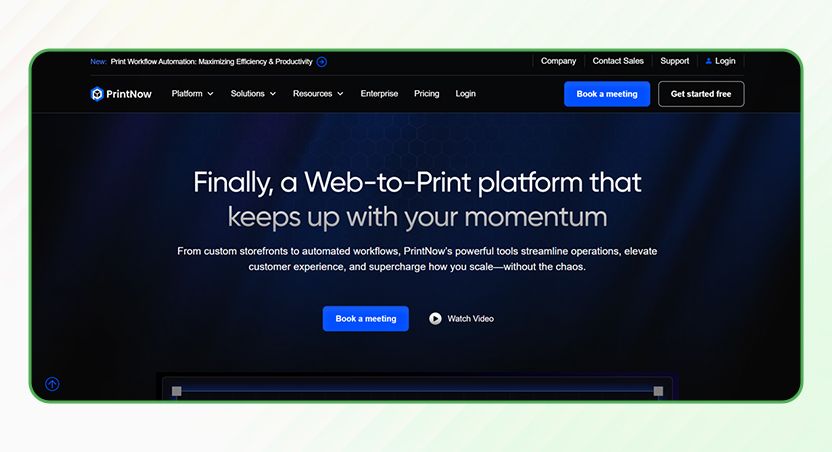
PrintNow takes a modular approach to web-to-print, making it a flexible option for print businesses that want to start lean and expand over time. The platform covers the standard bases: online storefronts, template-based design, order management, and file output, all in a cloud-hosted environment.
It tends to attract smaller to mid-size shops that need reliable core functionality without a lot of enterprise overhead.
Top Features
- Cloud-hosted B2B and B2C storefronts
- Template-based online designer with basic variable data support
- Order management with email notifications and job tracking
- Artwork upload with basic preflight checking
- Shipping and payment gateway integrations
What Users Appreciate
- Straightforward setup process makes it accessible for shops without a large IT team
- Core ordering and template workflows function reliably for standard print products
Where Users Feel It Falls Short
- Feature depth lags behind newer platforms, particularly in AI and advanced automation
- Design studio customization options are more limited for complex or high-volume personalization needs
Unique Positioning Insight
PrintNow is a dependable entry-level choice for shops that need a web-to-print presence without the overhead of a more complex platform. It works best when your catalog is relatively standard and your customization demands are moderate.
5. Print Science
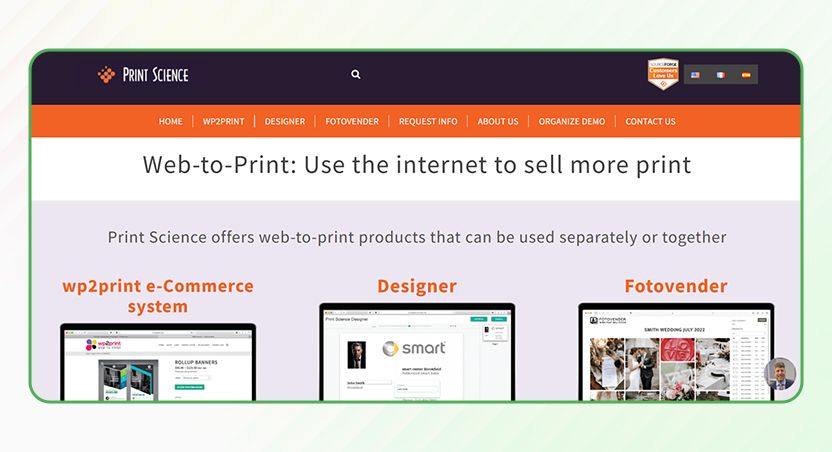
Print Science positions itself as a technology partner for print businesses that want to build a stronger digital ordering experience. The platform is particularly known for its clean storefront capabilities and focus on helping print providers look polished and professional to their end customers.
Top Features
- Branded storefront builder with clean, customer-facing UX
- Product catalog management with options for static and personalized products
- Online proofing and approval workflows
- Order management and production tracking
- Integration capabilities with common print production tools
What Users Appreciate
- Emphasis on customer-facing UX quality gives storefronts a more modern, professional look
- Responsive support team that takes a consultative approach to implementation
Where Users Feel It Falls Short
- Advanced automation and AI capabilities are less developed than leading platforms
- Scaling across multiple storefronts or complex B2B environments can require significant configuration effort
Unique Positioning Insight
Print Science is a solid mid-market option for commercial printers that want to differentiate on the quality of their customer experience. It's not the deepest platform on this list, but for its target audience, that's often exactly what's needed.
👉Explore More About Print Science
6. XMPie
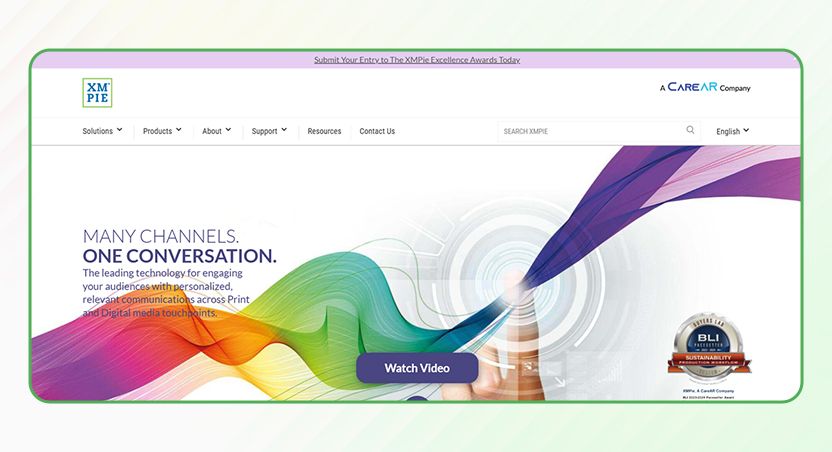
XMPie's StoreFlow is the choice of print operations that take Variable Data Printing seriously and we mean seriously. Built on XMPie's PersonalEffect composition engine and deeply integrated with Adobe InDesign Server, StoreFlow handles everything from simple static products to complex, data-driven omnichannel campaigns from a single storefront. It launched StoreFlow Cloud in February 2025, adding a more accessible SaaS entry point alongside its traditional on-premise offering.
This is enterprise-grade VDP software — the kind that real-estate firms, car dealerships, and franchise networks use to deploy thousands of personalized pieces at speed.
Top Features
- Unparalleled VDP through XMPie's PersonalEffect engine + optional Adobe InDesign Server (StoreFlow Pro)
- Built-in prepress automation via Xerox FreeFlow Core — automated imposition, preflight, and job submission
- Supports static products, personalized print, on-the-fly uploads, packaging, labels, and omnichannel campaigns
- eProcurement integration via PunchOut2Go (Ariba, SAP, Coupa, Oracle, and more)
- StoreFlow Cloud tiers: Basic, Standard, Premium, and Private Cloud
- Open XML/API architecture for integration with MIS, ERP, and CRM systems
What Users Appreciate
- The depth of personalization capability is genuinely unmatched for data-driven print operations
- End-to-end workflow from order acquisition to production, functions as a near-touchless pipeline for high volume
- Customer success stories include agencies doubling revenue and tripling staff within a year of adoption
Where Users Feel It Falls Short
- The platform has a steep implementation curve; it's not a tool you deploy in a weekend
- Understanding how all the product components fit together (StoreFlow, PersonalEffect, uProduce) takes time
- Primarily positioned around the Xerox ecosystem, which can feel constraining for non-Xerox shops
Unique Positioning Insight
If your business model revolves around high-volume, data-driven personalization particularly for enterprise clients running marketing campaigns, StoreFlow is arguably the most powerful tool in this list. The StoreFlow Cloud entry point makes it more accessible than ever, though you'll still need to invest in proper onboarding to unlock its full potential.
7. WebToPrint Shop
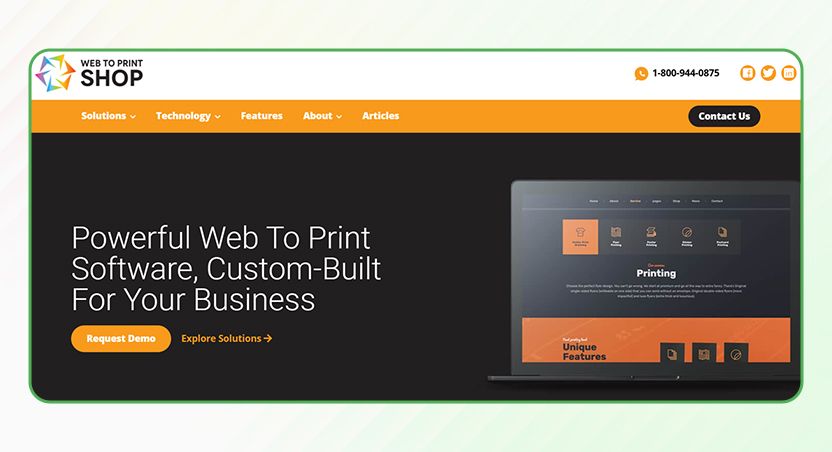
WebToPrint Shop takes a pick-and-choose approach to web-to-print, which makes it appealing to print businesses that know exactly what they need and don't want to pay for what they don't. The platform covers both B2B and B2C scenarios with components that can be combined based on your workflow requirements.
Top Features
- Modular architecture; choose only the components your workflow requires
- B2B and B2C storefront capabilities
- Online product designer with template and variable data support
- White-label options for resellers and print brokers
- Order and production management tools
- Direct mail product support
What Users Appreciate
- The modular approach keeps costs manageable for shops that don't need a full-suite solution
- White-label functionality is valuable for resellers looking to build their own branded storefront offerings
Where Users Feel It Falls Short
- The modular model can become complex to manage as requirements evolve and more components are added
- AI and advanced automation features are not as developed as leading all-in-one platforms
Unique Positioning Insight
WebToPrint Shop suits operations that want targeted capabilities without a full platform commitment. The pick and choose model is a genuine differentiator, though it requires clear planning upfront to avoid complexity creep as the business grows.
👉 Explore More About WebToPrint Shop

8. Infigo
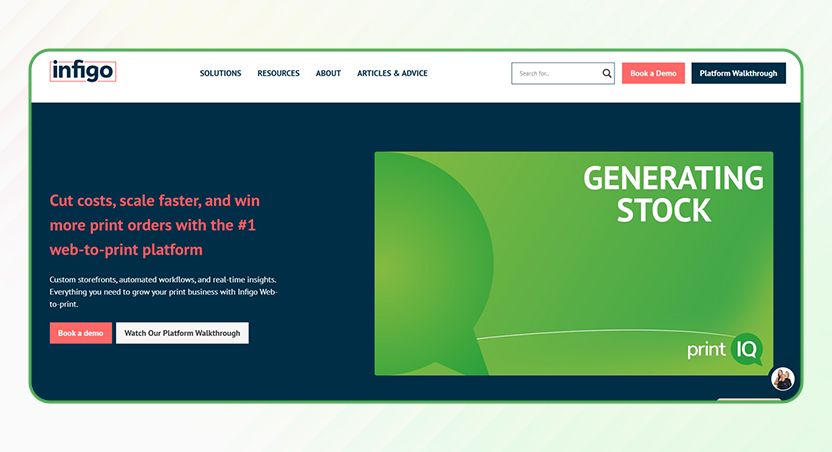
Infigo (formerly known for their Catfish platform) is a UK-based web-to-print provider that has built a reputation for something most competitors quietly struggle with: genuinely customizable storefronts.
One user review put it perfectly, "one thing that stood out the moment I found Infigo was that every site built with the platform looked different." In a world where you can instantly spot which software powers a competitor's site, that's a meaningful differentiator.
The platform is AWS-hosted, releases updates weekly, and invested heavily in 2025 compliance work, including full European Accessibility Act (EAA) readiness, OAuth 2.0 authentication for Microsoft 365/Google, and new payment integrations (Square, Global Payments). PrintIQ became their official ANZ reseller effective January 2026.
Top Features
- Highly customizable storefronts: frontend design is genuinely flexible, unlike most competitors
- MegaEdit: drag-and-drop online editor with 3D preview, template locking, and image library support
- Infigo Designer: Adobe Acrobat plugin for conditional content VDP templates
- Bi-directional integrations with Tharstern, printIQ, HP Site Flow, Enfocus Switch, VeraCore, and more
- Infigo Insights: real-time analytics including payment reconciliation for finance teams
- Weekly software update cadence with clear release notes and feature documentation
What Users Appreciate
- The team behind the software earns as much praise as the software itself — support responsiveness within 12 hours is frequently highlighted
- Dynamic template capabilities that genuinely outperform most competitors for conditional content use cases
- The platform keeps evolving; users feel they're growing with the product rather than waiting for it
Where Users Feel It Falls Short
- It's not ready out of the box — meaningful assembly is required, which demands either technical resource in-house or Infigo's professional services
- Advanced templates require JavaScript knowledge; users without development background need support
- Having two template engines (Designer and MegaEdit) means mastering both is a commitment
Unique Positioning Insight
Infigo is the go-to platform for print businesses that want their web-to-print storefront to look like theirs — not like everyone else's. If frontend differentiation and deep integration with enterprise MIS are top priorities, Infigo deserves serious evaluation. Just go in with eyes open about the implementation investment required.
9. Propago
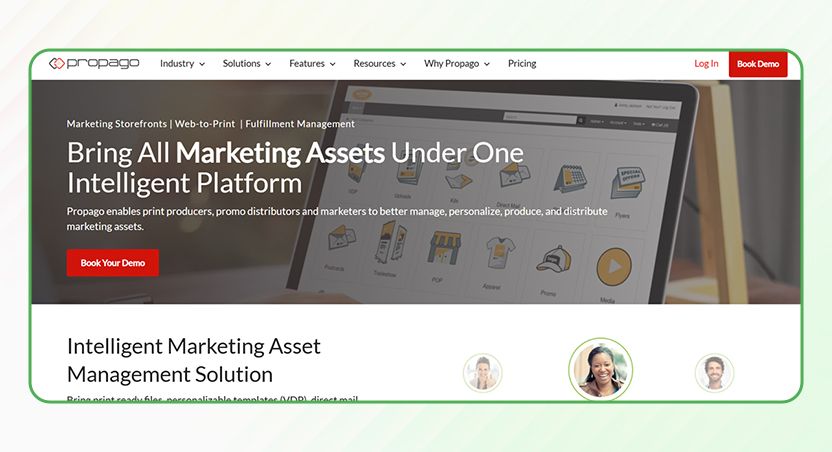
Propago occupies an interesting niche: it's as much a Marketing Asset Management (MAM) platform as it is a web-to-print solution. That positioning is deliberate. Propago is built for commercial printers who serve enterprise and franchise clients, organizations that need centralized brand control across hundreds or thousands of users, with print, promo, apparel, and digital assets all in one place.
If you're a print shop whose clients include multi-location brands, franchise networks, or large marketing departments, Propago's combination of brand governance, fulfillment tools, and inventory management is genuinely hard to replicate elsewhere. Pricing starts at $449/month.
Top Features
- Marketing Asset Management hub: centralize print, promo, apparel, and digital under one portal
- Brand governance with advanced business rules — control who can order what, and how it's personalized
- Comprehensive fulfillment tools: kitting, pick-and-pack, warehouse management, batch shipping
- Real-time order and inventory status updates with production queues and visual reporting
- Integrations with PrintSmith, PressWise, Shopify, Stripe, ShipStation, VeraCore, and Zendesk
- No per-user or per-transaction fees (flat platform pricing model)
What Users Appreciate
- Data collection and reporting capabilities are described as "head and shoulders above the rest" by long-term users
- Flat pricing model (no user or transaction fees) is cited as a major value driver for high-volume operations
- The support team is consistently described as one of the most responsive in the industry
Where Users Feel It Falls Short
- The variable data/personalization tool (PageFlex-based) is described as clunky by some users — it's functional but not fluid
- Warehouse management has a learning curve and may require training sessions for new staff
- Occasional loading time issues under heavy order volume have been noted
Unique Positioning Insight
Propago earns its place by doing something most web-to-print platforms don't attempt: genuinely connecting web-to-print with marketing asset management and fulfillment logistics. For commercial printers whose growth strategy involves becoming indispensable to enterprise marketing teams, Propago is a strategic investment, not just a software purchase.
10. DesignNBuy
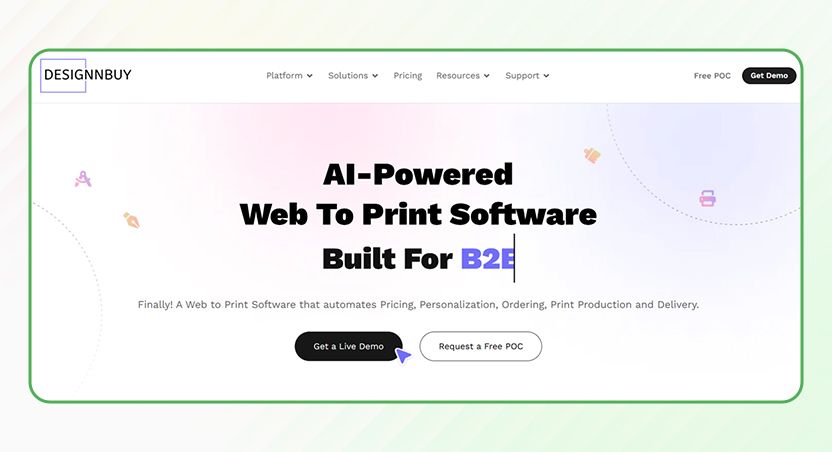
DesignNBuy rounds out this list with a platform that puts the online design experience front and center. It's an all-in-one web-to-print solution with a strong emphasis on giving end-customers a rich, browser-based design tool, making it well-suited for B2C print shops, photobook businesses, and personalized gift retailers.
The platform covers storefront, design studio, order management, and basic workflow automation, with mobile-responsive storefronts and multi-language support for global deployments.
Top Features
- Feature-rich browser-based design studio with extensive product type support
- Support for apparel, photobooks, packaging, promotional products, and wide-format
- Variable data printing and template customization
- Order management with production workflow integration
What Users Appreciate
- The design studio breadth supports a wide variety of personalized print products from one platform
- Good coverage of product categories that B2C-focused print shops serve — gifting, photobooks, apparel
Where Users Feel It Falls Short
- Enterprise-level multi-store management and complex B2B workflow configurations are less developed
- Backend reporting and analytics depth is more limited than platforms aimed at commercial printers
Unique Positioning Insight
DesignNBuy is at its strongest when the end-customer design experience is a core part of your business model. For gifting, personalization-first businesses, or B2C print shops building consumer-facing brands, the platform's design depth gives it a clear edge. For commercial print operations managing complex workflows, other tools on this list will serve you better.
👉 Explore More About DesignNBuy
Key Factors to Consider When Choosing Web to Print Software
Evaluating web-to-print platforms can feel overwhelming, especially when every vendor leads with the same promises. So before you sit through demos or start comparing pricing tiers, it helps to know which factors actually move the needle for print businesses at scale.
Here's what deserves real weight in your evaluation:
1. Print Product Range Flexibility
Your platform needs to handle not just what you print today, but what you'll add to your catalog in 18 months. Business cards and brochures are table stakes.
The sharper question is: can it handle wide-format, packaging, apparel, photobooks, and promotional products, without a separate system for each? Fragmented catalogs mean fragmented workflows, and that cost compounds quickly.
2. B2B and B2C Capability, Without Compromise
Many platforms do one well and the other adequately. But if your print business serves both corporate clients with approval workflows and end consumers placing one-off orders, you need a platform that genuinely supports both modes, not one that technically handles both but clearly has a preferred audience. This distinction is easy to miss in a demo and painfully obvious in production.
3. Design Tool Depth
The online editor is often where customers form their first impression of your business. A clunky, slow, or limited design tool doesn't just frustrate users, it drives abandonment. Evaluate the template editor, the level of customization control you retain, 2D/3D preview quality, and how well it handles variable data. The gap between good and great here is significant.
4. Automation and Workflow Integration
How many human touchpoints exist between a customer placing an order and that job hitting production? Every unnecessary touch is a cost and a risk. Look for platforms with built-in preflight automation, rule-based job routing, MIS/ERP integration, and shipping automation. The best platforms turn what used to be a five-step manual process into a single-click workflow.
5. Scalability Option: Stores, Users, and Volume
A web to print platform that handles your current operation fine might buckle under the weight of growth. Before committing, ask: how easy is it to launch a new storefront? How does pricing scale with order volume? Can you manage multiple B2B portals, each with their own branding, permissions, and product catalogs, from a single admin view? Growth should feel like expansion, not re-implementation.
6. Security, Compliance, and Uptime
Enterprise clients in particular will ask about this before signing off on any vendor. SSL, GDPR compliance, SSO support, role-based access controls, and SLA-backed uptime commitments aren't exciting to evaluate, but they're deal-breakers when they're missing. Don't leave this conversation until after you've already onboarded.
7. Support Model and Implementation Reality
A platform is only as good as the team behind it when things go wrong. Dig past "24/7 support" in the marketing copy and ask: what does onboarding actually look like? Is there a dedicated implementation partner? What's the average response time for critical issues? What do real customers say about support quality, not in case studies, but in G2 and Capterra reviews?
8. Total Cost of Ownership
Monthly subscription fees are just the starting point. Factor in implementation costs, customization development, integration fees, training overhead, and what happens to your bill when you add storefronts, users, or product categories. The platforms with the lowest entry price don't always have the lowest three-year cost. And the ones with higher upfront investment sometimes pay back faster through efficiency gains.
Our Reason to Create This List of Top 10 Web to Print Software in 2026
This list follows one principle: matching print businesses to the right platform, even when that platform isn't OnPrintShop.
That principle comes from experience. A packaging-focused print business once approached us needing a highly specialized design studio for structural diagramming and die-line editing. Rather than force a fit, we redirected them to a platform built specifically for that use case. No pitch, no workaround, just an honest referral.
This guide applies that same standard publicly. It's a research-backed comparison of the top 10 web-to-print platforms in 2026, built to help print businesses find the right fit rather than sell one answer.
OnPrintShop is included in this list. This isn't a conflict of interest: OnPrintShop powers 2,000+ print businesses across 50+ countries, spanning B2B portals, B2C storefronts, franchise management, trade printing, and wide-format, earning its place on merit. The other nine platforms earned their place the same way, each suited to different business models and buyer needs.
If you're still evaluating how to choose the right platform, the section below breaks down the key decision factors.
How to Choose Web-to-Print Software for My Business
There is no universally "best" web-to-print platform. The right web-to-print solution for print shops depends on three factors: your business model, your current scale, and where your business is headed.
Six questions determine the right fit:
1. What does your order mix look like today and in 3 years?
A platform that handles business cards and brochures well might fall apart when you add packaging or wide-format to your catalog. Choose a platform that covers your current product range and can expand without requiring a costly migration later.
2. Do you serve B2B clients, B2C customers, or both?
B2B web-to-print needs (approval workflows, multi-level permissions, PO management, tiered pricing) are fundamentally different from B2C needs (fast checkout, intuitive design tools, consumer-friendly UX). Platforms that genuinely handle both well, without a messy workaround, are rarer than the marketing copy suggests.
3. What's your current tech stack, and what needs to connect?
MIS, ERP, CRM, shipping carriers, payment gateways, the depth and reliability of integrations can make or break an implementation. Evaluate not just whether an integration exists, but how deeply it's maintained and whether it's bidirectional.
4. How important is automation to your margin?
Manual order entry, manual preflight, manual job routing, every touch costs money. If you're processing 50+ orders a day, automation isn't a feature. It's a financial necessity. Prioritize platforms with rule-based workflow automation and minimal human touchpoints between order placement and production.
5. What's the real cost of ownership?
Don't just compare monthly subscription fees. Factor in implementation time, training overhead, customization costs, integration development, and the ongoing cost of keeping up with your clients' evolving demands. Platforms with lower sticker prices often have higher total cost over 3 years.
6. Are you scaling through resellers, franchises, or global expansion?
If so, multi-store management, white-label capabilities, and multilingual/multicurrency support aren't nice-to-haves, they're table stakes. Evaluate how easy it is to spin up new stores, replicate configurations, and manage everything from one admin view.
Benefits of Choosing a Top Web to Print Software
The right web-to-print platform changes how a print business grows, not just how fast it operates. Businesses that invest in the right platform shift from reactive order-chasing and production firefighting to deliberate, scalable growth.
This shift comes from removing operational friction, not from any single feature. The sections below outline six specific changes print businesses experience when this decision is made correctly.
1. Your print customers stop needing you for the small stuff, in the best possible way.
When a customer can log into their branded portal, customize a template, approve a proof, and place an order without sending a single email, that's not them being less engaged. That's them trusting your infrastructure completely. The best web-to-print platforms turn your biggest clients into self-sufficient ones, which frees your team to focus on relationships that actually need a human touch.
2. Errors drop. Not because people got better. Because the system got smarter.
Manual print order intake is where mistakes live. Wrong files, missed specs, misquoted pricing, most production errors trace back to a handoff that didn't need to be manual in the first place. A well-configured web-to-print platform handles preflight, pricing logic, and artwork validation automatically. Your team stops being the last line of defence against every small mistake.
3. You start winning clients you couldn't have served before
The big account, Enterprise clients; the kind with multi-location teams, strict brand governance, and procurement workflows, don't just want good print quality. They want a vendor whose infrastructure matches theirs. A robust web-to-print setup signals operational maturity. It's often the difference between being a vendor a large client considers and one they actually onboard.
4. Margins improve without adding headcount
This one takes a few months to show up, but it's real. When order processing, job routing, and artwork management are automated, your existing team handles more volume without burning out. You're not paying for extra hours to process the same number of jobs. That's not a small win, that's structural improvement in your unit economics.
5. You stop losing business at midnight
Slightly dramatic? Maybe. But online print ordering doesn't keep business hours, and neither do your clients' deadlines. A web to print platform that lets customers order at 2 AM, with correct pricing, real-time product configuration, and instant order confirmation; means you're capturing revenue that would have otherwise waited until morning and sometimes gone elsewhere entirely.
6. Your team actually enjoys their work more
This one rarely makes it into ROI calculators, but it matters. When your operations team isn't manually re-entering orders, chasing artwork, or fielding "what's the status of my job?" calls all day, morale improves. The work becomes about problem-solving and growth, not administrative survival. That has a real effect on retention and team performance over time.
The bottom line is this: the right web-to-print software doesn't just digitize your existing process. It redefines what your business is capable of and who you're capable of serving.
That's worth choosing carefully.
Final ThoughtsThe w2p software market in 2026 is more capable, more integrated, and more automation-forward than it was three years ago, giving print businesses stronger options across every segment.Choosing the wrong platform costs more than the subscription fee. Lost time, migration headaches, and a system that can't scale your catalog or storefronts as you grow all add up fast.For mid-size commercial printers and enterprises that want depth and flexibility without compromise, OnPrintShop is the strongest all-around web-to-print software choice. For specialist needs, XMPie leads in VDP, Infigo in frontend customization, and Propago in franchise marketing asset management.The right time to upgrade your web-to-print infrastructure is now. Book a demo to see which platform fits your business.