



Blog Summary: A trade printer manufactures print for other businesses, a print broker outsources production without owning equipment, and a print reseller sells under its own brand using a trade printer for fulfillment. Understanding these differences helps you choose the right business model and technology. Read on for a detailed comparison.
Trade printer, print broker, and print reseller are three terms that get used interchangeably across the print industry, yet they describe fundamentally different businesses. The distinction matters more as the market grows: the U.S. printing industry only generated $81.5 billion in revenue in 2026 across more than 50,000 businesses, according to IBISWorld, and each of these three models carries its own ownership structure, risk profile, and margin structure within that market.
Confusing one for another can lead to the wrong technology, vendor, or growth decision. The trade printer vs print broker vs print reseller comparison ultimately comes down to one question: who owns the customer relationship, and who owns production? A trade printer manufactures unbranded work for other businesses, often relying on a modern web-to-print for trade printers to manage that order volume. A broker sources jobs across multiple vendors without owning equipment. A reseller runs an ongoing storefront under its own brand.
By the end of this guide, you will know exactly which model describes your business, or which one you should build toward.
Quick Definitions● Trade printer: a wholesale manufacturer that produces private-label print for other businesses and never sells directly to the public.● Print broker: an intermediary who sources and manages print jobs across outside vendors without owning any production equipment.● Print reseller: a branded storefront business that sells printed products under its own name while a trade printer fulfills the order out of view.
What Is a Trade Printer?
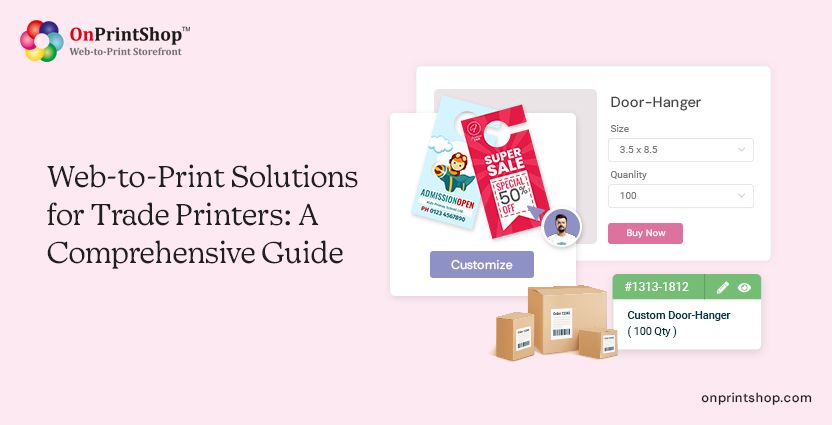
A trade printer is a wholesale manufacturer that produces print for resellers, brokers, and other print businesses under private label, and it never sells directly to the public. Many operators searching for a dedicated web-to-print solution for trade printers are trying to solve exactly this: managing high order volume from many downstream partners without exposing their own brand.
The defining trait of a trade printer is that it owns the equipment and the production process, but it never touches the end customer relationship. Orders arrive from resellers or brokers, get manufactured at scale, and ship out blind, meaning no trade printer branding appears anywhere on the package.
A practical example: a wholesale printer manufactures business cards for hundreds of local reseller storefronts across the country. Each storefront has its own branding, pricing, and customer base, but the cards themselves are all produced by the same trade printer behind the scenes. This is often called white label printing, since the manufacturer's name never appears to the end buyer.
The way how specialized web-to-print solutions help trade printers manage such high order volume from so many partners, typically become necessary well before a reseller-facing storefront would.
What Is a Print Broker?
A print broker is an intermediary who takes client orders and outsources production to one or more trade printers or vendors, without owning any manufacturing equipment. The broker's value lies in vendor selection, quality control, and delivery management rather than manufacturing itself.
A broker's margin comes from the markup on each job, not from production efficiency. This is the key trait that separates a broker from a trade printer: brokers own relationships with vendors, not with machinery.
The distinction between a broker and a reseller often causes the most confusion. A broker actively sources and negotiates across multiple vendors for each individual job, while a reseller typically runs a storefront tied to one supplier's ongoing catalog. MaxQ Printing's shift from a fragmented brokering process to a centralized storefront model, detailed in this print broker success story, illustrates how that per-job sourcing model can evolve over time.
What Is a Print Reseller?
A print reseller is a business, often a storefront or agency, that sells printed products under its own brand while a trade printer fulfills the order out of view. Unlike a broker, a reseller usually maintains an ongoing relationship with one primary supplier's catalog rather than sourcing per job.
The key trait of a reseller is ownership of the storefront and the customer relationship. Fulfillment is invisible to the end buyer, who only ever interacts with the reseller's brand, pricing, and customer service.
This is the section most often merged incorrectly with the broker model while starting a print reseller business. The distinction to remember: a reseller's relationship with its supplier is a standing storefront arrangement, not a per-job search for the best vendor.
Trade Printer vs. Print Broker vs. Print Reseller: Side-by-Side Comparison
The clearest way to see how these three models differ is side by side. The table below breaks each one down by production ownership, customer ownership, revenue model, branding, and typical tooling.
How Money and Risk Flow Differently in Each Model
Each model carries a different kind of risk. A trade printer takes on capital risk, since equipment, facility space, and production staff require significant upfront investment before a single job ships.
A print broker takes on relationship risk instead. Because a broker owns no equipment, its ability to deliver depends entirely on vendor reliability, capacity, and quality, which can vary from job to job.
A print reseller carries demand risk. Its success depends on marketing and customer acquisition rather than production or vendor management, since fulfillment is handled by a trade printer partner behind the scenes.
Who Owns the Customer Relationship?
This single question resolves most of the confusion between the three models. Trade printers never own the end customer relationship; their customers are resellers and brokers, not the public.
Print brokers own the customer relationship on a per-job basis, working directly with a client for the duration of that order. Print resellers own the customer relationship on an ongoing basis through a branded storefront that the buyer returns to repeatedly.
Can One Business Be All Three? (Hybrid Models)
Many print service providers blend these models rather than operating as a single pure type. A trade printer might also run a broker arm to handle specialty products that fall outside its own production capabilities.
Similarly, a reseller storefront might broker overflow orders to outside vendors during peak seasons rather than turning business away. These hybrid setups are common precisely because growing print businesses rarely fit one box cleanly.
What makes hybrid models operationally realistic is software that can route orders, assign vendors, and manage branded storefronts from a single system. An AI-powered web-to-print solution is often what allows a business to run more than one model at once without the order management becoming unmanageable.
Which Model Fits Your Print Business? (Quick Decision Framework)
If you are still unsure which model describes your business, or which one to build toward, these four questions can help you self-diagnose.
- Do you own production equipment, or would you need to invest in it to fulfill orders yourself?
- Do you want an ongoing storefront relationship with customers, or does per-job flexibility matter more to you?
- Is your value proposition built on manufacturing capability, vendor management skill, or brand and marketing strength?
- Are you comfortable with capital risk, vendor dependency risk, or demand and marketing risk?
Your answers will usually point clearly toward one primary model, even if you eventually blend in elements of another as the business grows.
How Web-to-Print Software Supports Each Model
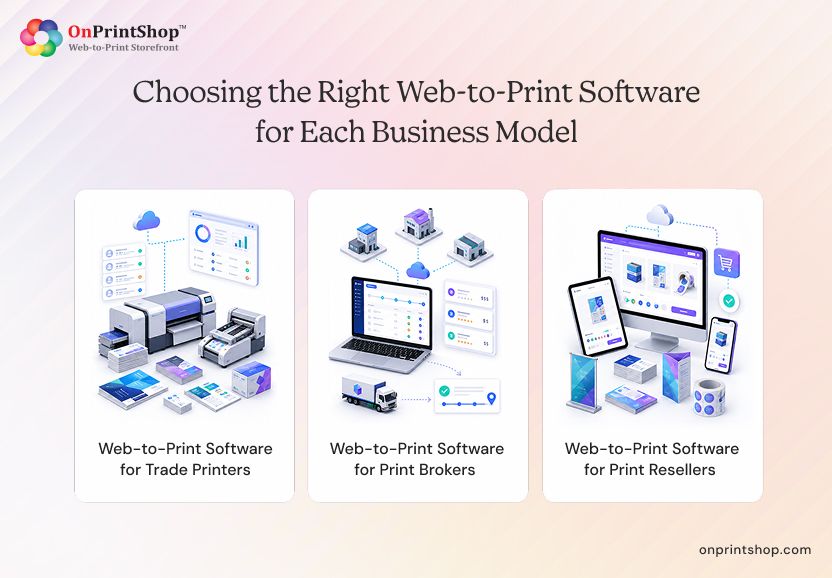
Each business model has unique operational requirements, but all three rely on software to streamline order processing, improve visibility, and reduce manual work. The right web-to-print capabilities depend on how your business manages production, vendors, and customer relationships.
Web-to-Print Software for Trade Printers
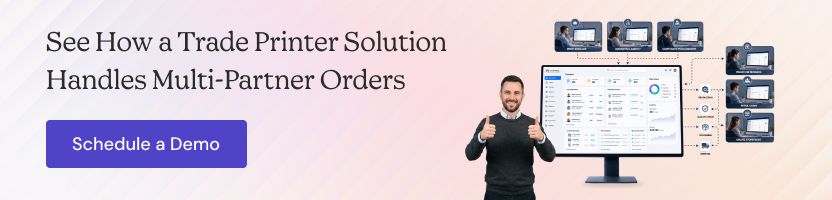
Trade printers process large volumes of orders from resellers, brokers, and other print businesses. They need software that simplifies multi-partner order management, automates production workflows, and provides complete visibility across incoming jobs. A web-to-print solution for trade printers helps manage reseller portals, vendor orders, and production from a centralized trade printer admin panel.
Web-to-Print Software for Print Brokers
Print brokers rely on efficient vendor management rather than in-house production. Multi-vendor routing, centralized quoting, and order tracking help brokers assign each job to the most suitable supplier based on pricing, capabilities, and turnaround times while maintaining a consistent customer experience.
Web-to-Print Software for Print Resellers
Print resellers need branded online storefronts that allow customers to browse, customize, and place orders seamlessly. Behind the scenes, the software connects those orders with a trade printer for fulfillment, enabling resellers to deliver a professional buying experience without managing production themselves.
Conclusion & Next StepThe difference between a trade printer, print broker, and print reseller ultimately comes down to ownership of production, customer relationships, and fulfillment. Understanding these differences also helps you determine whether a dedicated web-to-print solution for trade printers is the right fit for your business, enabling you to choose technology that aligns with your operational model and future growth.If your business operates as a trade printer or is transitioning toward that model, investing in the right web-to-print platform can simplify reseller order management, automate production workflows, and help you scale multi-partner operations with confidence.Ready to streamline your trade printing operations? Book a Demo with OnPrintShop and grow your print business 10x.