Is Your Print Business Ready for the Millennial Buyer? | Join Live Webinar on Oct 29






Back to News Page
OnPrintShop Launches Version 13.1 with AI-Powered Design, Smarter Product Setup, and Streamlined Workflows
Summary: OnPrintShop Version 13.1 introduced dynamic mask generation, AI-powered templates, PDF-based design blocks, flexible product configuration, and workflow enhancements to help print businesses simplify everyday operations.
OnPrintShop has officially launched Version 13.1, delivering a new set of AI-powered design capabilities, storefront enhancements, product configuration improvements, and administrative tools designed to make print business operations simpler and more efficient.
The latest release expanded the platform's capabilities across Designer Studio, the storefront, and the Admin Panel, helping print businesses reduce manual effort and manage everyday tasks with greater flexibility.
From generating product masks and design templates to simplifying product setup, quote management, order processing, and customer access, Version 13.1 brought practical improvements to multiple stages of the print ordering journey.
Smarter Tools Made Design Creation Faster
Design creation received significant attention in Version 13.1 with new tools designed to reduce repetitive work and simplify how print businesses prepare design assets.
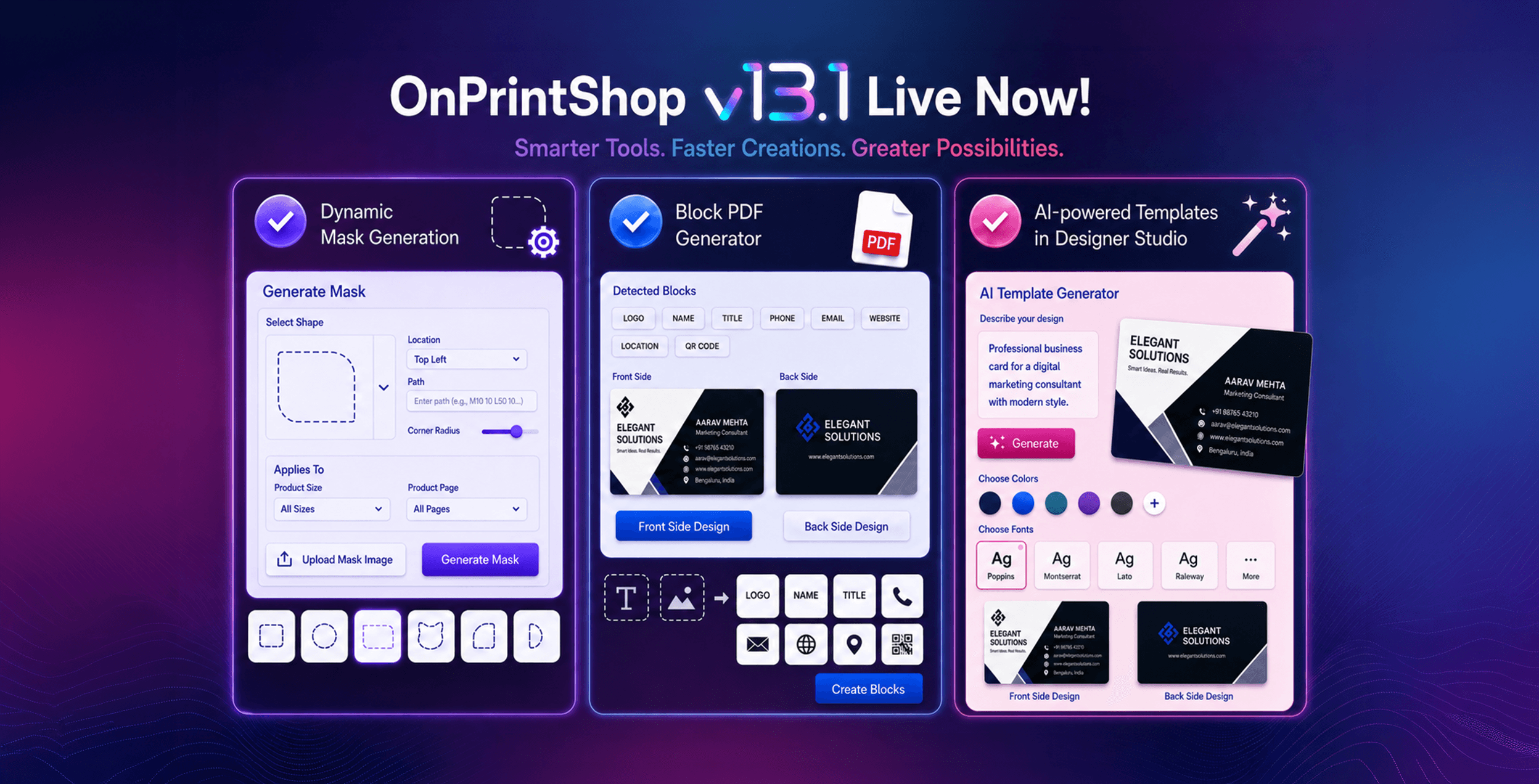
One of the key additions was Dynamic Mask Generation, which enabled users to generate product masks directly within OnPrintShop. Users could select a shape and configure the required mask details without depending entirely on pre-prepared mask images. The existing option to upload mask images remained available, giving businesses flexibility in managing their product assets.
The release also introduced the Block PDF Generator, allowing users to create individual design blocks directly from PDF artwork. The system automatically identified text and image elements within the PDF, making it easier to convert existing artwork into reusable blocks without requiring Adobe Acrobat or additional plugins.
Another major addition was AI-powered templates in Designer Studio. Users could provide clear prompts describing the design they wanted, and the system generated templates based on those instructions. This reduced the manual effort involved in creating design starting points and helped businesses accelerate template production.
Together, these capabilities made it easier for print businesses to create, prepare, and manage design assets within a single web-to-print environment.
Faster Order Handling with Greater Visibility
Version 13.1 also introduced improvements aimed at helping administrators manage orders more efficiently.
A new rush order indicator made urgent jobs easier to identify during order processing. Administrators could recognize priority orders at a glance, helping teams focus attention on jobs that required faster handling.
The release also streamlined the process of creating customer-specific designs during order modifications. Admins could now create a new customer design or version directly from the Order Modify page using Designer Studio. Once created, the resulting template was automatically saved and assigned to the relevant order.
By connecting order modification and design creation more closely, this enhancement reduced unnecessary navigation and helped teams respond more efficiently to customer design requirements.
Standard and Die-Cut Products Came Together
Product management became more flexible with the ability to manage standard and die-cut configurations within a single product.
Previously, businesses that offered both configurations could need separate product setups. Version 13.1 allowed them to manage both options together, reducing duplicate product administration and making catalogs easier to maintain.
This improvement gave print businesses greater flexibility when offering products with different shape or cutting requirements while simplifying the backend management of those products.
Phone-Based Login Added More Convenience
Customer account access also received an important usability enhancement.
With Version 13.1, customers could sign up and log in using their phone numbers, providing an alternative to email-based authentication.
The addition gave storefront owners another way to accommodate customer preferences and created a more convenient account access experience, particularly for customers who primarily interact with storefronts through mobile devices.
More Flexible Image and CMS Management
Version 13.1 expanded the tools available for managing storefront content and visual assets.
Users could now edit uploaded images directly within the platform using crop, rotate, flip, and zoom functions. The original image remained unchanged, while the edited version was saved as a new image. This allowed users to prepare assets for specific applications without modifying the original file.
The CMS also received a major usability improvement. Administrators could create responsive CMS pages without writing HTML or CSS, using drag-and-drop Bootstrap layouts, content blocks, styling options, and device previews.
This made it easier for businesses to build and manage responsive storefront pages while giving non-technical teams greater control over their website content.
Quote and Quantity Management Became More Flexible
Version 13.1 improved the quoting experience for both administrators and customers.
Incomplete quotes could now be saved as drafts, allowing teams to return to unfinished quotes without having to recreate them. The partial quote experience was also refined with an improved interface for reviewing and ordering approved items.
Quantity selection became more flexible through the new “Other” option in the Price Calculator. Customers could choose from predefined quantities or enter a custom quantity when their requirements fell outside the available options.
These improvements helped make quoting and ordering more adaptable to different customer requirements while reducing friction in the purchasing process.
4over Products Expanded into Shopping Feeds
Version 13.1 also extended product promotion capabilities by enabling admins to include 4over products in Google and Facebook Shopping Feeds.
The system automatically identified valid product combinations based on selected options and included only supported combinations in the feeds. This reduced the manual effort required to determine which product configurations could be promoted through external shopping channels.
For businesses using 4over products, the enhancement created another way to expand product visibility while keeping feed management more efficient.
Continuing the Evolution of Web-to-Print
With Version 13.1, OnPrintShop continued its focus on combining AI, automation, flexibility, and usability to address the evolving needs of print businesses.
The release brought improvements across the design, storefront, quoting, product, order, and administrative experiences. Rather than focusing on a single area, it strengthened a wide range of everyday workflows that contribute to a more efficient print operation.
From AI-generated design templates and automated PDF block creation to streamlined product management, faster rush order identification, and more flexible customer interactions, Version 13.1 gave print businesses new ways to reduce manual work and improve operational efficiency.
Alongside these enhancements, OnPrintShop also resolved identified bugs to further improve platform performance, stability, and the overall user experience.
Version 13.1 marked another step forward in OnPrintShop's vision of delivering a smarter web-to-print platform. By bringing intelligent design tools together with practical workflow improvements, the latest release helped print businesses simplify operations, respond faster to customer needs, and create a more seamless digital print experience.