


Blog Summary: North American print service providers are dealing with higher labor costs, tighter margins, and rising expectations for digital ordering. This article examines seven major operational challenges and shows how web-to-print software can address them.
Running a print business in North America has become more demanding. Labor costs continue to rise, margins remain under pressure, and buyers accustomed to ordering other products online increasingly expect print vendors to offer the same convenience and speed.
These pressures are among the biggest challenges for print service providers today, and PSPs that modernize their operations can gain an advantage over competitors still relying heavily on phone calls, email, and spreadsheets. PSPs can use comprehensive web-to-print software to reduce much of that operational friction without simply adding more staff, a shift that industry organizations such as Printing United Alliance have followed closely.
This article examines seven common operational challenges facing PSPs and the ways web-to-print software can address each one.
Quick Answer:
The table below summarizes the business impact of each issue and the web-to-print capability that can help address it.
7 Challenges Faced by North American Print Service Providers
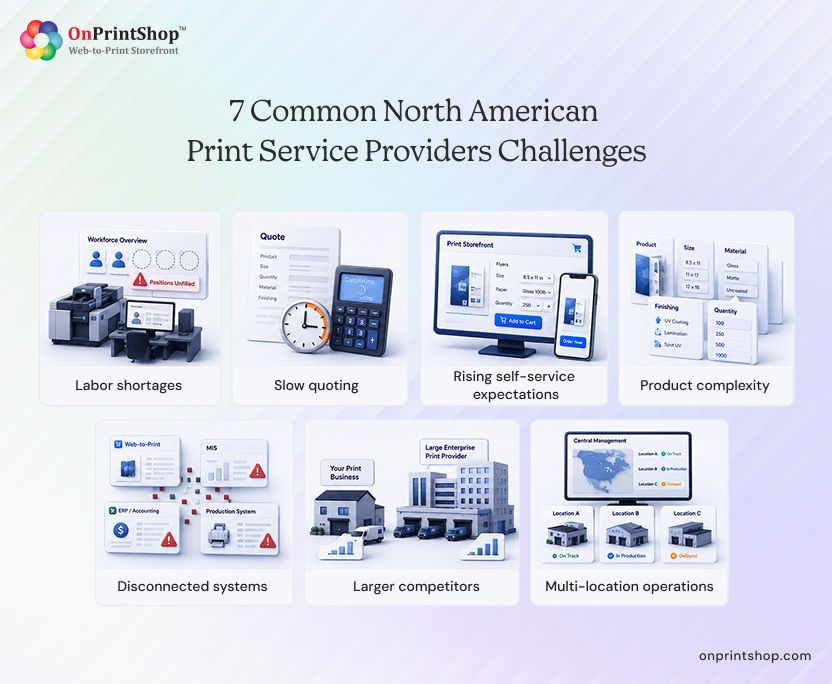
Across North America, print service providers commonly encounter seven connected operational hurdles: labor shortages, slow quoting, higher expectations for self-service, product complexity, disconnected systems, pressure from larger competitors, and the challenge of coordinating multiple locations.
#1) Labor Shortages and Skilled Staff Retention
Labor shortages remain a persistent challenge for print service providers in North America. As experienced press operators and prepress professionals retire, PSPs can find it harder to increase production capacity without placing more pressure on the people already on staff.
Where Skilled Time Gets Wasted
- Manual order-taking through phone calls and email
- Repeated prepress checks on submitted files
- Manual proofing and approval coordination
- Order entry that repeats information already supplied by the buyer
When skilled press or prepress employees spend time re-entering information or following up on approvals, that time is no longer available for production. The impact becomes more significant when the available pool of experienced workers is limited.
Shifting Repetitive Work to the Storefront
- Self-service ordering allows specifications, files, and proof approvals to be handled online
- Automated proofing can route files through standardized checks before manual review
- Standardized product templates reduce the need for one-off configuration
PSPs using dedicated web-to-print solutions shift much of this repetitive intake work away from staff inboxes and into a self-service storefront. That gives skilled employees more time for production, quality control, and work that requires human judgment.

#2) Slow, Manual Quoting and Order Processes
Manual quoting is another major challenge for print service providers. Phone- and email-based pricing can take hours or even days to complete, while competitors with faster processes may respond within minutes.
Why Delayed Quotes Cost Orders
- Buyers comparing several vendors may choose the provider that responds first
- Manual pricing calculations can create inconsistencies between quotes
- Sales employees spend time on repetitive calculations instead of customer relationships
What Real-Time Quoting Changes
- Rule-based pricing engines can calculate quotes from specifications, quantities, and finishing options
- Centralized order management keeps quote and order information together, reducing transcription errors
- Consistent pricing can be presented regardless of which employee handles the request
#3) Rising Customer Expectations for Speed and Self-Service
Print buyers increasingly expect a no-contact ordering process for print, like other online purchases. They want to access outside business hours, visibility into order status, digital previews, and easy customization. PSPs that depend primarily on phone and email can struggle to meet those expectations.
What Today's Buyers Expect
- 24/7 access to ordering instead of business-hour-only availability
- Live order status without requiring a follow-up call
- Digital previews before a job enters production
- Browser-based design and customization
- Less reliance on phone calls for routine repeat orders
An always-on storefront paired with a browser-based web-to-print online designer allows buyers to create and approve artwork without waiting for a design request to move through a queue.

#4) Managing Product Complexity and Customization at Scale
Variable data campaigns, wide-format signage, and packaging jobs can become difficult to price and produce consistently as order volume grows. The challenge is greater when product specifications and pricing rules are kept in spreadsheets or depend on individual employees' knowledge.
Where Manual Complexity Breaks Down
- Personalized and variable data jobs require accuracy for each recipient
- Wide-format work can involve substrate, finishing, and file-preparation requirements that differ from standard print
- Packaging projects may require dielines and structural specifications in addition to artwork
- Different products can require their own pricing logic
Centralizing Configuration and Pricing
- Configurable product templates can apply the appropriate options and pricing rules
- Dedicated design tools can support format-specific requirements while reducing manual rework
- Centralized configuration reduces the likelihood of incorrect specifications reaching production
A platform built around flexible large-format printing software can apply appropriate templates and pricing rules consistently instead of leaving those decisions to memory or spreadsheets.
#5) Disconnected Systems Between Storefront, Shop Floor, and Accounting
When the storefront, production system, and accounting software operate separately, employees may have to enter the same order information multiple times. Each additional handoff creates another opportunity for an error and adds friction to the fulfillment process.
The Cost of Data Silos
- Repeated manual entry between systems
- Order details can differ between what was quoted and what reaches production
- Billing can slow down when production and accounting data are not synchronized
- Employees lack one reliable view of order status
Connecting the Order Lifecycle
- MIS integrations can carry order specifications into production
- Accounting integrations can reduce manual invoice entry
- A connected workflow gives employees one place to check order status instead of several
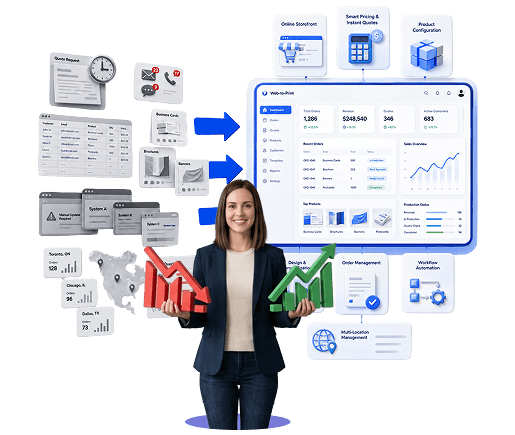
When a PSP's technology stack supports it, linking order management with production and accounting systems can close many of these gaps. This may include integrations with MIS platforms or accounting tools such as QuickBooks and Xero. Print fulfillment software can provide this connective layer.
#6) Competing with Larger, Better-Resourced Printers
Independent and regional PSPs do not necessarily need the same headcount as a national printer to compete. They do, however, need to deliver competitive turnaround times and manage per-order costs efficiently, both of which become harder when core processes remain manual.
Where the Gap Shows Up
- Manual work adds labor cost to every order
- Slower turnaround can send time-sensitive jobs to more automated competitors
- Inconsistent capacity planning can make tight deadlines harder to promise
Closing the Gap Without Adding Headcount
- Workflow automation can remove repetitive steps between order intake and production
- Automated job routing can reduce manual handoffs and keep work moving
- Time saved on administration can be redirected toward productive capacity
An all-in-one print workflow automation platform can lower per-order overhead and help smaller and mid-sized PSPs operate more efficiently alongside larger competitors.

#7) Coordinating Multi-Location and Franchise Operations
Multi-location and franchise PSPs face an added coordination challenge: pricing, branding, and order routing must remain consistent across locations while local teams still need enough flexibility to serve their markets.
Where Multi-Location Operations Break Down
- Pricing may vary unintentionally between locations
- Customer-facing storefronts may use inconsistent branding
- Orders can be routed to the wrong location or production queue
- Network owners may have limited visibility into performance across locations
Centralizing Without Losing Local Control
- Brand-compliant, location-specific storefronts can keep pricing and branding consistent
- Centralized administration gives network owners oversight without requiring them to manage every local detail
- Automated order routing can direct jobs to the appropriate location by default
An easy-to-use web-to-print platform designed for franchise owners gives network operators centralized control while allowing individual locations to serve their local markets.
ConclusionLabor shortages, slow quoting, higher expectations for self-service, product complexity, disconnected systems, larger competitors, and multi-location coordination may look like separate problems, but they often point to the same underlying issue: too many parts of the PSP operation still depend on manual and disconnected processes.AI-powered Web-to-print solutions connect the storefront, shop floor, and back office, helping address labor pressure, speed, complexity, and coordination through a more unified workflow.For PSPs deciding where to begin, reviewing web-to-print software be a practical starting point for addressing several challenges at once. If these bottlenecks sound familiar, schedule a demo to explore how the platform could fit your operation.