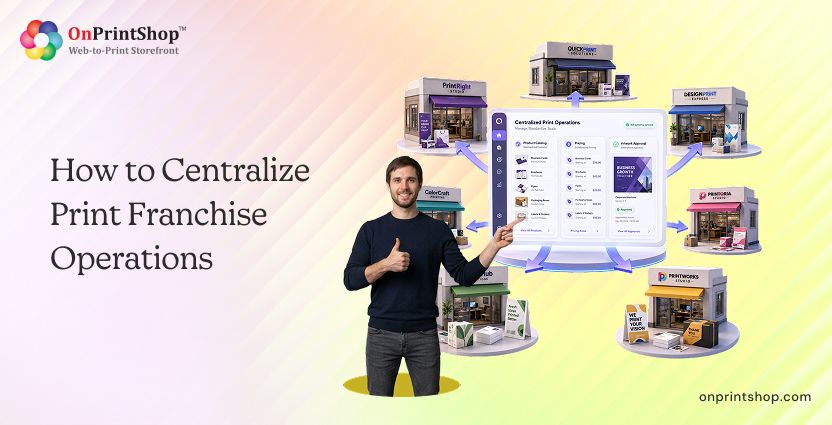




Blog Summary: Running a print franchise network means juggling brand control, pricing, and rollout across every location. This article breaks down how OnPrintShop's Franchise Management Module centralizes management while preserving franchisee flexibility, from store rollout to performance reporting. Read on to see how it fits your network.
If you already run web-to-print across your franchise network, ordering usually is not the hard part. The hard part is keeping pricing, branding, product catalogs, and reporting consistent once you pass a handful of locations. Many multi-unit operators reach a point where manual oversight can no longer keep pace with the expected output increase of 1.6% from $907.3 billion to $921.4 billion, according to industry analysis of franchise growth by Internation Franchise Association.
A generic W2P storefront handles transactions well, but it was not built to manage a distributed franchise structure that needs corporate-level control alongside local flexibility. That gap is where a dedicated franchise management module becomes necessary. OnPrintShop's leading web-to-print for franchise owners platform addresses this directly, and its Franchise Management Module is built specifically to give franchisors centralized control without stripping franchisees of day-to-day autonomy.
What OnPrintShop's Franchise Management Module Does for Print Networks
OnPrintShop's franchise management module makes centralizing print franchise dashboard effortless to control franchise-wise store access, product catalogs, pricing, and brand standards across every location, while still tracking order visibility and performance network-wide. It replaces spreadsheets and location-by-location administration with a single system built for distributed print operations.
For a franchisor, the module works as an operating layer that sits above individual storefronts rather than replacing them. It covers:
- Centralized franchise network management: view every location, its orders, and its performance from one dashboard instead of logging into separate storefronts.
- Franchise-wise store access: control who can see and manage which stores, products, and pricing, so franchisees only work within their assigned scope.
- Franchisee storefront management: launch, update, and monitor each franchisee's storefront without rebuilding it from scratch.
- Centralized product catalog management: approve and push products network-wide so every location sells the same standardized offerings.
- Franchise-wise pricing control: set base pricing at the corporate level while allowing approved local adjustments where your business model calls for it.
- Brand consistency across franchise locations: apply locked templates and approved artwork so every franchisee's output matches your brand guidelines.
- Centralized order visibility: track order status and volume across the entire network rather than one location at a time.
- Franchise performance reporting: compare locations against each other and against network averages to identify what is working.
This combination of centralized print franchise dashboard visibility and franchise-wise store access is what separates print franchise management software from a standard storefront. Local flexibility still matters. Franchisees may need to adjust for regional pricing, seasonal promotions, or local production capacity, and the module allows that within corporate guardrails instead of forcing every location into an identical mold. That balance of corporate control and local flexibility is central to how you manage multiple print franchise locations at scale.

How the Module Differs from a Generic Web-to-Print Storefront
A standard web-to-print storefront is designed primarily to take orders online, handle checkout, and manage a single catalog. A franchise management module adds a governance layer on top, addressing network-level control, franchise-wise access, brand governance, and multi-location reporting that a single-store platform was never built to handle.
This does not make a generic W2P storefront a poor choice. For a single location, it is often exactly what is needed. The distinction matters once a network grows past one storefront and corporate teams need visibility and control across many of them at once. The table below lays out the core print franchise software features that separate the two.
Core Capabilities for Managing Multiple Print Franchise Locations
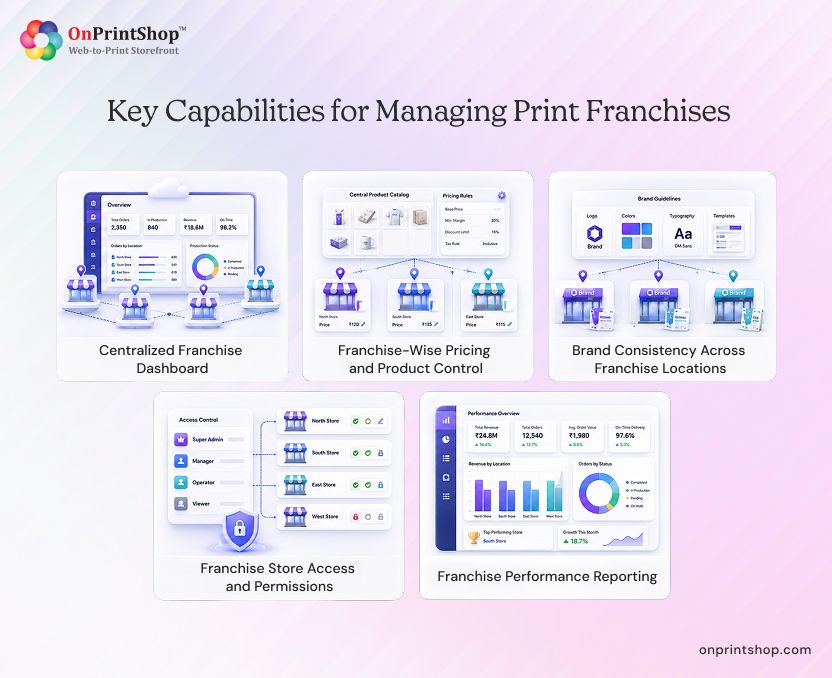
Franchisors evaluating print franchise management software should prioritize a centralized dashboard, franchise-wise pricing and product control, brand consistency tools, role-based store access, and performance reporting. These five capabilities determine whether a platform can actually support a growing, multi-location network rather than just processing orders.
Centralized Franchise Dashboard
A centralized franchise dashboard gives network operators one place to see orders, performance, and operational activity across every location, removing the need to log into and manage each franchisee's storefront separately. It turns scattered location-level data into a single operational view.
This kind of network-wide visibility works alongside centralized reporting & analytics tool, so operators can move from a high-level dashboard into deeper performance detail for any specific location when needed.
Franchise-Wise Pricing and Product Control
Franchise-wise pricing and product control lets corporate teams set approved products and base pricing structures network-wide while still supporting location-specific requirements, such as regional cost differences or local promotions, without losing oversight of what franchisees are allowed to sell.
Consistent pricing logic also depends on accurate cost calculation behind the scenes. Pairing this control with automated print estimation software helps ensure pricing stays accurate as products and locations are added.
Brand Consistency Across Franchise Locations
Brand consistency across franchise locations relies on brand lock templates, pre-approved artwork, and standardized product setups that prevent individual franchisees from altering corporate branding, helping every location present the same visual identity regardless of who manages the local storefront.
Storefront presentation plays a role here too. Customizable W2P storefront themes let corporate teams apply an approved visual template across every franchisee's storefront rather than leaving design decisions to each location.
Franchise Store Access and Permissions
Franchise-wise store access uses role-based permissions so each franchisee sees and manages only the stores, products, pricing, and information relevant to their location, protecting sensitive network-wide data while still giving franchisees the operational control they need day to day.
Franchise Performance Reporting
Franchise performance reporting compares individual locations against each other and against network averages, including figures such as quarterly forecast vs. actuals, so franchisors can identify underperforming locations and replicate what is working at the strongest ones.
Centralized reporting and location-level visibility together give corporate teams the data they need to make network-wide decisions rather than reacting to individual location issues one at a time.
How Fast Can You Roll Out a New Print Franchise Store?
Once you are done with implementing the W2P for your print brand, new print franchise store rollout follows a repeatable workflow rather than a fixed timeline: setting up the location, configuring access and pricing, applying brand and catalog controls, and validating the storefront before launch. The exact time depends on catalog complexity, required integrations, and how many internal approvals a franchisor requires.
A typical franchise store rollout software workflow includes:
- Set up the new franchise location in the franchise management dashboard.
- Configure store access and franchise-wise permissions.
- Apply approved products and catalogs to the new store.
- Configure location-specific pricing where required.
- Apply brand lock templates and approved artwork controls.
- Configure workflows and ordering rules for the location.
- Validate the storefront before it goes live.
- Launch the store and monitor its early performance.
Working from a repeatable rollout workflow means new locations reuse existing brand and catalog setup rather than starting from a blank storefront each time.

Why OnPrintShop Runs the Franchise Management Module
OnPrintShop brings more than 18 years of web-to-print experience to franchise network management, supporting over 2,000 print businesses across more than 50 countries. In 2026, the platform won the EDP Award for Best Print Commerce Solution, external recognition from Europe's print industry press.
For a franchisor evaluating any platform, credibility signals like customer base, longevity, and independent industry recognition matter when choosing the best web2print software because they indicate whether a vendor can support a growing network over time, not just at launch. OnPrintShop's customer base spans commercial printers, wide format and packaging printers, and print franchise and trade networks.
The platform's most recent recognition, the EDP Award 2026, was awarded by an independent jury of experts from 20 of Europe's leading print trade publications for making AI practical within everyday print commerce workflows.
What Results Can Print Franchise Networks Achieve?
Two verified OnPrintShop customer results illustrate what a franchise management approach can produce. Shapco Printing added 12 new B2B and franchise clients, and Kwik Kopy locations, operating on the Fortusis-managed OnPrintShop platform, achieved a 20% increase in online sales.
12 new B2B/franchise clients.Shapco Printing used OnPrintShop's customizable platform to win back lost corporate accounts and add new large-scale B2B and franchise clients, including accounts with complex multi-location ordering needs.Read the Shapco Printing success story
20% online sales increase.Kwik Kopy locations, part of the Fortusis franchise network, saw consistent online sales growth after moving to OnPrintShop's scalable, multi-location web-to-print platform.Read the Fortusis / Kwik Kopy success story
When Does a Print Network Need a Franchise Management Module?
A print network typically needs a dedicated franchise management module once manual processes stop keeping pace with growth. More locations, more product variations, harder-to-enforce branding, inconsistent pricing, and reporting that requires manual consolidation across stores are the clearest signals that a network has outgrown a single generic storefront.
- Multiple franchise locations operate independently, with no shared visibility.
- Corporate teams need centralized control over stores, pricing, and products.
- Product catalogs are becoming difficult to maintain consistently across locations.
- Franchise-specific pricing is difficult to manage from a single storefront.
- Brand consistency is becoming harder to enforce as the network grows.
- Reporting requires manual consolidation from multiple separate stores.
- New stores require repetitive, time-consuming manual setup.
- Franchisees need operational autonomy without unrestricted network access.
- The network is actively preparing for additional franchise expansion.
Not every franchise needs a dedicated module immediately. The decision comes down to operational complexity and where a network sits on its growth curve.

ConclusionA generic web-to-print storefront can process orders, but it cannot govern a distributed franchise network on its own. OnPrintShop's advanced web-to-print software for print franchise adds the centralized control, franchise-wise management, brand consistency, and pricing governance a growing network needs, alongside faster store rollout and network-wide reporting visibility.As a network adds locations, these capabilities compound: consistent branding protects the customer experience, centralized pricing protects margins, and network-wide reporting protects decision-making. Franchisors who pair this with centralized Print Order Management get a fuller operational picture across every location.If your network has reached the point where spreadsheets and separate storefronts no longer scale, it is time to book a demo with OnPrintShop about your franchise network.