




Blog Summary: Print shops hit a growth ceiling not because of weak demand, but because of broken internal processes. This post walks you through the exact operational fixes that drive real print business growth. Read on to build a business that scales without burning you out.
Most print businesses do not fail because of lack of demand. They stall because internal operations cannot keep up. Owners get buried in daily firefighting, quoting delays pile up, production errors repeat, and customers quietly move on.
According to a McKinsey & Company report, companies that automate core workflows reduce operational costs by up to 30% while significantly improving turnaround speed.
The path to sustainable print business growth starts with replacing manual dependency with structured, repeatable processes backed by the right technology. Start by exploring what a modern print order management system can do for your operation.
Why Print Business Growth Stalls
Print shops that hit a growth ceiling almost always share the same root cause, the business is built around people, not processes.
When orders, estimates, and customer communication all depend on one or two individuals, the business cannot scale beyond their personal capacity. Add disconnected tools, manual order tracking, and no centralized data, and sustainable growth becomes structurally impossible.
The most common growth blockers in print businesses:
- Owner or manager is the single decision point for most daily tasks
- Estimates and quotes depend entirely on key staff availability
- Orders are tracked manually across spreadsheets or email threads
- No real-time visibility into production status or delivery timelines
- Multiple software tools that do not communicate with each other
- Customer data spread across departments with no central record
Identifying which of these apply to your business is the first step toward fixing them.
The Real Cost of Manual Operations
Manual processes do not just slow things down. They create compounding costs at every stage of your workflow.
A delayed quote loses an order. A missed production update frustrates a customer. A data entry error triggers a costly reprint. Over time, these small failures add up to serious revenue loss and reputational damage.
Where manual work hurts most:
- Quoting delays: Estimating jobs manually slows your sales cycle and gives faster competitors an edge. The right print estimating software removes this bottleneck entirely.
- Proofing bottlenecks: Email-based approval chains extend turnaround and create version confusion. Centralized proofing approval systems cut this cycle significantly.
- Reporting gaps: Without real-time reporting and analytics tools, managers cannot spot bottlenecks until they have already become customer complaints.
Callout: "The print businesses scaling fastest are not the ones working harder. They are the ones that replaced reactive firefighting with structured, automated workflows."

How to Delegate without Losing Control
Delegation fails when there are no systems to support it. Handing off responsibility without documented processes or tracking tools creates more confusion than it solves.
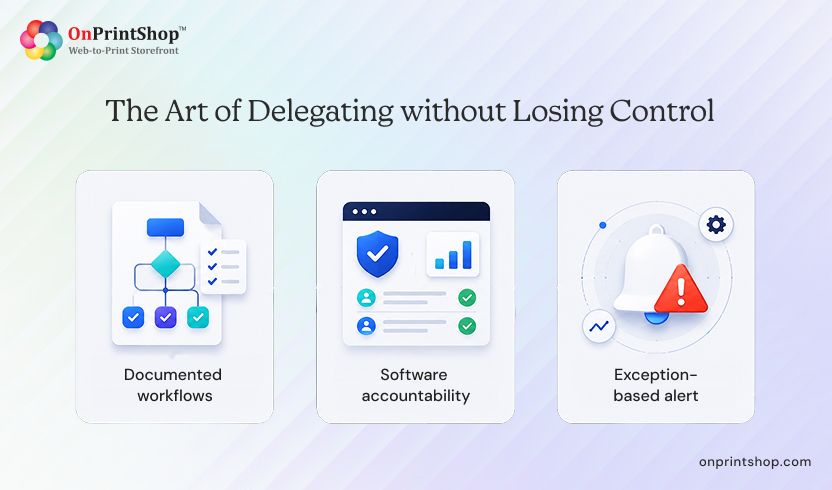
Effective delegation in a print business requires three things:
1. Documented workflows so every team member follows consistent steps for each task type
2. Software accountability so task ownership and completion timestamps are visible without constant check-ins
3. Exception-based alerts so managers are only notified when something deviates from expected parameters
When the print business owners place these three elements by automating the print business with a step-by-step guide, they can step back from daily operations and focus on growth strategy without losing visibility into what is happening on the floor.
Fixing Workflow Bottlenecks That Drain Time
Before investing in any software, map your current operations in detail. Walk through each department and identify where time is lost most consistently, where errors recur, and where customer frustration originates.
Most print businesses find that 20% of recurring problems drive 80% of operational friction. Solving those specific issues delivers outsized results faster than any broad overhaul.
High-impact areas to address first:
- Order intake and job ticketing
- Design file management and proofing approvals
- Production scheduling and live status updates
- Delivery tracking and proactive customer notifications
- Invoice generation and payment follow-up
Addressing these with print workflow automation builds a foundation that handles significantly higher order volumes without proportional increases in headcount or cost.
Choosing the Right Print Management Software
Choosing print management software based on a feature list is one of the most expensive mistakes print businesses make. Features matter, but operational fit matters more.
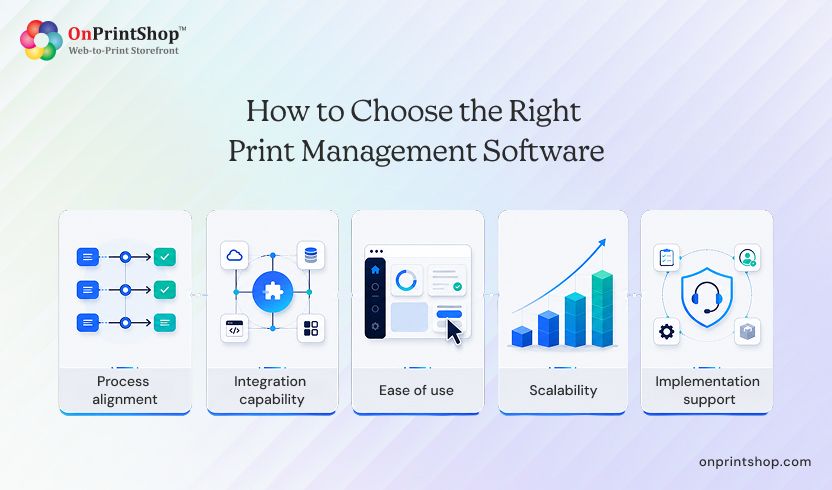
What to evaluate before committing:
- Process alignment: Does it match how your team actually works, or does it require rebuilding every workflow from scratch?
- Integration capability: Can it connect with your existing tools for shipping, accounting, or design?
- Ease of use: If your team finds it difficult, adoption will fail regardless of how technically capable the platform is
- Scalability: Will it support your business at 2x or 5x current order volume?
- Implementation support: Vendor support during rollout is just as important as the product itself
Always request a personalized demo using your own product types and order scenarios. Ask the vendor to walk through your specific workflow, not a generic presentation.

How to Implement Without Disrupting Operations
Software implementation fails most often not because of the technology, but because of poor change management. The most capable platform will underdeliver if your team is not brought along properly.
Common implementation mistakes to avoid:
- Rolling out company-wide before piloting with one team or workflow
- Over-customizing the system before your team understands the default setup
- Excluding key production staff from setup and testing
- Treating implementation as a technical project instead of an operational transition
A phased rollout works best. Start with one workflow, measure the outcome, adjust, then expand. Keep the configuration simple in the early stages. The goal in the first 90 days is adoption, not optimization.

ConclusionPrint business growth does not come from working longer hours or adding headcount to a broken system. It comes from replacing manual dependency with structured, automated workflows that run consistently at scale.The print shops growing fastest today made one deliberate decision: they built systems first and let those systems support their team.If you are ready to move from reactive operations to a scalable print business, explore the print order management system purpose-built for this transition. Book a personalized demo and see how it maps to your specific workflow.