



Blog Summary: Profit margins are under growing pressure across the print industry, but some businesses continue to move forward. Discover the five data-backed strategies successful print companies are using in 2026, along with the technology supporting them, and assess where your business stands.
Successful print companies in 2026 are taking a different approach to growth. They are focusing on specific markets instead of relying on price competition, making workflow automation part of their core operations, using AI as an everyday business tool, expanding into higher-value print categories, and giving customers digital-first, self-service ordering options. Together, these practices help growth-focused print businesses maintain profitability while others struggle to keep pace.
According to PRINTING United Alliance's State of the Industry Report 2026, print businesses are facing a widening gap between operating costs and price increases, putting additional pressure on companies that continue to operate as they did several years ago. Growth remains achievable, but equipment alone is no longer enough to drive it. Business strategy plays an increasingly important role. The sections below examine the practices that distinguish growing print companies and show how a modern web-to-print storefront can support those strategies.
How Are Print Companies Actually Performing in 2026?
Operating costs across the industry climbed 4.8% in 2025, compared with a 2.8% increase in prices, according to PRINTING United Alliance and NAPCO Research's 2026 State of the Industry Report. When costs rise faster than pricing, printers have less room to protect their margins.
The same report found that just 45.1% of printers increased their prices in 2025, while 64.6% reported flat or declining pre-tax profitability. According to ASI Research and Print & Promo Marketing, profitability is expected to remain one of the leading sales challenges for printers in 2026, ranking just behind customer-base growth.
These figures do not suggest that the entire print industry is in decline. Instead, they point to an increasingly uneven market. Some print businesses are continuing to grow despite higher costs, while others are keeping prices unchanged as their expenses continue to rise.
The key difference is often not the equipment sitting on the production floor. It is how businesses choose to operate around that equipment. Successful print companies are making different strategic choices, and five recurring behaviors stand out among businesses that continue to grow profitably under the same market pressures.
These strategies are also a part of the print industry trends shaping commercial printing, providing context for why these strategies have become important.
What Separates Growing Print Companies from the Rest?
Businesses experiencing growth tend to share five core behaviors, although the way they apply them varies according to their market and business model. Here is how these strategies translate into practical action.
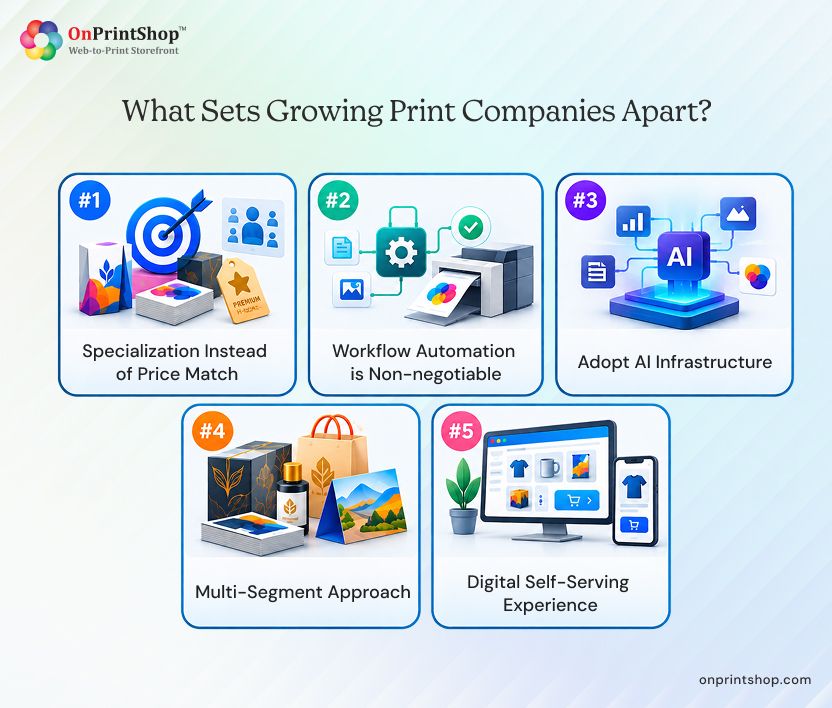
#1 They Specialize Instead of Competing on Price
According to NAPCO Research, roughly half of printers reporting sales growth combine niche specialization with a clearly defined customer segment. Instead of attempting to appeal to every possible buyer, these businesses focus on a particular area and develop deeper expertise around it.
Specialization can provide a print business with several tangible benefits:
- It helps distinguish the company from generalist competitors through service and expertise rather than price alone.
- It develops deeper knowledge of a particular product category or industry vertical.
- It allows sales and marketing efforts to address the needs of a specific type of buyer.
- It creates a more compelling and defensible value proposition than simply claiming, "we can print anything."
A specialized print shop competitive advantage could take the form of a wide-format printer serving only retail environments or a trade printer dedicated to a particular vertical, such as healthcare marketing. The exact niche is less important than committing to one and developing meaningful depth within it.
#2 They Treat Workflow Automation as Non-Negotiable
About 84% of printers that report sales growth are investing in workflow automation, according to NAPCO Research. The finding shows that automation is becoming part of how growth-focused print businesses operate today rather than something they plan to adopt at some point in the future.
For a print business, automation can deliver several practical improvements:
- Less manual and repetitive work during order entry and job routing.
- Fewer errors caused by repeatedly entering the same information into different systems.
- Faster movement of orders through submission and production.
- More consistent processes across employees, shifts, and locations.
- The ability to handle greater order volumes without increasing headcount at the same pace.
For print businesses that still depend heavily on phone orders, email approvals, and manual estimates, implementing reliable print workflow automation software is one of the most impactful operational improvements available.
#3 They Adopt AI as Infrastructure, Not Experimentation
PRINTING United Alliance reports that 85% of print service providers consider AI critical to remaining competitive. More than 70% also identify productivity as their leading business priority for 2026, according to the same research.
For most print businesses, AI is not limited to one standout feature. Instead, it can be applied across everyday activities such as:
- Creating and improving product descriptions and marketing content.
- Producing or enhancing images for templates and product mockups.
- Handling common customer questions through chat-based support.
- Generating product recommendations based on previous orders.
- Translating storefront content and communications for customers who speak different languages.
- Assisting operational processes such as estimating and job routing.
AI is not about replacing the people who operate a print business. Its role is to take repetitive tasks off their workload, giving teams more time for customer relationships, complex quotes, and account growth. Businesses exploring practical AI-powered web-to-print capabilities can begin with one or two useful applications rather than attempting to automate every possible process immediately.
#4 They Diversify Into Adjacent, Higher-Margin Segments
Pressure on traditional print margins is encouraging growth-oriented businesses to explore neighboring product categories. NAPCO Research reports that more than half of growth leaders are expanding into production inkjet.
Wide-format printing provides one example of this broader opportunity. The large-format printing market was valued at approximately $9.82 billion in 2025 and is expected to reach approximately $10.42 billion in 2026 before growing to roughly $19.92 billion by 2030. Diversification into specialty and decorative applications is one factor contributing to this growth.
Other adjacent and potentially higher-value areas being explored by print businesses include:
- Large-format, giant-format, and wide-format printing.
- Specialty and decorative applications.
- Personalized and customized products.
- Growing print-on-demand trends for PSPs.
There is no single product category that delivers the highest margin for every print business. The right choice depends on factors such as existing equipment, the current customer base, and demand in the region. What remains consistent is the strategy of moving beyond dependence on a single product line. A dependable large format printing software platform can make it easier to introduce new product categories without having to build an entirely new storefront.
#5 They Run Digital-First, Self-Serve Ordering Experiences
Digital ordering has moved beyond being a differentiator. In 2026, it is a baseline expectation for many B2B and B2C print buyers.
A self-service, digital-first ordering experience can help print businesses:
- Accept orders beyond standard business hours.
- Reduce the emails and phone conversations required to confirm specifications.
- Make repeat purchases easier for existing customers.
- Support B2B, B2C, and reseller customers through a single platform.
- Handle increasing order volumes without expanding sales staff at the same rate.
This connects directly with where B2B print businesses are investing their digital budget in 2026. Order accuracy, self-service functionality, and faster turnaround are taking priority over features that simply look impressive. With a well-designed web-to-print storefront, customers can place orders themselves within minutes and at a time that suits them, without having to depend on a salesperson to process every request.

How Web-to-Print Technology Supports Each of These Strategies
Strategy works best when the underlying technology can support it. A modern Web-to-Print platform can connect the five behaviors above to specific capabilities that make them easier to implement.
Specialization: Product-Specific Storefronts
A specialized print business needs an ordering experience designed around its products and target customers rather than a broad, generic catalog. Useful capabilities include:
- Product-specific storefronts built around a defined catalog.
- Customized catalogs tailored to individual market segments.
- Ordering experiences designed for different types of buyers.
- Dedicated B2B storefront solutions for corporate and reseller accounts.
With this approach, a specialized printer can reinforce its expertise in a particular category rather than positioning itself as another generalist competing primarily on price.
Automation: Order Management Without the Manual Work
Effective automation requires the different systems within a print operation to work together. Relevant capabilities include:
- Centralized print order management.
- Workflow automation covering the process from order placement through production.
- Automated estimating that eliminates manual quote calculations.
- Integrations that maintain consistent data between systems.
Businesses considering accurate print estimation software are often trying to address a straightforward operational issue: estimates take too much time to prepare or produce inconsistent results depending on who calculates them.
AI: Practical Tools, Not Hype
AI capabilities that align with the strategies above include AI Designer Studio, AI image generation and enhancement, AI-assisted product content, AI-powered recommendations, and translation. Each capability can address a specific operational challenge, whether that means shortening design turnaround, improving product imagery, creating better descriptions, or making a storefront accessible to customers using different languages.
Digital Ordering: Storefronts Built for Self-Service
A digital-first ordering model relies on Web-to-Print storefronts that combine online design tools, self-service workflows, and product personalization. An intuitive online designer studio gives customers the ability to create and approve their own artwork, eliminating one of the common delays in the print ordering process.
Integration: Connecting the Rest of the Business
These capabilities cannot operate effectively as isolated systems. Web-to-print technology needs to work with the tools a print business already depends on, including MIS, accounting platforms, CRM systems, payment gateways, and production workflow solutions. OnPrintShop offers 100s of third-party integrations, allowing digital ordering and automation to operate without forcing businesses to manage an additional disconnected system.

Real Print Companies Putting These Strategies Into Practice
The strategies discussed above are not merely theoretical. Print businesses across different segments, including trade printers, commercial printers, wide-format shops, and franchise networks, are combining these approaches according to their individual market positions.
For example, a trade printer focused on quick turnaround may concentrate specifically on reseller and broker relationships. It can then introduce automation to keep quoting and production fast enough to compete through speed rather than lower pricing.
A commercial printer with an established B2B customer base may take a different route. It could introduce a wide-format or specialty product line to capture revenue that customers might otherwise spend with another vendor.
The common factor is not one particular tactic. It is the ability to bring specialization, automation, AI, diversification, and digital ordering together as parts of one operating model instead of handling them as unrelated projects.
A Practical Checklist to Become a 2026-Ready Print Company
- Identify a profitable niche or clearly defined customer segment.
- Review existing manual processes across order entry, quoting, and production handoffs.
- Select one or two automation opportunities that offer the clearest potential ROI.
- Determine practical applications for AI, including customer support, product content, or image enhancement.
- Assess adjacent print segments that align with your existing equipment and customer base.
- Strengthen digital ordering and self-service capabilities for repeat buyers.
- Track profitability, productivity, and customer acquisition alongside order volume.
ConclusionPrint businesses that continue to grow profitably in 2026 tend to follow five common practices. They focus on specialization rather than relying entirely on price competition, make workflow automation part of their core infrastructure, use AI-powered web-to-print storefront for practical business needs, expand into adjacent product categories, and provide digital-first self-service ordering.Adopting these behaviors does not mean replacing everything that already works. Instead, print businesses can review their current operations against the checklist above and introduce changes in a deliberate order. One useful starting point is determining whether your existing W2P storefront solutions are capable of supporting the customer segment and experience you want to develop. So, book a demo today with OnPrintShop and experience how Web2Print solutions can make your print business stand out.