


Blog Summary: Your corporate customers may already source branded merchandise from another vendor. Promotional product printing gives PSPs a way to capture more of that demand. This guide covers the category, key product types, decoration methods, market-entry models, and practical steps for adding branded merchandise to your business.
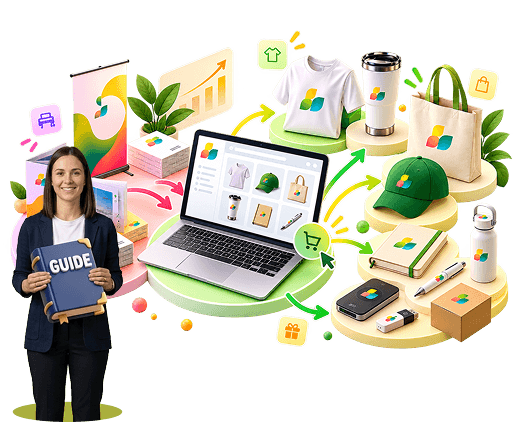
Many PSPs have an established base of corporate customers that regularly purchase business cards, signage, brochures, and other printed materials. Those same customers may also source branded merchandise from separate vendors. Promotional product printing creates an opportunity to extend these existing relationships into apparel, drinkware, bags, tech accessories, and other branded items while keeping print at the center of the business.
This is where PromoStandards becomes relevant. PromoStandards is an open industry standard that allows suppliers, distributors, and decorators to exchange product, inventory, and order information through a common format. With the help of a robust PromoStandards integrated web-to-print solution, printers can provide a structured way to manage product presentation and ordering.
This guide looks at what promotional product printing means, how it differs from commercial printing, which products and decoration methods are commonly used, and the different ways PSPs can enter the market.
What Is Promotional Product Printing?
Promotional product printing refers to decorating branded products, including apparel, drinkware, bags, and technology accessories, with a logo, design, or marketing message. Businesses typically use these products for promotional campaigns, corporate gifting, events, employee programs, and other business initiatives. The physical item is the promotional product, while the printing or decoration is the service applied to it.
Promotional products may also be described as branded merchandise, swag, or corporate gifts. The supply chain generally involves four main participants:
- Supplier: Produces or stocks the blank product and typically provides the product catalogue.
- Decorator: Applies the customer's logo, artwork, or message through a method such as embroidery or screen printing.
- Distributor: Sells the finished product to the customer and manages the business relationship.
- Buyer: The company purchasing the merchandise for an event, campaign, employee program, or other purpose.
A single company can perform more than one of these functions. For example, a PSP can operate as both distributor and decorator, or it can sell the products while depending on suppliers for decoration and fulfillment.
How Is Promotional Product Printing Different from Commercial Printing?
Commercial printing generally involves producing paper-based materials through specification-driven production runs. Promotional product printing is different because it involves decorating a broad range of physical products, often with different shapes, materials, and imprint areas. It also creates greater dependence on supplier catalogues, inventory information, and decoration requirements. The following comparison highlights the major differences.
For PSPs, one important difference is the role supplier relationships and product data play. A business does not necessarily need to own decoration equipment to offer a broad promotional product catalogue if it has dependable suppliers and access to accurate product information.
Why Are PSPs Moving into Branded Merchandise?
PSPs are exploring branded merchandise because their existing corporate customers may already purchase these products, creating an opportunity to expand existing accounts. Promotional products can also support recurring orders while allowing PSPs to broaden what they offer through an existing storefront or customer relationship.
According to PPAI's 2025 U.S. Distributor Sales Volume Estimate, promotional product distributors in the United States generated $27.1 billion in sales during 2025, representing 1.3% growth from the previous year (PPAI, January 2026).
There are three practical reasons PSPs may consider this market:
- Existing customers can create an entry point. Corporate customers already purchasing printed materials may also need apparel, gifts, and other branded items.
- Recurring programs can create repeat business. Employee onboarding kits, event merchandise, and company programs can generate recurring requirements.
- Merchandise can broaden the storefront offering. Adding branded products can help PSPs create a one-stop print shop experience for customers that want multiple types of business products from one provider.
What Types of Promotional Products Can PSPs Sell?
PSPs can build a promotional product offering around seven broad categories: apparel, drinkware, bags, tech accessories, office and desk products, event and trade-show merchandise, and packaging or gift kits. Rather than launching with every possible product, PSPs can begin with categories that align with their existing customers and production capabilities.
- Apparel: T-shirts, polos, and hoodies can be decorated internally or sourced through suppliers when a broader selection is required.
- Drinkware: Mugs, tumblers, and bottles can be fulfilled through suppliers, particularly when shipping and handling fragile products are involved.
- Bags: Totes and backpacks can be decorated in-house or fulfilled through a supplier.
- Tech accessories: Chargers, phone accessories, and similar products often make more sense through supplier-side decoration or a drop-ship distributor model.
- Office and desk items: Notebooks, pens, and desk accessories can work with either in-house or mixed fulfillment.
- Event and trade-show items: Lanyards, banners, and giveaways can combine internal banner production with supplier-sourced promotional products.
- Packaging and gift kits: Branded boxes containing selected products can build on existing PSP kitting capabilities and often involve a combination of internal and supplier-side fulfillment.
As a general approach, products that closely align with traditional print production may be suitable for in-house work, while specialized, fragile, or equipment-intensive products can be sourced through suppliers or drop-ship distributors.
What Are the Main Decoration Methods?
Common promotional product decoration methods include screen printing, embroidery, pad printing, direct-to-garment (DTG), dye sublimation, laser engraving, UV printing, heat transfer, and digital transfer. Each method has different applications based on the product material, artwork, surface, and order volume. PSPs should evaluate the product and decoration requirements together before deciding which methods to offer.
When selecting a decoration method, PSPs can assess five key considerations:
- Artwork complexity: Detailed artwork may be better suited to DTG, sublimation, UV printing, or digital transfer.
- Number of colors: Screen and pad printing can require additional setup for each color.
- Material: Cotton, polyester, metal, plastic, and other materials require different approaches.
- Order quantity: Processes with limited setup requirements can be more appropriate for short runs.
- Product shape or surface: Small or curved products may require methods such as pad printing or laser engraving.
What Are the Three Ways to Enter the Market?
PSPs generally have three options for entering promotional product printing: operate as an in-house decorator, work as a distributor using supplier catalogues, or combine the two approaches through a hybrid or franchise network. The appropriate model depends on the PSP's investment capacity, desired level of control, existing capabilities, and launch timeline.
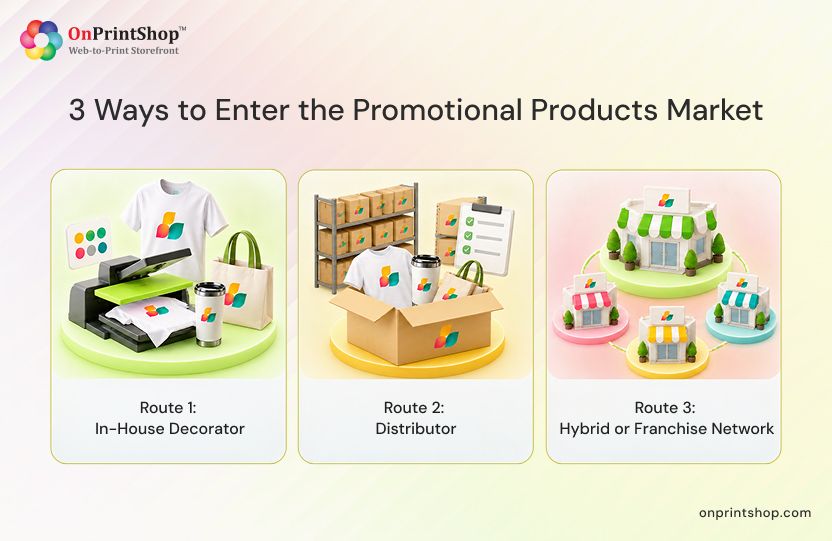
Route 1: In-House Decorator
An in-house decorator purchases or operates the equipment required for product decoration while sourcing blank products from suppliers. Because the decoration work takes place internally, the PSP gains more control over production quality and scheduling. However, the model also introduces responsibilities related to equipment, employees, maintenance, and blank-product inventory.
Route 2: Distributor
A distributor sells products from supplier catalogues while the supplier or an external decorator manages the decoration process. This approach of becoming a print reseller can require less operational investment, but the PSP becomes more dependent on supplier data, inventory availability, and fulfillment processes.
Route 3: Hybrid or Franchise Network
A hybrid approach combines internal production for straightforward or time-sensitive jobs with supplier fulfillment for products outside the PSP's internal capabilities. Franchise and multi-location organizations can also combine centralized supplier and catalogue management with local fulfillment and ordering using a multi-location supporting web-to-print solution for franchises.

What Do Corporate Buyers Expect from a Promotional Products Supplier?
Corporate buyers generally want promotional product ordering to be straightforward, consistent, and easy to repeat. They expect access to approved artwork, clear proofs, dependable lead times, consistent pricing, and ordering options that reduce manual coordination. Meeting these expectations can help PSPs strengthen their relationships with corporate accounts.
- Online ordering: Buyers want to browse products, configure orders, and complete purchases without relying on lengthy email exchanges. An AI-powered B2B web-to-print storefront can provide approved buyers with a dedicated ordering environment.
- Brand-approved artwork: Logos and brand guidelines can be centrally maintained so products follow established brand requirements.
- Proofs: Buyers need an opportunity to review the final design and provide approval before production.
- Reliable turnaround: Lead times should account for both product availability and decoration schedules.
- Easy reordering: Previous orders should be simple to repeat for recurring programs and campaigns.
- Consistent pricing across locations: Multi-location organizations may expect the same products and pricing to be available across their locations.
- Sustainability options: Some corporate buyers look for recycled materials or products with lower environmental impact.

What Operational Challenges Should PSPs Plan For?
Promotional product operations introduce several areas that PSPs need to manage carefully, including supplier catalogues, product data, decoration charges, artwork approvals, inventory, and supplier dependencies. Compared with conventional print production, more of the ordering process can depend on information and fulfillment controlled outside the PSP's own operation.
- Supplier data and catalogue maintenance: Products, specifications, and availability can change, requiring regular catalogue updates.
- Decoration and setup charges: These costs need to be clearly reflected, so customers understand how their quotes are calculated.
- Artwork and proof approval: Customer logos may arrive in unsuitable formats and often need adaptation before production.
- Inventory visibility: PSPs need current stock information to avoid committing to products that are unavailable.
- Multi-location consistency: Franchise organizations need to know how to use a centralized W2P solution for print franchise for consistent products and brand rules across locations.
- Product data accuracy: Incorrect dimensions, imprint areas, or product specifications can result in errors and rework.
- Supplier dependencies: PSPs should consider alternative suppliers for important products to reduce reliance on a single source.
How Does Web-to-Print Technology Support Promotional Products?
Web-to-print technology can bring supplier catalogues, private B2B storefronts, product personalization, online ordering, franchise controls, and repeat purchasing into one ordering environment. For PSPs, this can reduce manual quoting and data-entry tasks while making a broader product range easier to manage and sell.
- Supplier catalogue synchronization: Through PromoStandards, web-to-print systems can retrieve product, inventory, and pricing information from participating suppliers.
- Private B2B storefronts: Corporate customers can sign in and access a catalogue containing approved products.
- Product personalization: Buyers can add approved logos, text, and other personalization elements within predefined rules.
- Online ordering and reordering: Customers can manage orders, proofs, and repeat purchases through the same environment.
- Franchise controls: Central teams can establish product and brand rules while individual locations place orders as needed.
How Do You Get Started? A PSP Checklist
A PSP does not have to launch a full promotional product catalogue immediately. A practical starting point is to choose a market-entry model, select a small group of product categories, establish supplier and decoration processes, and test the offering with an existing corporate customer. The following eight steps provide a starting framework.
- Choose your route. Determine whether an in-house, distributor, or hybrid model makes the most sense.
- Pick two or three product categories. Begin with products that align with what your existing customers already purchase.
- Shortlist suppliers. Evaluate catalogue breadth, MOQs, lead times, and the quality of available product data.
- Define the decoration methods you will offer. Match each method to the product categories you have selected.
- Set up a storefront. Launch an online storefront and give approved buyers a place to browse products, review proofs, and submit orders.
- Run a pilot with an existing corporate client. Start with a defined program, such as an employee onboarding kit.
- Review the results. Evaluate turnaround times, artwork problems, operational issues, and customer feedback.
- Expand the catalogue and offering based on demand. Add products and categories when customer demand supports the expansion.
ConclusionPromotional product printing involves decorating branded items such as apparel, drinkware, bags, and other merchandise with a logo, design, or message. For PSPs, the category can provide a way to serve existing corporate customers with more of the products they already purchase.PSPs can enter the market through an in-house decorating model, a distributor approach, or a combination of both. Regardless of the route selected, supplier information, product selection, and the ordering experience play important roles in managing the offering. An award-winning PromoStandards-integrated web-to-print solution can help connect these elements within the ordering process.If promotional products are the next addition to your offering, schedule a demo with OnPrintShop to see how you can bring products, ordering, and supplier data together.