


Blog Summary: Got confused between public eCommerce and private storefronts? Public eCommerce is for B2C printers, and a private storefront is for B2B printers. And there is a hybrid model too. Discover how each model works and when to use it in this blog.
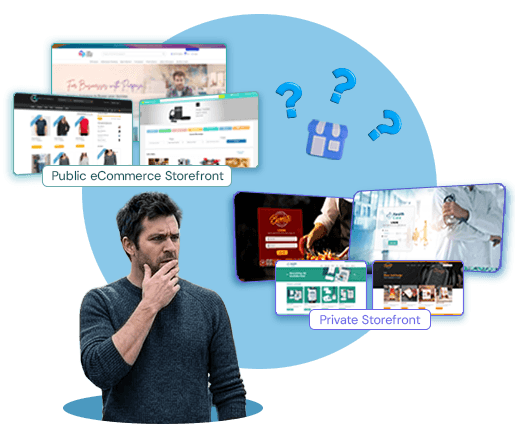
The print industry is rapidly moving online, and many print businesses now rely on digital storefronts to attract customers, automate orders, and scale operations. However, printers often face important decisions: public eCommerce vs private storefronts.
According to a report by Mordor Intelligence, the web-to-print market is projected to expand from USD 26.59 billion in 2025 to USD 28.04 billion in 2026, and is expected to reach USD 36.58 billion by 2031, growing at a 5.45% CAGR between 2026 and 2031.
Both models offer unique advantages depending on your target audience, business model, and growth strategy. Whether you are building a print ecommerce website for retail customers, adopting an advanced web-to-print storefront, or offering private storefronts for printers to corporate clients, understanding the difference is essential.
In this blog, we’ll explore how each model works and help you decide which approach is best for your print business.
What Is a Public eCommerce Store for Printers?
A public eCommerce store for printers is an online print store accessible to anyone on the internet. Thus, a public eCommerce print store is used by B2C print businesses. The open-to-all store helps businesses reach as many customers as possible.
A robust B2C print storefront is highly customizable and may or may not have a niche, depending on the brand. Generally, it showcases all the products that a brand has to offer.
Key features of a public print eCommerce store include:
- Open access for all customers
- Online product catalog and pricing
- Design tools for customization
- Secure online payments
- Automated order processing
A well-built print ecommerce platform enables printers to create a scalable online print storefront that supports b2c print ecommerce while expanding market reach.
This model is ideal for attracting new customers and generating consistent online sales.
Pros and Cons of a Public eCommerce Store for Printers
Though there are mostly benefits, there are a few limitations that a non-B2B print business might face in a public print eStore.
What Is a Private Storefront for Printers?
A private storefront for printers is an online storefront dedicated to a single user. These restricted storefronts are created for specific clients, organizations, franchises, or internal teams. A private storefront provides a personalized user experience, and the user only sees the relevant products and services that they need.
Many printers use the web to print storefronts to build dedicated portals for corporate clients who need branded materials, marketing collateral, or standardized print products.
These private storefronts for printers typically include:
- Client-specific catalogs and pricing
- Pre-approved templates and brand guidelines
- User access control
- Order approval workflows
- Budget and reporting tools
In many cases, businesses compare private portal vs online print store options when deciding how to manage corporate accounts. A high-converging b2b print storefront is designed to streamline recurring orders and strengthen long-term client relationships.
This model focuses on efficiency, consistency, and customer retention.
Pros and Cons of a Private Portal Store for Printers
Private storefronts are highly effective for the print businesses catering to corporate clients; however, it has some cons too.
Let’s discuss some benefits and limitations of private portals.
Which Model Is More Profitable for Printers?
When evaluating public ecommerce vs private storefronts, profitability depends on your business goals and customer base.
A public ecommerce for printers can generate high order volume by reaching a wider audience. It helps printers attract new customers, increase visibility, and expand into new markets through b2c print ecommerce.
On the other hand, private storefronts for printers often deliver higher lifetime value per client. Corporate customers typically place repeat orders, making b2b print storefront models more predictable and stable.
Here’s a quick comparison:
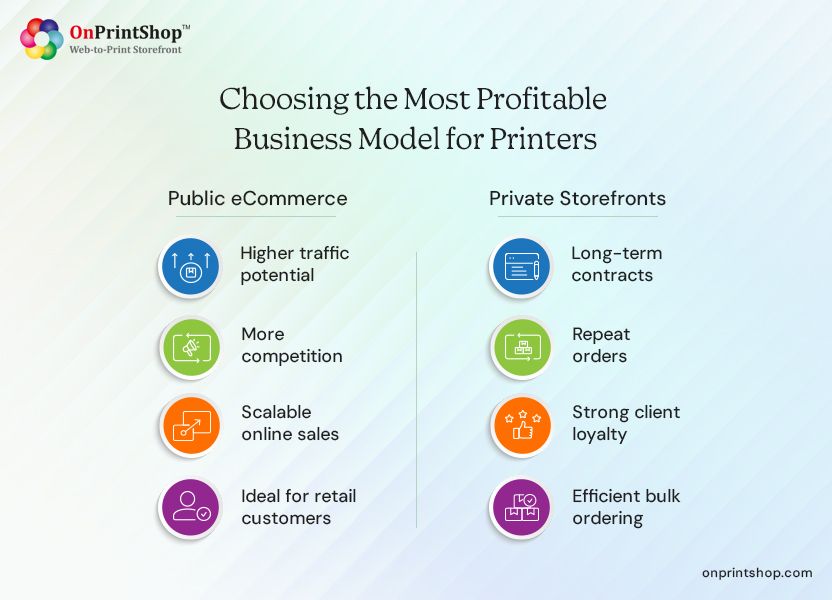
Public eCommerce
- Higher traffic potential
A public print ecommerce website is accessible to anyone online, allowing printers to attract a broader audience. This increases visibility and creates more opportunities for new customer acquisition and online orders.
- More competition
Since many printers operate public web to print ecommerce stores, customers often compare pricing, quality, and turnaround times. Standing out requires strong branding, competitive pricing, and effective marketing strategies.
- Scalable online sales
With the right print ecommerce platform, printers can handle increasing order volumes without adding manual effort. Automation in an online print storefront allows businesses to scale operations efficiently.
- Ideal for retail customers
Public stores work well for individual buyers and small businesses looking for quick and convenient ordering. This model supports b2c print ecommerce, making it easy to sell standard print products online.
Private Storefronts
- Long-term contracts
Many private storefronts for printers are built for corporate clients who sign ongoing agreements. These partnerships ensure a steady flow of orders through a dedicated b2b print storefront.
- Repeat orders
Businesses frequently reorder branded materials like business cards, stationery, and marketing collaterals. With web-to-print storefronts, clients can quickly place recurring orders without redesigning products each time.
- Strong client loyalty
A personalized online print storefront tailored to a client’s brand and requirements strengthens relationships. This encourages companies to continue working with the same printer long-term.
- Efficient bulk ordering
Private portals simplify ordering for organizations with multiple departments or locations. Using print storefront software, clients can place bulk orders while maintaining brand consistency and approval workflows.
Many successful printers implement both, using a robust print eCommerce store to balance customer acquisition and recurring revenue.
When Should a Printer Choose Public eCommerce?
A printer should choose public ecommerce for printers when the goal is to reach a larger audience and increase online sales through an open online print storefront. This model is ideal for businesses that want to grow their b2c print ecommerce and attract new customers searching for print services online.
You should consider a public web to print ecommerce for the following goals.
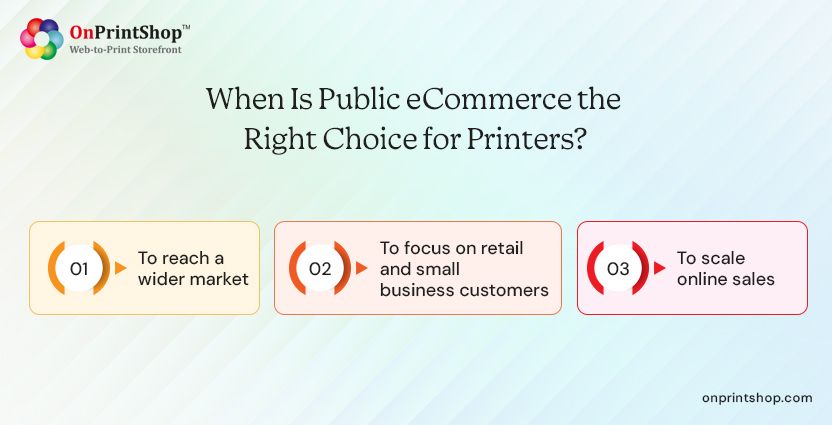
To reach a wider market
A public print ecommerce website allows anyone to browse and order products, helping printers expand beyond their local customer base.
To focus on retail and small business customers
Public stores are perfect for selling standard print products like flyers, business cards, and banners through b2c print ecommerce.
To scale online sales
As the digital storefronts are becoming the new growth engine, printers can automate ordering, customization, and payments, making growth easier.
Overall, public eCommerce works best for printers who want to increase visibility, generate more orders, and build a scalable print ecommerce website.
When Should a Printer Choose Private Storefronts?
Printers should opt for private storefronts for printers when they work with corporate clients or organizations that need a dedicated ordering system. These specialized web-to-print storefronts help streamline repeat orders and maintain brand consistency.
Private storefronts are a good choice for the following purposes.
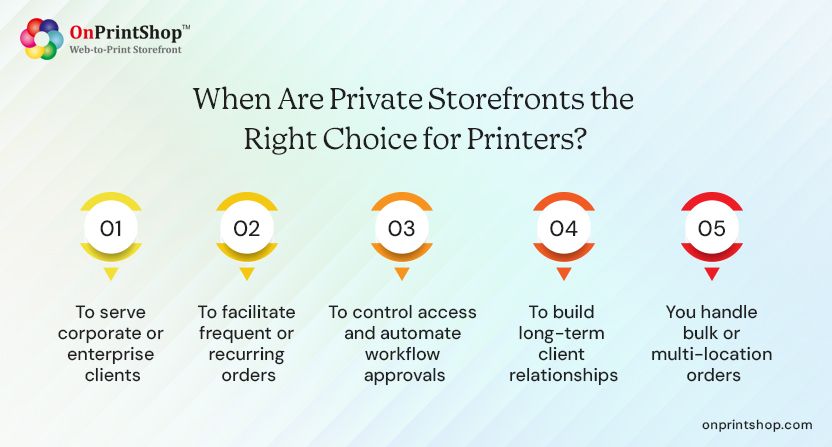
To serve corporate or enterprise clients
A b2b print storefront allows businesses to order branded materials through a secure and personalized portal.
To facilitate frequent or recurring orders
Companies often reorder marketing materials, stationery, and promotional products through their dedicated online print storefront.
To control access and automate workflow approvals
When comparing private portal vs online print stores, private portals provide better control over users, budgets, and approvals.
To build long-term client relationships
Offering customized portals through print storefront software strengthens partnerships and increases client loyalty.
You handle bulk or multi-location orders
Private storefronts make it easier for franchises or large organizations to manage orders efficiently with a smart print order management solution.
In short, private storefronts for printers are ideal for building stable, recurring revenue while delivering a streamlined ordering experience for business clients.
Now that we have simplified “which print ecommerce storefront to choose and when”, a pivotal step in launching a print storefront must be clear to you.
But do you know you can combine them both, too?
Hybrid Model: The Best of Both Worlds?
Many modern print businesses are adopting a print eCommerce with a customized web-to-print hybrid approach that combines public ecommerce and private storefronts within a single print eCommerce platform.
In this model:
- A public online print storefront attracts new customers
- Private portals manage corporate clients
- One print storefront software system handles both B2B and B2C operations
This strategy allows printers to scale efficiently while maintaining strong relationships with enterprise clients.
By leveraging both b2c print ecommerce and b2b print storefront capabilities, printers can maximize revenue and operational efficiency.
ConclusionChoosing between public ecommerce vs private storefronts depends on your target market, growth strategy, and customer needs. Printers focused on attracting new buyers and expanding online sales often benefit from public ecommerce for printers, while businesses serving corporate clients may prefer private storefronts for printers.Many print businesses are now moving toward a next-gen web-to-print software that supports both B2B and B2C ordering in one system.With the right print storefront software, you can build a scalable print ecommerce website that supports long-term growth. To see how it works in practice, you can book a demo with OnPrintShop and explore the platform in action.